Helen Walsh: Young, gifted, bold as brass
Helen Walsh has matured since she bashed out her drug-fuelled first novel on her mum's kitchen table. But, Katy Guest finds, she's still not scared of controversy
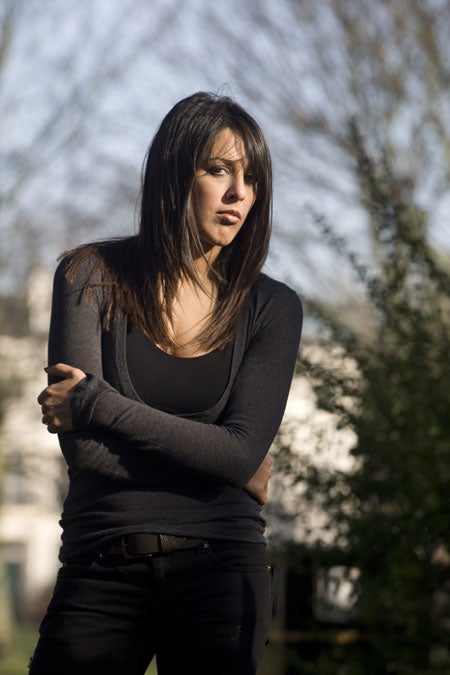
Sitting in Liverpool's Anglican cathedral, overlooking its windblown graveyard and the genteel houses beyond, I wonder if any of the other half-term sightseers are thinking what we're thinking about that view. "I did a reading on that gravestone as part of the European Capital of Culture celebrations," says Helen Walsh, nodding casually towards the setting where her first novel, Brass, begins. "Randomly, she selects a grave," goes the chapter that she read out to an audience of earnest local culture seekers. "She removes her clothes with a routine agility. She's serviced a hundred other punters on this very slab of time- worn concrete... 'I don't do fish,' she says."
She giggles at the recollection: she never expected to find herself standing beside a gravestone reading the mucky bits from her critically acclaimed debut novel as part of a state-sponsored celebration of her beloved city, warts and all. She doesn't even like the Capital of Culture label. "Liverpool has always been a place that won't swallow its medicine," she says. The idea of marshalling its anarchic spirit, packaging it up and marketing it as "Culture" fills her with dread.
Helen Walsh and Brass crashed on to the literary scene four years ago in a tornado of booze, beak and lustily described bodily fluids. Reviews of the novel, the story of 19-year-old Millie's drug-fuelled sexual adventures and ultimate self-discovery, were mixed. This newspaper hailed it as "spellbinding and utterly unique". The Guardian called it "less a cry from the heart than a bellow from the guts." "Brass is to When Harry Met Sally what Apocalypse Now is to Dad's Army," said the Telegraph. Amazon's lead customer review, meanwhile, calls it "The most uninteligent [sic], shallow and loathesome [sic] work of fiction I have ever had the misfortune to read."
The subsequent book tour and publicity saw Walsh both fêted and decried by feminists and grumbling old buffers alike. She describes the book now as "an attack against Andrea Dworkin feminism and... its homophobic inference that there are only two genders or sexualities, and all men are perpetrators and all women are victims." But what shocked her most was that she didn't get more flak for the girl-on-girl rape scene. "Particularly, male reviews were not revolted by that scene," she says, amazed. "Because it's a woman doing it, not a man." She remembers it as by far the most difficult scene to write.
If Walsh was put off by these misreadings of her feminist novel, it doesn't show. Four years and a few life-changes later she is back with Once Upon a Time in England (Canongate, £14.99) – a very different but equally unsettling book. Whereas Brass was suffused with the rich language and grubby glamour of Liverpool's inner-city badlands, the suburban setting of Once Upon a Time... gives it a very different tone. Opening in 1970s Warrington, it tells the story of Irish Robbie, his Malaysia-born wife Susheela and their children Vincent and Ellie, as they grow up amid the menace of unemployment and the BNP. Walsh claims to be inspired far more by music and landscape than by reading other books, and this is a novel that rings with a 1980s soundtrack of Morrissey and The Cure (Vincent's theme tunes), as well as ecstasy highs and acid house (Ellie's).
Many readers assumed that Millie, who binged on ecstasy and brass (prostitutes), was a thinly-disguised version of Walsh herself; but this second novel is by far the more autobiographical. Walsh describes her surprise at discovering how her own mother, a nurse who moved to Warrington in 1970 to fill an NHS staff shortage, had "expunged" her whole culture. "We had no idea that she spoke Tamil and Mandarin and three other languages. We thought we were white. We thought we were English. And in a sense, as certain pockets of town became colonised by Asian immigrants, I resented their presence. I didn't want to be lumped in with them."
Four years of touring as Millie's defence counsel have made Walsh no less outspoken about the things that generally remain unspoken. But there is one taboo that even she finds difficult to talk about. "I specifically made Ellie and Vincent good-looking," she begins, hesitantly. "I mean... feminists place enormous stress on determinants that inform life chances, such as social circumstances, gender, sexuality, race... And the thing that they always omit is physicality; it's aesthetics, it's beauty... I think that one reason my race and gender never imposed all these rules and constraints on me is that... do you know what I'm getting at?" Because she's beautiful, I offer. "I'm probably going to regret saying it," she laughs. "But I think that whole thing overrode the fact that I was a Paki."
As Walsh talks of her mother with admiration and affection, you can't help but think that Mrs Walsh had a lot to put up with. Her beautiful and clever daughter was a straight-A student until she discovered ecstasy at 13 and "fell smack bang in love with acid house". There followed a period of hard clubbing and petty theft before she high-tailed it to Barcelona, pursued by debts and a bad crowd. There, she worked as a fixer in a transvestite bar, setting up punters with prostitutes. She returned to Warrington after a couple of scary near-misses and sat down at her mum's kitchen table to hammer out Brass over a frenzied nine months. "She used to liken me to Jack Nicholson's character in The Shining. It's weird even hearing Brass talked about as a novel because it sort of wrote itself, in one fell swoop. It was like lancing a boil."
Writing Once Upon a Time..., therefore, was a very different experience. When she began the second novel, by then self-consciously with an audience in mind, she was coming off mood-stabilising drugs and was off pills, booze and even fags. She later admits, sheepishly, that she has become engaged to the novelist Kevin Sampson and, less sheepishly, that she recently gave birth to their baby. She adds fiercely that she is in no hurry to get comfortably married and insists that she is not a suburbanite just because she has moved to the Wirral – the Merseyside peninsula that all real Scousers insist is "posh". But she admits that working in her own family home, with occasional productive journeys to "a little thinker" she hired in Majorca, makes her writing very different.
Not surprisingly, Once Upon a Time... is a more grown-up novel than Brass. In fact, it is a novel that she didn't expect to tackle until she felt sufficiently mature. "After Brass, I could have done an Armistead Maupin and written the chronicles of Millie O'Reilly because I had so much fun writing about her adventures."
What happened instead was that, driving back from a walking holiday in Yorkshire, she heard on the radio Hank Williams's "Your Cheatin' Heart" followed by Jeff Buckley's version of Leonard Cohen's "Hallelujah", and "that was Robbie's voice. And the Fitzgeralds, who had been on the back burner all along, were suddenly at the front."
Whereas Brass is undoubtedly a Liverpool novel, Once Upon a Time... is far more driven by the characters of the Fitzgeralds and the unfriendly circumstances in which they find themselves. It is certainly grim – her editor thought the ending too depressing. But, as in Brass, it is significant that one of the last words in the novel is "hope". What some readers will see as a desperate climax, she regards as a gift to her beautiful, homosexual, brown-skinned creation, Vincent. In the end, she says, he takes his life back. But the scene still makes her cry.
Walsh's next book will be doubtless be different again now that her circumstances are so altered. She says she is writing short stories and putting together a collection of suicide notes, so there's no danger of her work becoming as suburban as her setting. She tells me that Brass is being made into a film by the Bafta-winning director, Andrea Arnold. She just hopes that Liverpool's brasslands, beneath the cathedral we sit in, manage to hold off the gentrification until it is filmed.
She confesses that she still misses Millie, Robbie, Susheela and the others. "When I finished [Once Upon a Time...] I used to drive up to the Irish Club in Warrington, just to be close to them. That's going to sound strange – they're fictional people, they're not real." But it's still good to know that, even in the poshed-up City of Culture, there is a small, fictional corner of Liverpool that will remain forever dirty.
Biography: Helen Walsh
Helen Walsh was born in Warrington in 1977. Her mother, originally from Malaysia, was a nurse; her father an Irish truck driver and musician. She was a model scholarship student until she discovered ecstasy and acid house at 13. After living in Barcelona and London and taking a degree in sociology at Liverpool (she blew her first student loan on lap-dancing, wrote a dissertation on porn and was awarded a First) she went home to Warrington, where she worked with socially-excluded teenagers and wrote her first novel, Brass, on her mum's kitchen table. It was published in 2004. She now lives in the Wirral with the novelist Kevin Sampson and their baby. Once Upon a Time in England is now published by Canongate.
Join our commenting forum
Join thought-provoking conversations, follow other Independent readers and see their replies
Comments
Bookmark popover
Removed from bookmarks