How Aharon Appelfeld chronicled the Holocaust
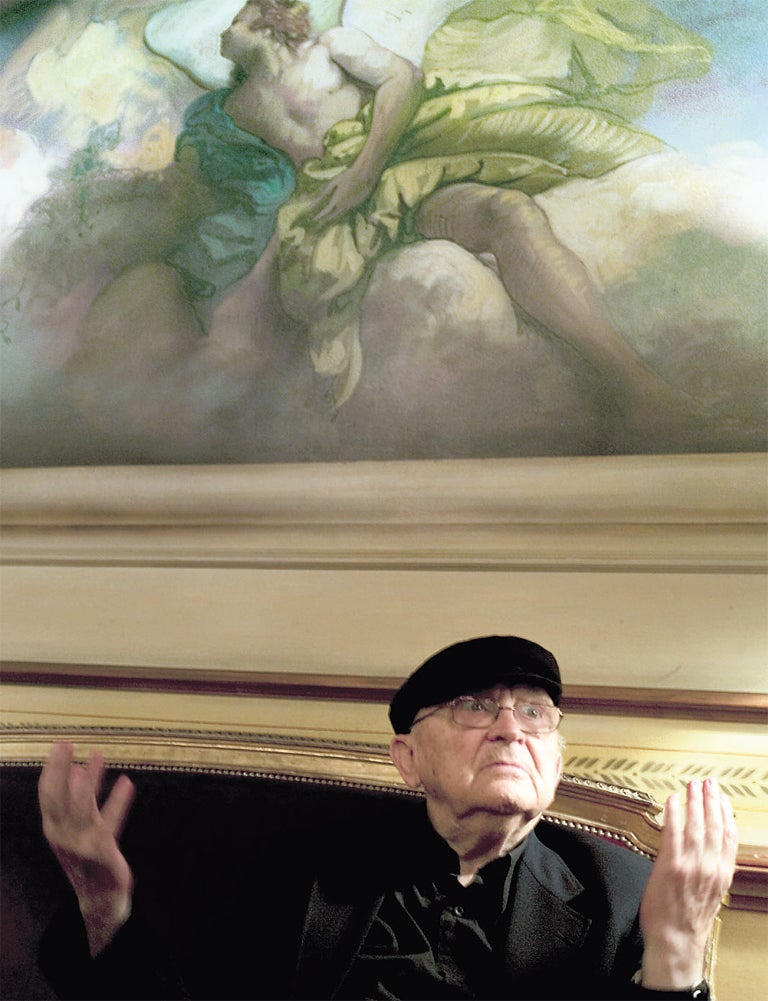
Blooms of Darkness by Aharon Appelfeld has won this year's Independent Foreign Fiction Prize. The Israeli author, who shares the £10,000 award with his translator Jeffrey M Green, is the first writer in Hebrew to take the leading British honour for fiction in translation and, 80 this year, he is also the oldest winner
Blooms of Darkness, in Green's graceful, grave and irresistibly readable English version, tells the story of Hugo, a young Jewish boy in an occupied town in eastern Europe who loses his parents to the camps but stays alive thanks to the shelter and salvation offered him by a local prostitute, Mariana. It extends and deepens one of the most remarkable journeys in all modern literature. In a prolific career whose highlights include novels such as Badenheim 1939, Tzili, The Immortal Bartfuss and The Iron Tracks, as well as the memoir The Story of a Life, Appelfeld has interrogated the meaning of what happened to him, to his community, and to humanity itself, during Europe's era of genocide.
The prize was supported again by Arts Council England and Champagne Taittinger, and a formidable shortlist featured, one of which won such strong support that the jurors agreed to give it a special mention: Yan Lianke's dramatic, courageous and lyrical epic of a Chinese community destroyed by a blood-farming scandal, Dream of Ding Village (translated by Cindy Carter ).
Philip Roth, Aharon Appelfeld's long-standing friend and admirer, calls Appelfeld "fiction's foremost chronicler of the Holocaust" Roth writes that "The stories he tells, as here in Blooms of Darkness, are small, intimate and quietly narrated, and yet are transfused into searing works of art by Appelfeld's profound understanding of loss, pain, cruelty and grief."
That understanding has its roots in a youth that, however often recounted, can still beggar belief. Appelfeld, who lives outside Jerusalem, was born in 1932 in the Jewish heartland of Czernowitz in Bukovina, now in Ukraine. German was his mother tongue, although he picked up some Russian, Romanian and Ukrainian from the polyglot streets.
"I come from a deeply assimilated Jewish home," he told me last week. "My parents thought of themselves as Europeans, not particularly Jewish. But my grandparents were very observant Jews." He cherishes his childhood memories of visits to their farm in the Carpathians: "My grandfather used to show me his prayer book. It was miraculous for me, to see the Hebrew letters." In the farm grounds stood a small synagogue maintained by the family: "It was magical for me to see people coming to the little wooden synagogue and praying."
In 1940, the fatal chain of events began which overturned Appelfeld's young life and liquidated his community. First the Soviet army occupied Czernowitz, followed by the Nazi-allied Romanians. His mother was murdered; his father disappeared into the camps. Son and father each believed the other had perished. When they met again in Israel, neither could speak. Young Aharon escaped from ghetto and went on the run, a wild boy for whom one false move or flawed judgement would mean death. "In the forest," he explains. "a group of criminals adopted me. So I was living for two years with this group of Ukrainian criminals. They didn't know that I was Jewish. I was a poor animal, a poor slave, doing what they ordered me to do." Later he met the village prostitute with whom he sought refuge for five months. That episode lends Blooms of Darkness an autobiographical core but, as Appelfeld insists, his books transform memory into fiction. "I'm not writing memoirs – I'm using pieces of my own experience."
The real-life model for Mariana was, he recalls, "a bit like a mother to me. In the winter time, when there were no clients, she used to tell me pieces of her personal history." Nonetheless, "She was a very capricious person, and I could never trust her fully. I left because, one night, one of her clients said to me: 'What are you doing here, bloody Jew?'" He had the wit to riposte, "How dare you say to a Christian boy that he's Jewish?".
After the Axis defeat, he worked as a cook for the Red Army, and came alone to Palestine, two years before the creation of Israel: "I was 13 and a half, but I was a grown-up person, with what I had seen and what I had experienced." He went to a farm school, where "they trained us to be peasants."
As for the renovated Hebrew of the fledgling Israeli state, "it was a struggle to gain the language. I used the dictionary, and I copied out parts of the Bible... I started with Genesis, and I went from chapter to chapter, book to book... I wanted to affiliate myself to the Hebrew language". That Biblical poetics bore lavish fruit in the spare, vivid and almost oracular prose of his fiction, a resonant language of earth, stone – and blood.
His literary vocation had begun with a chronicle of his family, born in a time of utter solitude and abandonment. "It was the middle of the 1950s. I was alone, in the fields of the Judaean Hills. I thought, is this my landscape? Is this my language? This was a moment of despair."
Yet from that desolation came a story, then another, and then another... His hard-won tongue gave him first tools, then wings. Although home-grown writers such as SY Agnon acted as literary mentors, "Most of the Hebrew writers were born in Israel. I'm actually the only one who adopted Hebrew as my language... My task was to combine the Hebrew language with my horrible experience."
In youthful Israel, an "idealistic, socialistic country", memories of the genocide were taboo. "No one wanted to hear about such terrible experiences... The slogan was, 'Forget it! You should begin again.'"
Now, however, those once-buried traumas feed a rich culture of memory. His fiction – with Blooms of Darkness in its front rank – continues to mine depths and bring us blazing light from them. As a laboratory, and testing-ground, of human nature in its occasional glory and frequent shame, the wild child's adventures remain inexhaustible.
Join our commenting forum
Join thought-provoking conversations, follow other Independent readers and see their replies
Comments
Bookmark popover
Removed from bookmarks