Margaret Drabble: The original angry young woman
A career-spanning collection of Margaret Drabble's short stories reveals a surprisingly steely former self, she tells Andrew Johnson
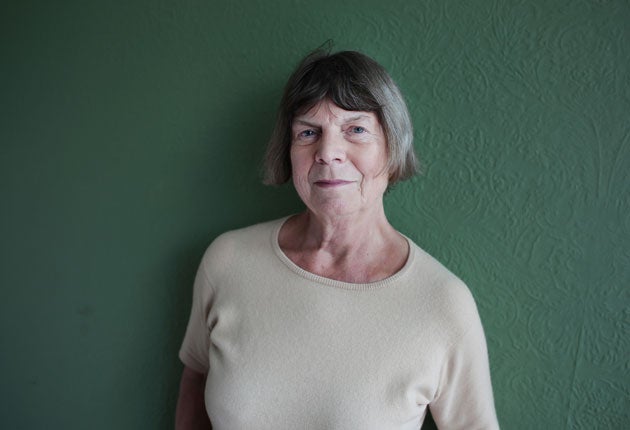
Margaret Drabble is part way through writing her third short story in the space of six months. Considering she has previously written only 13 during her near 50-year career, that's quite an acceleration.
The surge is down to those first 13 finally being collected into a single volume. Reading them again, she says, has reminded her that this unfashionable – although resurgent – literary form isn't so bad after all.
"I suddenly got interested in them again," she says. "You can do something with the short story that you can't do in a novel. You don't have to tell the whole story; you just say, 'This is this bit of it.'"
The mistress of English literary letters is sitting comfortably in the sitting room of the home she now shares permanently with her husband, the biographer Michael Holroyd, in west London – for many of the 30 years of their marriage, they lived separately. There is art on the wall, books on the shelves, busts on the mantelpiece, fat sofas, and tea on the glass coffee table. It is exactly the sort of place you'd expect two writers to live.
Drabble, 72, is renowned for chronicling the lives of women as they adapt in Britain's changing social landscape. The stories in A Day in the Life of a Smiling Woman are no exception. They are arranged in chronological order, the first written in 1963 and the last in 2000. As such, they provide a kind of social history in miniature, and although they are not autobiographical, it is telling that the women grow older – from a young newlywed via young mums to merry widows. In typical Drabble fashion, major turning points in the lives of secret lovers or harried housewives are triggered by trivial, everyday events.
What really stands out, however, is the men. They are all awful: patronising, pathetic, mean and feckless layabouts. One is ill for an entire illicit road trip across the Alps, leaving his lover to drive and care for him. Another is recently dead, to the great relief of his widow; a third is penny-pinching on his honeymoon.
Drabble is initially ambivalent about using the term feminist, claiming that her only thought was to "reflect the female experience". "That's how life was," she says unapologetically. "It's realism, not feminism." Later, however, she does use the term. "I was surprised by how angry some of the middle stories were. They were quite feminist and I was a bit surprised because I hadn't thought they were. I thought that was what everybody was thinking. And in fact, everybody was. Women were thinking like that; it wasn't just me. But I was surprised by how conspicuous it was."
What it boils down to is that, as a middle-class woman bringing up three young children in newly liberated times, Drabble was her readership. "You create the times you live in," she says. "I don't think I reacted to it. I was it. I was lucky to be there. But there was a demographic, a lot of people my age were in a similar situation. It was fortunate for me in that there was a big readership."
Drabble was born in Sheffield, the daughter of the barrister and novelist John F Drabble. Her sister is the novelist A S Byatt, her daughter, the poet Rebecca Swift. Words run in the family. She began writing because it was something she could fit in around her small children, unlike acting, which she had to give up. It came easily to her, once she found the time in the evenings, and she was surprised when she finished her first novel, A Summer Bird Cage, in 1963.
None of the stories in A Day in the Life of a Smiling Woman was conceived as a novel, says Drabble. Many were magazine commissions, and she'd forgotten about most of them until a Spanish academic and fan, José Francisco Fernández, tracked them all down and persuaded her to publish them.
Drabble is polite in that distinct English middle-class fashion that hides the steel beneath – she leaves the impression that she would never tolerate a fool. And although denying any conscious politicking in her stories, she's happy to say she is still of the "egalitarian persuasion".
So she expresses a resigned disappointment that the optimism of her early years wasn't rewarded quite as expected. Her favourite story in the collection is the first, "Hassan's Tower" – the one with the penny-pinching honeymooner – because of its hope for international understanding. "It was the first story I ever wrote," she says. "I like it very much because it's quite hopeful and optimistic. Unfortunately, all its speculation about how wonderful society was going to be internationally was wrong, but nevertheless that moment of hope was there."
Nor have the lives of women changed as much as her generation might have hoped. "In [the contemporary writer] Helen Simpson's stories, the characters are just as cross as mine, so it's as if nothing has moved forward. And her men are even worse than mine. So I don't think all that much has changed," she says, before adding: "That's not quite fair. I do know quite a lot of younger couples where there's a far more equal distribution of housework and fathers who are far more co-operative about looking after children than they used to be. But on the other hand, it is usually the woman who's left with it when it comes down to it."
So if she were starting out now, that is what she'd be writing about, she says. And the likes of the super-rich, such as Roman Abramovich. "The job of the kind of writer I am is to interrogate society, reflect it, jog it along a bit and engage with it. I don't think it's at all good for people to be extremely rich. I don't think it's good for anybody. And I'm surprised that we're now in a society that worships riches and celebrity to the degree that it appears to. I don't know how it happened really. I would write about Abramovich and banking – if I were in my thirties I'd be having a go."
A Day in the Life of a Smiling Woman: Collected Stories, By Margaret Drabble (Penguin Modern Classics £20)
"....'It's as true as that you came to this place to look for me,' she said.
'I did come,' he said.
' And I did weep,' she said.
'Did you ever try to ring me?' he asked then, unable to resist.
'No,' she said with some pride. 'No, not once. I'd said I wouldn't and I didn't.'
'I rang you once,' he said.
'You didn't,' she said, and became aware at that instance that her knees under the table were trembling."
Faithful Lovers (1968)
Join our commenting forum
Join thought-provoking conversations, follow other Independent readers and see their replies
Comments