Raymond Tallis: A head for heights
Doctor, researcher, philosopher, critic, Raymond Tallis has achieved enough to fill a dozen careers. He tells Nicholas Fearn why every citizen has to be a polymath
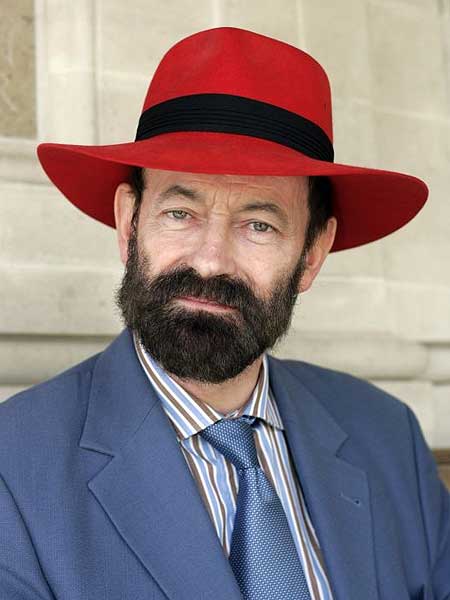
When Kirsty Young was asked to name her favourite guest on Desert Island Discs, the rock star Paul Weller was beaten into second place, for her own luxury item would be the writer Raymond Tallis. I meet Tallis in the Athenaeum, the Pall Mall club for scientists, writers and public intellectuals – all descriptions that can be applied to the thinker from Liverpool. He is one of Britain's greatest intellectual all-rounders: a philosopher, novelist, poet, former professor of geriatric medicine at Manchester and an international authority on epilepsy in older people. This evening he has little competition in the drawing room where Dickens and Darwin once held forth, which is empty but for two slumped elderly gentlemen. Right now, the place he describes as "paradise" resembles nothing more than a quiet day in the House of Lords.
Not for long. Tallis is quick-eyed, expressive and irrepressibly cheerful, even though he has been up since 5am. It is hard work being a polymath. When I once asked him how he managed to produce a dozen books on philosophy while working full-time as a consultant in the NHS, he said that he was a philosopher between five and seven in the morning. He still rises before dawn in the second year of his retirement from medicine. So it doesn't surprise me when he offers a Pro-Plus tablet as one might a convivial cigarette. These days he does much of his writing in pubs and cafés where, to cut out the hubbub, he dons the kind of earmuffs used by pneumatic-drill operators. They clearly do the trick, because he has three new books out this year, the latest of which, The Kingdom of Infinite Space (Atlantic, £19.99), explores the human head in a genre of his own invention – one we might call "philosophical anatomy".
The book is a sparkling tour of our senses and the way in which we are embodied. We learn that tears of anguish are chemically distinguishable from those shed to rid the eye of foreign bodies, and that cauliflower ears once advertised opium addiction, from hours spent reclining on hard wooden pillows. "It's a wonderful feeling when you have a book coming on," Tallis says. "The only point of writing a book is to discover things you've never thought before." Like its predecessors, this one makes the world seem a more interesting place and life that much more important.
The organs and processes behind kissing, sneezing, laughing and blushing are all explored in turn. Yet there is an elephant in the room: the deliberate omission of the brain. As the author explains, "There is no shortage of books on the brain. Indeed, I would venture that there is a serious lack of such a shortage." For someone who has spent much of his working life in neurological research, he is quite dismissive of its potential to answer fundamental questions about human nature. For example, "I'm not sure that beauty has any correlation with neural activity. Sodium ions going through flea-bitten membranes – is that what beauty is about?... You can't take what this community of minds has produced – this thing called culture – and pack it back into the brain."
I ask Tallis if he is ever accused of dualism: the belief in a non-material substance that explains our thoughts and feelings. "I sometimes find myself accused of having religious beliefs, which is even more upsetting. The vast majority of neural activity is not associated with consciousness. So why do we think that we can explain consciousness... something categorically different from material processes, by activity in a particular part of the brain? It's nothing but primitive, magical thinking."
Like most philosophers today, Tallis has little patience for religious belief. However, unlike other champions of reason such as Richard Dawkins, he concentrates on those who would be expected to defend the Enlightenment but betrayed it – the literary critics who hate literature, the philosophers who despise reason, and anyone else working in the tradition of Left Bank postmodernism. "When the Emperor is restocking his wardrobe he usually shops in Paris," Tallis once wrote.
But lately, it seems, the Emperor has been looking for a lab coat. Scientists are increasingly eager to tell us that everyday concepts such as free will, the self and right and wrong are figments of our imagination. According to Tallis, this amounts to dishonesty. "Scientists who say they don't believe in free will are still utterly committed to the kind of moral judgements that you and I have... They say that their moral sense has been implanted in them by evolution, but that actually there is no basis for it, that the concept of free will is an illusion that happens to be of adaptive value. Well, I don't think they are sincere".
In a time when many philosophers live in perpetual disappointment at the limitations of their chosen discipline and look with envy at scientists, it is probably his scientific background that has allowed Tallis to get away with such heresy. He remains our most respected philosopher never to have held an academic position in the subject. He has also had the power to turn reflection into action. As Chair of the Royal College of Physicians' Committee on Ethics in Medicine, he was persuaded to support the patient's right to assisted dying after a correspondence with Nelson Mandela's former defence lawyer, Joel Joffe. "I'm strongly in favour of assisted dying," he says, "because I don't want a bishop committed to medieval beliefs and ill-thought-out ideas telling me how long I should suffer for before I die."
So I assume that he was unimpressed by the church's recent intervention on the question of human-animal embryos? He certainly was. "Cardinal [Keith] O'Brien doesn't understand that the hybrids involved contain less human tissue than human embryos we use at the moment. A cluster of cells at a few days is not a person. The talk of 'Frankenstein' experiments is ill-informed, raising the spectre of something that has the front end of a bishop and the back end of a sheep, which is not on the cards at all."
With so much religious special pleading and crackpot alternative medicine around, does he not despair of the epidemic of irrationality in the West today? "Not particularly," he says, "because at least the epidemic takes place against a background of rationality. Of course, it's pretty chilling when that background isn't there, or where, as in Sudan, the background involves condoning genocide."
Last year, Tallis helped to set up an epilepsy care service in Sudan. "Hippocrates – one of my great heroes – was the first person to see disease in purely naturalistic terms. He wrote a book called On the Sacred Disease, in which he argued that epilepsy isn't about being struck by the gods; it's purely a brain phenomenon. Some people in Sudan – including some clinicians, believe it or not – have pre-Hippocratic views and they think epilepsy is due to possession by the devil. But even there, people expect the principles of engineering to hold when they cross a bridge... And, in this country, even the most irrational patient demanding a quack remedy still has to be rational in arranging for the children to be looked after while they attend the appointment."
I wonder if he ever engages in any of the time-wasting activities beloved of writers. "Never," he says, "I find things like that unbearable. It's not thinking that I find incredibly stressful. But I'm always thinking. Even on our honeymoon I was making notes on philosophical ideas... Being a thinker is being an opportunist, and the opportunities can be thrown up at any time." The closest thing to idling he'll admit to is watching the comedy show Red Dwarf, which he adores for Rimmer – a kind of anti-Tallis played by Chris Barrie.
For someone who comes closer than most ever will to knowing everything, Tallis happily admits that life consists in applied ignorance. "In order to be a serious citizen, you have to make decisions about things that far exceed any possible knowledge you might have – about taxes, laws... how the NHS should be run and so on. For me there is a kind of irony in this. I might agonise over the right choice of an epilepsy drug for a patient – something I've spent my life studying – whereas I'll blithely vote for a political party. The problem is this: to be a responsible citizen you have to be a professor of data-lean generalisation."
Biography: Raymond Tallis
Born in Liverpool in 1946, Raymond Tallis studied medicine at Oxford and St Thomas's, London. From 1987 until early retirement in 2006, he was professor of geriatric medicine at Manchester University and NHS consultant in the care of the elderly in Salford. His writing includes two major textbooks, Clinical Neurology of Old Age and Geriatric Medicine and Gerontology. He has also published poetry, fiction, and books on philosophy and criticism, including Not Saussure, I Am, The Knowing Animal and the new The Kingdom of Infinite Space (Atlantic). Named by Prospect as one Britain's top 100 public intellectuals, awarded doctorates from Hull and Manchester, a Fellow of the Academy of Medical Sciences, he lives in Stockport.
Join our commenting forum
Join thought-provoking conversations, follow other Independent readers and see their replies
Comments