Teenage picks: Six teenagers set to judge Orange Prize alongside the regular panel
The astonishingly grownup group of students are deadly serious about their role. We sat in on their heated discussions, and, opposite, exclusively reveal their shortlist
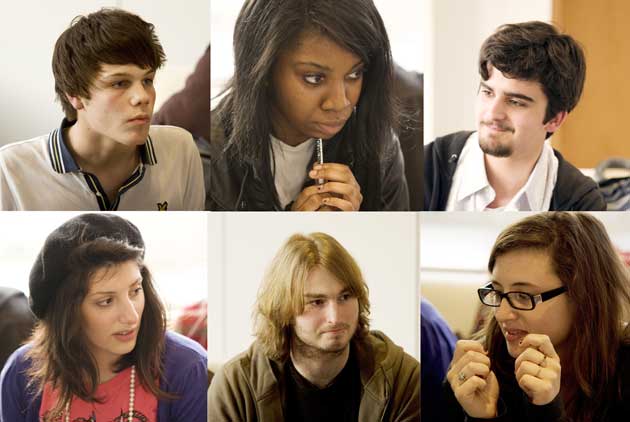
Were I to tell you that some of the Orange Prize judges discussed the shortlist while kneeling animatedly on the floor, would you feel any differently about those august exponents of women's fiction? If one judge had never heard of Toni Morrison, and another explained that the Nobel Prize-winner's new novel has "the X factor", would that change your mind? If a member of the panel wore low-slung trousers, ate all the biscuits and described a favourite book as "bare good!", would you be surprised when the same person praised the "almost Joycean" balance of one longlisted novel and admired the "poetry and lyricism" of another? Would you think that more literary-prize judging panels ought to show this much enthusiasm?
In a quirky experiment of the kind that has come to characterise the award, the 2009 Orange Prize for Fiction has appointed a youth panel of judges to assess the longlist alongside the regular panel. The six teenagers met in a sunny office in central London last month to decide on their shortlist, and provided quite a number of surprises. "If anything, I think we should have been more rowdy," said one after they had reached their conclusion. "In general, I think the grown-ups will not have been rowdy enough." "You'd be surprised!" laughed the prize's honorary director, Kate Mosse. In fact, given the illustrious history of literary prize panels and their spectacular fallings out (Nicholas Mosley, to name but one, resigned from the Booker panel in 1991; partly to "strike a blow for 'ideas'", he said, and partly "in a huff"), these teenagers could teach the literati a thing or two about discipline. Perhaps the Booker administrators ought to consider providing Haribo in their meetings.
When the Orange Prize was first conceived in 1992, as well as its more famous role – to celebrate international fiction by women – it also aimed to promote a range of educational, research and literacy initiatives. Each year it has developed a project to forge links with younger people, whether by providing classroom materials, sponsoring The Reading Agency's Chatterbooks reading groups or, last year, having Lily Allen as a (shortlived) member of the main judging panel. (Some of these ideas have been more successful than others.)
The panel was chosen from among regular contributors to the forum Spinebreakers (www.spinebreakers.co.uk) – which makes them more than usually dedicated to books. They have read the novels on the longlist at the same time as studying for GCSEs and A-levels, and have been fitting in judging meetings around their exams. Mosse is not surprised, though. As the mother of teenagers, she says, "I know that the image portrayed in the popular media of teenagers is incredibly far from the teenagers I come into contact with. Actually, in the areas of reading, music and so on, I think they have a very high level of integrity and passion for the work. They're not influenced by reputation or marketing, so their analysis is very pure, and it's really refreshing because it is entirely text- based." This is more than demonstrated by the panel's reaction to Toni Morrison. A Mercy is the first of her books that most of them have read, it turns out. But it seems unlikely to be the last.
The regular panel for this year's Orange Prize is made up of the broadcaster Fi Glover, the writer and broadcaster Bidisha, the journalist and academic Sarah Churchwell, the journalist and novelist Kira Cochrane and the entrepreneur Martha Lane Fox. The youth panel is: Lily Dessau, 16, who lives in south London and is studying art, English, history and maths; Rossana Duarte, 18, who likes go-karting, astronomy and writing poetry and hopes to study chemistry at university; Max Elsworth, 19, who plays the guitar and cello, writes short stories and admires Edgar Allan Poe; Joe Kerridge, 16, a sportsman who is equally keen on the stories of Franz Kafka and Richmal Crompton; Clarissa Pabi, 18, a keen theatregoer and the 2008 Roundhouse Theatre Poetry Champion; and Francis Rowe-Gene, a gap-year student who is working as a part-time teacher and tutor before going to UCL to read English.
The Orange Prize, by all accounts, is known for its unusually civilised approach to the judging process. The poet Jackie Kay once said that she had never judged a literary prize in an environment so supportive and respectful. But even she might have been surprised had she been allowed to sit in on the youth panel's meeting, as I did. Everyone is allowed their say. They are passionate and knowledgeable about all the books. At one point, Joe moves on to the floor so that he can better see Clarissa as she discusses her reaction to Bernadine Evaristo's Blonde Roots. He munches Haribo, thoughtfully, as the panel admires the complex structure of Evaristo's stark dystopia, and they all laugh delightedly at her linguistic jokes. Their reactions to the novels are both intelligent and instinctive. In Gaynor Arnold's Girl in a Blue Dress, one of Rossana's favourites, "The love between the protagonists begins to turn quite stagnant," says Max. "He pumps her up with kids and dumps her in a house!" exclaims Rossana, horrified. The book is promptly shortlisted.
In a month in which the English curriculum has been roundly castigated, it is a relief to hear that some teenagers, anyway, have managed to develop a love of literature in spite of school. Says Mosse: "The way the exam system is set up does not in any way encourage children to read novels. But the other side of that, which is really positive, is that many teenagers are finding their own ways of engaging with literature that are not through school. When you look now at all these lists of everybody's top 100 books, they're all similar because, well, we all studied Wuthering Heights. In future, there will be a wider range of novels that matter to people, and that is quite healthy. But the publishing industry, booksellers and literature prizes do need to find ways of engaging with younger readers that are not through school. And that's why we're doing this."
After an animated and exhausting meeting, the panel hammers out its shortlist with only one threat of physical violence (on behalf of A Mercy) – and that made in good humour. As we reveal opposite, they and the adult panel have chosen different shortlists entirely. But, according to Mosse, who was present during both meetings, their discussions of each novel were remarkably similar, and the shortlists came close to overlapping. Molly Fox's Birthday was one near miss from the youth panel's list, with Joe, in particular, a fierce advocate.
Each panel will announce its own, individual winner on 3 June. Twelve authors are hoping to win. Twelve judges are preparing their arguments. Six of them are hoping that the ceremony doesn't clash with their exams. Congratulations must go to these six for their patience, commitment and passion for the task. And for proving that judging panels, sometimes, do not have to fall out.
YOUTH PANEL SHORTLIST
Blonde Roots by Bernardine Evaristo
In a parallel world, white slaves face the horrors of life in the sugar-cane fields, where they are treated as savages
Girl in a Blue Dress by Gaynor Arnold
A family recalls the hypnotic power of a celebrity author after his death
The Lost Dog by Michelle de Kretser
Looping in time from an Anglo-Indian childhood to the Melbourne art world, a story of family, love and the loss of a dog
The Russian Dreambook of Colour and Flight by Gina Ochsner
In a dusty museum, Tanya dreams of Russian art and of Yuri. Meanwhile, a spirit is troubling her apartment block
The Flying Troutmans by Miriam Toews
Plucked from Paris by a midnight phone call, Hattie heads to Canada
A Mercy by Toni Morrison
Smallpox, abandonment, slavery and unexpected love in the 1680s
REGULAR PANEL SHORTLIST
Scottsboro by Ellen Feldman
The story of the 1931 Scottsboro trial in Alabama, narrated by a young journalist
The Wilderness by Samantha Harvey
A man with Alzheimer's struggles to hold on to his personal story, as memories and identity become increasingly unreliable
The Invention of Everything Else by Samantha Hunt
A love story and a literary mystery woven around the life of Nikola Tesla, the Serbian scientist who invented radio
Molly Fox's Birthday by Deirdre Madden
A novel about acting and identity that questions ideas of who we are
Home by Marilynne Robinson
A prodigal son returns after 20 years, and a troubled family forges new bonds
Burnt Shadows by Kamila Shamsie
From Pakistan to Guantanamo Bay... New York, Nagasaki and Delhi all fall under the shadow of a turbulent history
Join our commenting forum
Join thought-provoking conversations, follow other Independent readers and see their replies
Comments