Thoroughly modern Virginia
So you thought she was a fey, apolitical author in an ivory tower. Not true, say academics, who tell Holly Williams about the new, sexual, political Woolf
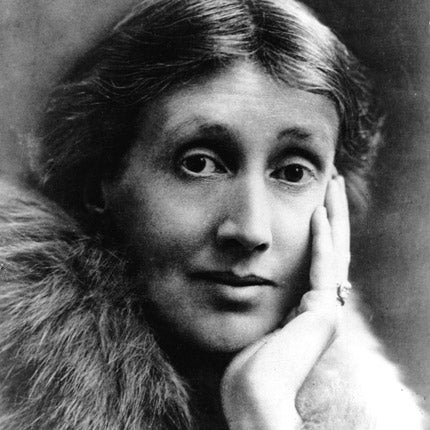
If there's one thing that everyone knows about Virginia Woolf, it's her death. This month sees the 70th anniversary of her suicide, when on 28 March, she filled her pockets with stones, walked into the River Ouse near her home in Sussex, and drowned.
In those 70 years, Woolf's work has been recognised as some of the most significant writing of the 20th century, widely read and widely written on. But, despite the hundreds of books published about her life and writing, there are still discoveries being made – including a new revelation that Woolf studied to degree-level at university.
This month also sees the publication of the first two volumes of a new Cambridge University Press edition of her works Between the Acts and The Waves. These scholarly tomes give arguably long-overdue attention to Woolf's oeuvre in a way that her fellow Modernists – Joyce, Eliot, Pound – received long ago, by mapping out textual changes between her manuscripts, proofs and different published editions, as well as offering the fruits of years of archival research in extremely thorough annotations.
The result is that Woolf emerges as a more clearly politically astute, historically aware, educated, playful and precise author than she is widely thought to be. And the hope is that these new editions will finally sweep away the stubborn stereotype of Woolf as just a troubled soul – delicate, ethereal, and utterly out of touch with the real world.
"The narrative of her which developed in the 1930s as invalid, apolitical, asexual – it's really been deep-rooted," says Anna Snaith, who edited the forthcoming edition of The Years. "And while scholars have, since the 1930s, seen her differently, the public lags behind. It's partly to do with class, and the whole idea of 'Bloomsbury', and it's partly to do with [her nephew, Quentin] Bell's early influential biography. This edition will put paid to that – she was a thoroughly committed political writer and a rigorous intellectual; it is astonishing how rigorous she was with her reading and studies."
New evidence of Woolf's rigorous study was uncovered by Snaith and her colleague Christine Kenyon Jones last year, in the archives at King's College London where they work. Biographers of Woolf have long repeated the idea that she was self-educated, gaining her knowledge from her father's library. This was partly thanks to Woolf herself stating that she had "never been to school". In fact, she had studied seriously for five years, and to a notably high level.
Snaith and Jones found that, between 1897 and 1901, Woolf had taken courses in History, German, Greek and Latin at King's, attending lectures that were pitched at degree level (although she never took the final exams). "This discovery is hugely significant," insists Snaith. "It transforms our understanding of her own experience of educational institutions, and also of her knowledge of Greek and Latin. Also, given that she wrote extensively about women's colleges, about women educational reformers and about the psychological effects of the inequities between male and female education, her early experience must have been influential."
Snaith even uncovered what reads like a precise forerunner to Woolf's celebrated feminist treatise on women's education and independence, A Room of One's Own. In an article in the college's magazine in 1900, the principal, Lilian Faithfull, wrote that: "The possession of a castle of one's own is, perhaps, the first keen joy of College life."
The Cambridge editions, which took almost a decade to put together, trace this classical knowledge. "For the first time, we had the resources to research fully the state of Woolf's texts and the extraordinary range of allusions she weaves into her writing," explains Susan Sellers, who edited the series with Jane Goldman.
But it's not just classical references. By also pinning down character and place names, dates and overlooked details, researchers have discovered dense webs of allusion to the politics and society at the time that Woolf wrote. "History is so present in her work," says Goldman. "Chasing up those deeply woven and highly precise references is worth the candle."
From naming a seemingly insignificant character (Mrs Moffat, a servant in The Waves) after a strike-leading trade unionist (Abe Moffat), to a subtle reference to the Battle of the Somme in relation to a character who will later be killed in the war in To the Lighthouse – countering the accusation that the novel fails to address the Great War and the political climate of the era – this reference-chasing has thrown up an astonishing amount of significance in Woolf's apparently casual choices.
Sellers hopes that this will "end the idea that Woolf was inspired but other-worldly, uninterested in history, politics or society. The annotations show Woolf in a very different light to the one in which she is so often viewed."
And not before time. While Goldman points out that a Cambridge edition itself is an "imprimatur on an author", both she and Sellers also observe that this sort of research on Woolf has lagged behind work done on some of her contemporaries.
"I personally think it's interesting in terms of the sexual politics of publishing and research investment, that it has taken so long for Woolf to be given the kind of attention afforded to male modernist writers such as Joyce and Eliot," points out Sellers.
New attention was also given to Woolf's manuscripts and drafting process. Being a publisher herself – running, with her husband Leonard, the Hogarth Press from their home – Woolf had the luxury of tinkering with her typescript to the last. And some of these edited out sections or toned down references are surprisingly juicy. "A lot of references are more overtly political, more overtly sexual in the drafts of her works," says Goldman.
Snaith agrees, suggesting that in the manuscript of The Years, Woolf is far more explicit about both queer relationships and politics. It's received little attention before, partly because it's so long: 1,000 pages of difficult handwriting. "There's definitely a mutually homoerotic relationship between a pupil and tutor. You can see Woolf's scoring out and re-writing this part; you can see her anxiety about it." There's also a scene which is apparently more clearly a masturbation fantasy in the manuscript than in the final novel. Snaith explains that these – and more explicit references to the political hot potatoes of the era in which the novel is set, such as Irish Home Rule and the Suffragettes – would have been edited not only to get the book down to a more manageable size, but because of Woolf's "absolute fear of propaganda, a fear of being dogmatic".
In Woolf's third draft of The Waves in 1929, the schoolgirl Rhoda fantasises about her classmate Alice: "How she could pile up, dream by dream, the wondrous story of Alice & herself ... but always as she was about to kiss, the lips faded." This also got the chop – but the reasons may have been less prudish, more practical. For there was also the threat of censorship, of which Woolf was well aware, having been a witness during the 1928 obscenity trial of Radclyffe Hall's lesbian novel The Well of Loneliness.
"The availability of the manuscript material will change the way we read The Years, and in turn counter images of Woolf as prudish or apolitical," insists Snaith.
She adds that "we are constantly reinventing Woolf", and it seems that serious study of her work reaps serious rewards. We may all know Woolf as a tragic suicide, but the idea that she was an airy-fairy female, too delicate to study, too prudish to write about sex, and too other-worldly to engage with politics, may finally be allowed to float off downstream.
The Waves, By Virginia Woolf, Cambridge University Press, £80
"A noble Roman air hangs over these austere quadrangles. Those are laboratories perhaps; and that a library, where I shall explore the exactitude of the Latin language, and step firmly upon the well-laid sentences, and pronounce the explicit, the sonorous hexameters of Virgil, of Lucretius; and chant with a passion that is never obscure or formless the loves of Catullus, reading from a big book, a quarto with margins."
Join our commenting forum
Join thought-provoking conversations, follow other Independent readers and see their replies
Comments
Bookmark popover
Removed from bookmarks