What would Jane Austen do?
Today's romantic comedies and louche celebrities set a poor example for the modern woman. So should we take lessons from a literary great instead? Emily Jupp tries Austen's morals and values for size
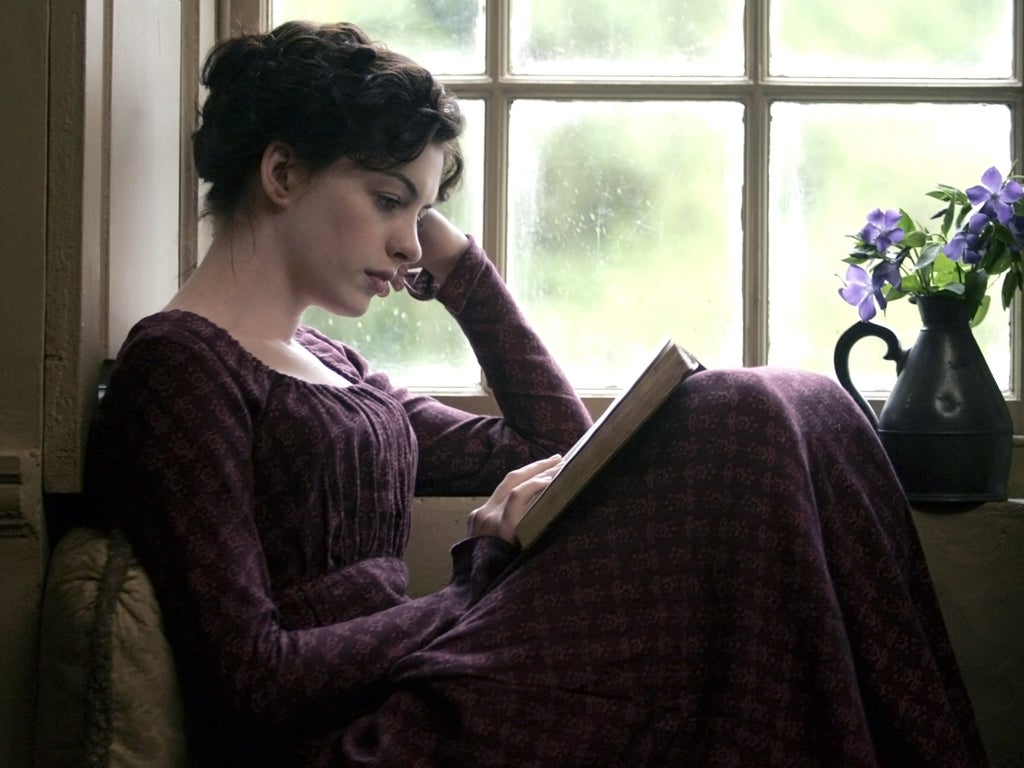
I blame the toxic combination of Disney and Sex and the City for my delusions about adulthood. As a teenager, they gave me a vague idea that I would transform, like an ugly duckling to a serene swan, into my adult self. Adult Me's hair would always be bouncy and her outfits would be glamorous. Conversely, I thought that friendships, my social life and finding Prince Charming would all just happen without much effort.
Of course, it's not like that. Where once I dreamt of flawless coordination, I now consider it a "good dress day" if my socks match and I avoid spilling food on myself. I've discovered the path of true love doesn't always run smoothly, experienced the perils of workplace politics and felt the loss of unappreciated friendships. Those characters I wanted to emulate – from Belle in Beauty and the Beast (bibliophile, adventurous, great hair) to Carrie in SATC (writer, funny, great hair) haven't proven to be good examples for coping in any really tricky situations. Maybe I need a new role model?
Elizabeth Kantor, author of The Jane Austen Guide to Happily Ever After (£16.99, Regnery Publising), thinks that chick lit and romantic comedies, where bitching about men and soppy romance prevail, have provided poor examples for coping with modern relationships. Her book shows us how to use Jane Austen's heroines as role models instead. So, in an attempt to find my "Happily Ever After", I'm swapping Sex and the City for Sense and Sensibility, and attempting to mimic the behaviour of a Jane Austen heroine by making Kantor's book my bible.
Although she got little recognition in her lifetime, Austen has become one of our most popular authors. As Claire Harman says in her book, Jane's Fame, Austen has "conquered the world". But what can a series of books written more than 200 years ago have to teach us that's relevant for women today? Quite a lot, says Kantor. "Human nature hasn't changed all that much," she says. "That includes male and female psychology and relationship dynamics – we still have to work with people we don't find congenial. [These are] things Jane Austen was so smart about, that modern women seem to have trouble with."
On Twitter, I ask if anyone has applied Austen's morals to their own lives, as the Guide recommends. Rose Keen tells me: "I have always found 'Run mad as often as you choose, but do not faint!' [a quote from Love and Friendship] to be excellent advice." Another tweet tells me she actually quoted Austen during a break-up with a boyfriend of three years, telling him: "Anything is to be preferred or endured rather than marrying without affection." So it seems there really is something about Austen that speaks to modern women.
The Guide devotes several chapters to romantic relationships. "Romanticism was an intellectual fad when Austen was writing," explains Kantor, "she makes fun of the Romantic idea of love. The love scene where you see a man for the first time and decide he is the one on which all your future happiness will depend is satirised."
So by searching to be swept off my feet, did I have it all wrong? "Yes," says Kantor. "Austen believed in everything in balance, but we have gone too far in the direction of 'is this a guy good for me?' rather than just 'is he a good guy? Is he a person I can respect and trust?'" Austen's portraits shun Disneyesque romance in favour of unions that involve delicate, slow-burning emotions. "The kind of love Elizabeth finds with Darcy is a solid basis. It's not a cold, passionless thing, but she gets excited for his moral qualities," says Kantor.
Kantor's advice sounds sensible, but a little unromantic. "Jane was not a romantic, she was a realist," says Marilyn Joice, a member of the northern branch of the Jane Austen Appreciation Society. During a talk in the genteel, Austenesque surroundings of Harrogate library, Joice explains that the author's experiences shaped her writing. Austen once rejected a proposal from someone she found repellent, but who would have offered financial security, but she also let a potential romance die out because he wasn't wealthy enough to support her. "She would want to marry for love, but she wouldn't marry without money," says Joice. Could it be that Austen was trying to justify her own decisions in her books, rather than guide readers' behaviour? I'm not sure it's right to follow her example if this is the case, and besides, her logic applies to a time when women needed to rely on men for financial security.
To make me think more like an Austen heroine, Kantor recommends I examine my conduct at bedtimes. I read one of Austen's prayers: "Have we neglected any known duty, or willingly given pain to any human being?" she writes, "Oh! God, and save us from deceiving ourselves by Pride or Vanity." Looking back over the day, I see I don't act in an Austen-approved manner at all. I consistently show aspects of Pride and Vanity at work, plus Control Issues and a Hint Of Paranoia. Being an Austen heroine certainly isn't easy. Kantor agrees. "They hold themselves to a very high standard. They are really stellar people."
I still don't see how it leads to the Happily Ever After that the Guide promises. Kantor explains that it's important to practise getting on with people, even those we would rather avoid, such as annoying neighbours and difficult work colleagues. "I think the more we practice delicacy to the feelings of other people, the more we develop those mental muscles that enable us in a romantic relationship to have forbearance," she explains. "Anyone who is married will tell you patience is necessary for a happy marriage."
So I decide to make more effort with a neighbour, and discover some interesting things, like his hobbies, which include taking his kids for nice days out and break-dancing, and about his struggle to give up smoking. "Jane Austen built her life around relationships," says Kantor, "the important points of her life were her nieces and nephews, her sisters, her community... she helped them with their novels and advised on their love affairs." I start looking forward to seeing my neighbour in his front garden, luxuriating in a cloud of smoke from "one last cigarette". I'm pleased we're getting on well, but all this business of considering other people all the time is becoming quite tiring.
Finally, the Guide says to work on your friendships. What qualities would Jane look for in a friend? "You look for character. Character means good principles and a good temper," says Kantor. "It seems obvious, but I don't think people nowadays judge people that way." She's right. My method of selecting friends is based on a complex algorithm combining who I lived with at university, whose dress sense I admire and who is most often free on a weekday evening for a spontaneous pub session. Kantor says I should find a friend who demonstrates "right conduct". They should have good principles and self-control. "In a friend, and a man, those are the things you should look for."
It all seems a bit earnest for me, but I do have a friend who always puts her friends and family first. I'm sure Austen would approve. It's her 30th birthday, so, in a final effort to become an Austenite, I turn up at her house, ready to tell her how wonderful she is. "Where's Rachel?" I ask a stranger who's wearing only a bath towel. "In the hot tub with the others," he says. I'm not sure Austen would approve of a hot tub party. It's quite possibly immoral... think of all those people who you might inadvertently tease by sharing the hot tub with them! What should I do? What would Jane do?
I suddenly realise I don't care. I can't manage to make myself into an Austen heroine, because in the modern world, you need more than good principles to guide your own conduct, and it's not sufficient in your colleagues, friends and lovers, either. You also need a bit of silliness, too. I slink home, put on my fluffy slippers and, embracing my shallow side, watch an entire Sex and the City box set. They really do have great hair.
Join our commenting forum
Join thought-provoking conversations, follow other Independent readers and see their replies
Comments
Bookmark popover
Removed from bookmarks