Why do we enjoy reading about female detectives?
Long before Mma Precious Ramotswe there was Miss Gadden, fiction's first female detective. Alexander McCall Smith celebrates a new edition of the Victorian novel that gave birth to her
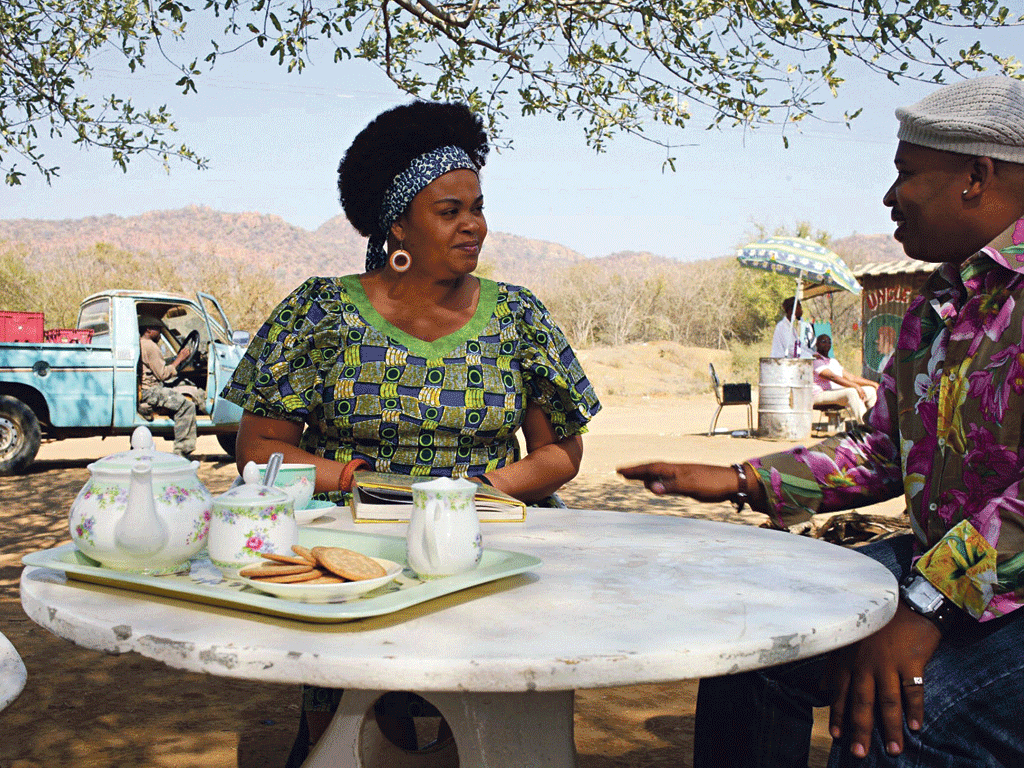
One of the questions I am asked most frequently at literary events is this: why have you chosen to write about women? This question, I suspect, is a familiar one for male authors who choose to have female protagonists in their books, and no doubt the answers they give are varied. My own answer focuses on the nature of the conversation that my female detectives have.
If that small office in Gaborone were to be home to two male detectives rather than two female sleuths, I imagine that the conversation would be much less interesting. This is not to say that men – and male detectives – do not talk about things that matter; it is just that they would be less likely to make the same observations that Mma Ramotswe and Mma Makutsi make. Their conversation, in effect, would be less personal, less subjective – and less emotionally engaging. Of course any generalisations about the behaviour of men and women will give rise to accusations of gender stereotyping, but why deny that, for one reason or another, there are differences in the perspective that men and women have on the world? Certainly it would be an unobservant detective who failed to notice these.
Why do we so enjoy reading about female detectives? Part of the enjoyment, I suspect, lies in the satisfaction that we derive from seeing women, who have suffered so much from male arrogance and condescension, either outwitting men or demonstrating that they are just as capable as men of doing something that may have been seen as a male preserve. We live today in a society in which gender equality has been, to a very large extent, realised. At the time at which The Female Detective was written, in 1864, of course, things were very different. The relegation of women to a subservient position within society – a position in which they were outsiders to the male-dominated worlds of work and affairs – meant that for women to be involved in the investigation of crime was a novel thing. Today one might expect that novelty to have faded, as women do all the jobs previously monopolised by men. Yet the idea of the female detective as being special or unusual still persists in literary and cinematic treatments of criminal investigation. Why do we still think that female detectives are in some way special and make, for that reason, good reading?
The explanation probably has to do with gender stereotypes. At the time at which The Female Detective was written, these stereotypes would have had the force of established truth. Andrew Forrester's novel was the first to feature a professional female detective, Miss Gladden, in British fiction. Middle-class women did not engage in what were seen as '"unladylike activities". They were protected from the harsh realities of life; they were thought to be in regular need of smelling salts; they were assumed to have no interest in sex; there were many jobs that a woman simply could not be expected to do because they were viewed as unsuitable for finer female sensibilities. The idea of a woman being involved in the murkiness of criminal detection must have been radical and adventurous in Victorian times: women simply did not do that sort of thing. That, of course, has changed. Women are expected now to do everything that men do, including taking on the role of submariners, infantry soldiers, and, of course, forensic pathologists. Yet even as they are cast in these roles, there may be a residual feeling, shared, perhaps, by women as much as by men, that there is something in certain functions – including fighting crime – that is at odds with the more gentle nature of women. Nonsense say the proponents of equality: men and women are the same when it comes to the vices and the virtues. That may well be true, but it is also true that there is a residual belief that women are inherently more endowed than men with the qualities of sympathy and care. A concomitant of this, then, would be that the woman sleuth is somehow slumming when she ventures into a criminal world dominated by crude, unsympathetic and cruel men.
Of course there are those who argue that such a view of woman's nature is old-fashioned and sexist. That may be so in certain expressions of it, but then feminist philosophers themselves have been at pains to stress what they call the "ethics of care", suggesting that woman do have a greater ability to show care in their dealings with others than do men.
There are other factors, though, that I suspect lie behind the popularity of the female detective. One is that the woman sleuth is often portrayed as the outsider in the male world of policing and criminal investigation. This operates in two ways: one where the woman is a member of a police force, and one where she is the freelance who operates either at the request of the official investigators or as a well-meaning bystander. In the case of the female detective who is part of a police team, the outsider status results from the fact that women police detectives frequently operate in a male-dominated force. They are frequently portrayed as having to deal with sceptical and sexist superiors who are only too eager to detect weakness and when we see women defeat these overbearing men we feel the satisfaction that accompanies the victory of the underdog.
Another source of pleasure is the way in which the female detective uses the apparent marginality of her position to good effect. Once again we are in the territory of stereotype. Men are to be distrusted but women are assumed not to be interested in whatever it is that is being concealed. Then we suddenly realise that it is the woman who has seen and understood what is happening without ever being suspected of being a threat to anybody. Of course the world is not like that. If one is in the position of having to distrust others, then one would be well advised to distrust everybody regardless of gender.
The Female Detective has a claim to mark the beginning of a rich and continuing tradition in crime literature. That tradition shows no signs of abating, even if the factors that distinguish the respective roles of men and women in society are becoming increasingly irrelevant. Society may be becoming more androgynous, but the niche occupied by the female detective will continue to be a rich source of literary pleasure. The world of the narrator in The Female Detective is far removed from our own, but just as we recognise hers then she would probably recognise ours. Human nature and the struggle between good and bad – that essential kernel of the detective novel, as Auden famously declared – has not changed much in the years that separate us from Victorian England. Crime and deception still flourish, but so too do the curiosity and intuition that we see so charmingly portrayed in these pages. Ultimately there may be a woman to set things right, which prompts the Freudian conclusion that the female detective, when all is said and done, is mother.
The first lady of crime fiction
When 'The Female Detective' was first published in 1864, there were no official female police officers, let alone detectives in Britain. The first-ever lady detective "Miss Gladden" works incognito, tracking down killers while concealing her own identity. "My friends suppose I am a dressmaker", she writes in the introduction to her tales. "I am aware that the female detective may be regarded with even more aversion than her brother in the profession… Criminals are both masculine and feminine – indeed, my experience tells me that when a woman becomes a criminal she is far worse than the average of her male companions, and therefore it follows that the necessary detectives should be of both sexes." Andrew Forrester was the pseudonym of James Redding Ware.
'The Female Detective', by Andrew Forrester, with a foreword by Alexander McCall Smith, is published by British Library (£8.99, bl.uk/shop)
© Alexander McCall Smith
Join our commenting forum
Join thought-provoking conversations, follow other Independent readers and see their replies
Comments
Bookmark popover
Removed from bookmarks