Molotov's Magic Lantern, By Rachel Polonsky
In search of a past behind Moscow's closed doors
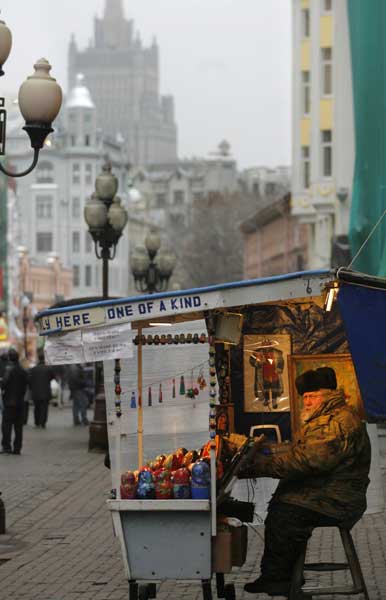
The genesis of this intriguingly entitled book is the writer's discovery, as an academic expatriate living in Moscow, that the flat directly above hers had been occupied for many years by the disgraced Soviet foreign minister, Vyacheslav Molotov. His heirs, who were now renting the flat out to well-to-do foreigners, had left bits and pieces from his library, and a "magic lantern" affording faint pictures of a forgotten past. She learned this from the then tenant, an American banker, who cheerfully gave her the run of the place.
The result is that Rachel Polonsky was diverted from her flagging research into early 20th century Russian Orientalism and wrote this unusual and elegant book. It moves outwards, chapter by chapter, from the flat, in a block and a street at one time reserved for the Soviet priviligentsia, via provincial cities in the Russian north and south, to the Russian Far East, marking the point at which Molotov's professional life declined into quasi exile when he became ambassador to Mongolia.
The Bolshevik apparatchik who changed his name from Skryabin to the more proletarian and activist-sounding Molotov (derived from the Russian for "hammer") provides the link, sometimes tenuous, between the different strands. But this is not a book about Molotov – his character remains only intermittently revealed - so much as a book about Russia: the "journey in Russian history" of Polonsky's subtitle. As such, it is an exercise in total immersion, one in which the writer surrenders herself completely to the experience.
The surrender, like the writing, is at times a little too self-conscious for my taste. But felicity outweighs the burdensome many times over. I stopped marking the choice phrases after chapter one; there were too many – even as I kept returning to the thought that it was probably not by chance that Polonsky was initially drawn to Russian Orientalism.
Let me to declare a particular interest here. As a one-time exchange student, a graduate delving into some of the same early 20th century themes as Polonsky, and then as a journalist in Moscow as the Gorbachev "thaw" set in, I was drawn to many of the same places as Polonsky visits, and share many of her responses to the landscape, the people, and the authenticity, both of Moscow and what might be called the Russian heartland. I also have more than a passing acquaintance – via my husband's PhD thesis! – with the vicissitudes of the archaeological expedition at Novgorod and the political and cultural currents that swirled around the study of history in 1980s and 1990s Russia and, to an extent, still do.
I mention this only to endorse the accuracy and perceptiveness of Molotov's Magic Lantern and commend it to a wider audience. This is a many-layered portrait in which the strands of Russia past and present, town and countryside, real and intellectual, are interwoven with skill and – sometimes, dare I say, almost a surfeit of - erudition. There comes a point where almost too many connections are made. A tour de force of compilation obscures what can be a frustrating absence of synthesis.
Molotov's Magic Lantern is a hard book to catalogue. It repeatedly crosses the borders between memoir, travelogue, cultural appreciation and intellectual history. Nor are would-be readers particularly helped to know what they are getting by the folkloric design of the jacket, which suggests the contents are more historical than is the case. It could also do with far better maps than the two rather mean, and deficient, efforts the publisher has seen fit to include.
In Polonsky's style and approach, there is something reminiscent of what now seems the very precise, rather mannered, travel-writing of Patrick Leigh Fermor. Most of all, though, this book reminded me of Orlando Figes's virtuoso study of Russia, Natasha's Dance (2002). Which is not without irony, because Polonsky herself slated Natasha's Dance at the time, charging Figes with numerous inaccuracies and "pastiche writing" in a celebrated TLS review.
The similarity of treatment, however, which can be found also in other recent studies of Russia, poses a question of its own. What makes Russia almost uniquely susceptible to this variegated, cross-genre, and often highly subjective approach? Is it just that this vast country remains in many ways strange, even now that we have unlimited freedom to travel there? Or is it rather the emotional response that Russia, for whatever reason, tends to draw from otherwise buttoned-up Britons?
The risk for the chronicler then becomes self-indulgence. It is a risk that Polonsky, thanks to the quality of her writing, avoids, but she sometimes runs it perilously close.
Join our commenting forum
Join thought-provoking conversations, follow other Independent readers and see their replies
Comments