David McVicar: 'I'm good because I care so much'
He's opera's bad boy with a reputation for bloody stagings and tantrums, but the world-renowned director is a big softie at heart
It takes a certain kind of genius to take a four-and-a-half-hour Handel opera, traditionally sung by castrati, with a tortuously complicated plot and a Roman emperor played by a middle-aged matron, to stick it in front of a woman who still has no idea what happens in Cosi fan tutte, even though she's seen it several times, and turn the whole experience into one of unbroken, unmitigated bliss.
What it takes, in fact, is David McVicar. I'd barely heard of him when my mother dragged me to see his production of Giulio Cesare at Glyndebourne a few months ago (but then I tend to mix up my Puccinis and my Verdis), yet by the end of the evening I was ready to kiss his feet.
That, however, might be tricky, because David McVicar's feet, according to press reports and interviews, do an awful lot of stomping around. The man who is widely regarded as the leading opera director of his generation, and frequently described as a genius, rarely escapes the label of "enfant terrible" and "angry young man". In a South Bank Show about his work, which you get when you buy the DVD of his magnificent Salome, you see a solid, pony-tailed figure striding around, saying things like, "it has to go the way I want it to" and, "we want Jokanen's head with a reservoir, so it can spout tons of blood". And somehow that bloody, severed head feels like both a metaphor and a threat.
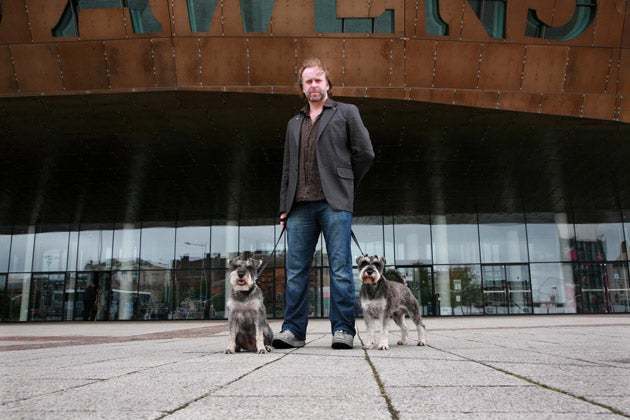
But the head that greets me on a rainy day at the Millennium Centre in Cardiff isn't bloody, severed or pony-tailed. The eyes are blazing with the kind of intensity that has you turning your gaze away, but the mouth is twisted into something that could almost be a smile. I don't notice the feet (or indeed kiss them) because, quite frankly, I'm distracted by the arms. They are bursting out of a tight T-shirt full of artful rips. They're the kind of arms that have you thinking of Glasgow shipyards, or perhaps gay nightclubs. They're not the kind of arms that have you thinking of arias.
They're not, in fact, the kind of arms that have you thinking of Handel, or castrati, or a Cleopatra played with Bollywood wit, or magic flutes, or consumptive courtesans dying in attics, but that's what we're here to talk about, so I dip a toe in the water with a little rhapsody on Giulio Cesare and over-egg the pudding with a reference to McVicar's favourite period, the 18th century. Presumably, I venture, it's the wit, clarity and level-headedness of the 18th-century (think Johnson, Swift) that appeals?
"It was also," says McVicar ferociously, "a time of physical oppression and lack of democracy, and only the rich could have bathrooms and sanitation and everyone was dropping dead all the time." Er, yes. "And all that's left," he continues, "was the art, and what we're getting is the beautiful veneer of the civilisation, but also its intuitive artistic expression. I think we'd all get a bit of a shock if David Tennant took us back there." Yes, yes, I'm sure we would. And now that we've established your credentials on the gritty realism front, do you think we could get back to what you like about the century which, after all, is the one you (not me!) said you liked?
"I like," says McVicar, more calmly now, "the 18th century because that was my introduction to classical music and to opera. And because I was just really interested in 18th-century Europe just as a historical period and a social period and a philosophical period and just very, very interested in how the whole thing blew up in the French revolution, just before industrialisation kicked in. And how that all happened and the way the age of enlightenment sort of ate itself."
I'm beginning to get a sense of the rich mix of ingredients that make up the sumptuous banquet that is a David McVicar opera. Here is history, here is philosophy, here is politics, here is art, and here, of course, is music. "There's an argument," he continues, "for taking a Mozart opera and just treating it on its own terms as a kind of lone child with no connections, and people do that, but I don't. I really want to know what was going on around, even if I then dislocate the piece from that period. Most of my Mozarts," he says, "I took out of the 18th century and put into the 19th century. I'm not quite sure why," he adds. "But there was a good reason at the time!"
Gosh. "David McVicar has sense of humour!" shock horror. Actually, he laughs quite a lot. One of the things he laughs at (but not in a good way) is the way operas can be produced in Germany. "There'll be combat physiques," he says, "and balaclava helmets, and machine guns, and there'll be neon strip-lighting, and everything will be antiseptic and everyone will over-react madly and the audience will sit there, taking it all incredibly seriously, and I'll be sitting there stuffing my fist in my mouth, because I'm trying so hard not to laugh."
What he hates most of all is a "concept" ("das Koncept" he says in a forbidding German accent), anything that sticks a work of art in a straitjacket and tries to "tie up the ends". "Art," he says, "comes from a much more instinctive, intuitive place, a place you can't quite understand, that place you go when you're asleep". In The South Bank Show, he talked of productions that come to him "in visions". "I'll wake up," he said, "and have dreamt about how I want it to be." Is that true?
"Yup," he says. "I'm a great believer in the process of dreaming." And he's had therapy? "Yup." And did the dreams figure prominently in that? "Yup." Freudian or Jungian? A long pause. "I think they're Jungian." Let's hope he spoke a bit more volubly to his therapist. "I had a really weird dream last night," he volunteers eventually. "I was watching Adrian Noble's production of Tosca – which he hasn't done. I dreamt it," he adds, with a deep-bellied laugh, "in some detail."
McVicar, it's clear, eats, sleeps and breathes opera. His nightly dreams about it add to his sense of artistic destiny, but the destiny, he admits, is retrospective and was quite a long time coming. Growing up in an unhappy and sometimes violent home in a lower middle-class suburb of Glasgow – he won't talk about this while his father's still alive – he discovered opera by catching a TV screening of Bergman's Magic Flute. ("I say the Ring Cycle sometimes" he says, "because I like to keep everyone on their toes.")
He discovered theatre in his early teens and started going to the Citizens Theatre in Glasgow and seeing "really crazy stuff". After a term at art college (he still draws and paints), he went to study acting at The Royal Scottish Academy of Music and Drama. A glittering career as an actor didn't seem to be beckoning, but the head of the school took him to one side and told him he thought he should be a director. And so it proved. Since the early 1990s, he has been directing operas – sometimes as many as five a year – all around the world.
Here in Cardiff he's working on a new production of La Traviata (a co-production between Welsh National Opera, Scottish Opera and Gran Teatre del Liceu) which sounds absolutely thrilling. "We wanted to inject sex," he says, "which is pretty explosive in the novel [Dumas's La Dame aux Camélias, on which the opera is based]." In order to emphasise the eroticism of the story, and the deeply unrespectable world of the courtesans at the heart of it, he has set it in the demi-monde of Paris in the 1880s. "For the ladies," he says, "the 1840s is hard – the poodle curls and the big crinolines. It's not a line we think of as sexy. So then we went to the 1880s instead and the beautiful line with the long, long corset and the bustle and the long trains, the layers, the thrill of what lies beneath..."
It's not hard to see why McVicar, who is as interested in the costumes, and set design, and lighting, and acting as the music, would be keen to do pure theatre work, too, but he can't, he says, because "they won't let me in". Why not? "I don't know," he says, a touch sullenly, "you ask them. No one will take the risk of giving me a King Lear, because somehow 'oh, he won't know how to do that'."
So would it bother him if he only did opera? "Not in the slightest," he says, contradicting everything he's just said. "As long as I can keep on doing it, as long as I don't go out of fashion and stop getting work."
But he's the leading opera director of his generation! "Not in Germany, I'm not." Does he want to work in Germany? "No, it's horrible. And institutionalised. You have to fight against ineptitude, and arrogance, and stupidity." And is he good with stupid people? "No," he says. "I have a knack of sniffing out bullshitters and making it absolutely obvious that I think they're not doing their job well." And does he, er, have trouble controlling his temper? "I used to," he says. "I'm much better at it now." Why? "Because," he says, "I changed my lifestyle."
It takes me a moment to realise that he is talking about drugs. For some years, David McVicar, supposed enfant terrible, and single, gay man about town, had quite a love of what diarists like to call "partying". "When I got rid of that whole aspect of my life," he says, "things began to get really, really smooth. And also," he adds, "being in love with Andrew, my partner." For six years, he has lived with the choreographer Andrew George. When not travelling and working together, they live a cosy domestic life in Islington with their two dogs. "I'm much happier," he says simply, "because I'm not lonely any more."
I have no doubt that David McVicar is less angry than he used to be. Which is not to say that he isn't angry. He still hates critics. ("Public school idiots," he says, who "pursue vendettas".) He still feels shut out by the theatre establishment, slighted by some of the music establishment and misunderstood, misrepresented and misquoted by journalists. But why does he care? Why does this super-talented, super-sensitive, super-successful (and, it has to be said, super-handsome) man care if some lisping idiot whose dramatic abilities are limited to snide asides in reviews doesn't like him?
"I think," says McVicar, with a rueful smile that verges on a grimace, "what we're getting to is I am good at what I do because I care so terribly much, and I do put so much into it, so much energy and so much love." Yes, love. And passion. And anger. All the stuff of opera, in fact, the stuff that makes the great human drama of love and death and war, and the stuff that needs great artists to bring it alive.
'La Traviata' opens at the Wales Millennium Centre tomorrow (www.wno.org.uk)
Join our commenting forum
Join thought-provoking conversations, follow other Independent readers and see their replies
Comments
Bookmark popover
Removed from bookmarks