Tom Courtenay: 'I had this knack, my own thing'
From Hull docks to the infamous Marshalsea prison in the BBC's Little Dorrit, it's been a long-distance journey for Tom Courtenay
It's almost an axiom of our time that angry young men turn into grumpy old ones. You start off Billy Liar, recreating the world in your own fantastic image, and you end up William Dorrit, locked in the Marshalsea, brooding on your misery and failure. Your fierce blue eyes start to look rheumy; your firm jaw slackens into hangdog jowls. That, at least, is the trajectory of Tom Courtenay, actor, the man who started off an icon of the working-class hero, and ended up the apostle of fussy disappointment. And Tom Courtenay, the man? Well, who knows?
Tom Courtenay the man is, it seems, considerably more cheerful than the characters he has played. Not difficult, perhaps, when your most prominent roles in the last decade have included King Lear, Uncle Vanya and Philip Larkin. He has developed a fine line in quivering emotion kept – only just – under control, those blue eyes on the point of welling up, a mesmerising mix of vulnerability and pride.
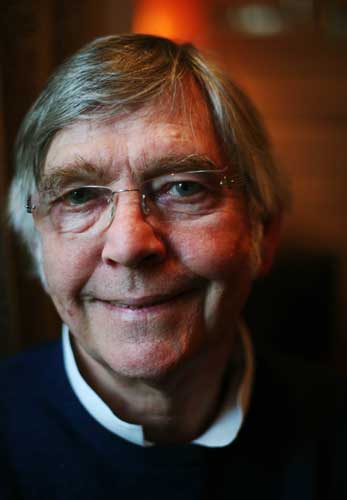
In the flesh, however, the eyes are sparkling and if the chin, at 71, is tending towards the jowly, the smile is undeniably sweet. "I washed my hair," he tells me, in a surprisingly quiet voice with just a trace of a Yorkshire accent, "[My wife] Isabel made me wash my hair."
It's a rather touching thought, that the man who surfed the crest of the Sixties New Wave in The Loneliness of the Long Distance Runner and Billy Liar, and who starred with Julie Christie in Dr Zhivago, and who has won critical acclaim in zeitgeisty productions like The Norman Conquests and Art, and a string of awards for work ranging from Alan Ayckbourn to Andrew Davies, a man knighted for his services to acting, indeed, should wash his hair for The Independent's photographer. But very nice it looks, too. With the fluffy blue jumper, which perfectly matches those twinkly eyes, he looks like a favourite uncle, maybe meeting a niece for tea.
I am not, however, Courtenay's niece, and I haven't, in the tea room of the Langham Hilton, quite got the hang of asking questions that elicit clear answers. Has he, I ask by way of an ice-breaker, seen the current production of The Norman Conquests? It's the first West End production since that epoch-making premiere, in 1974, with Courtenay, Michael Gambon, Felicity Kendal and Penelope Keith, and it's at his old stamping ground, The Old Vic. Courtenay looks bemused. "No," he says. Unwisely, I persist. Did he have fun doing the play? "There was a lot of giggling," he says. "Michael used to stand in the wings and make me laugh." Did he like the play? "I must have. But it's a long time ago."
OK. Message received. Back to the present, back to business and back to Little Dorrit, a new BBC production, adapted, of course, by Andrew Davies. "That," says Courtenay firmly, "is more interesting to me." The series itself, on the single hour-long episode I've been allowed to see, certainly looks interesting. It is, in fact, hard to think of a book better suited to our times than Dickens's grim depiction of financial fecklessness and its consequences. The Marshalsea, the debtors' prison in which his father was incarcerated when he was a child, no longer existed at the time he wrote it, but the memory of it haunted him, and, after a few nights in front of the telly, it may yet haunt us, as a symbol of the 21st-century equivalent into which so many of us have crawled.
This being Davies, it's distractingly gorgeous – all distressed paintwork, shadows, a vast cast of glittering brilliance and, if I remember the book rightly, some rather unexpected racial and lesbian overtones. Courtenay is terrific as the pompous, deluded William Dorrit, who forces his daughter into a servitude that matches his own captivity, a fascinating combination of the innocent and the cynic. As so often, he brings an engaging vulnerability to the role that has you swinging between irritation and pity. "People say, 'Well, do you sympathise with him?'" says Courtenay, "but Dickens, knowing how awful he was, was still sympathetic. It was unfortunate to be incarcerated for 25 years. He had such a big heart and such a big imagination, which is why he writes so many parts. I'm not saying he's better than Shakespeare, but in Dickens the small parts are usually interesting, because they were alive to him."
Dickens, it's clear, is a passion. It's clear from his memoir, too. "One of my excitements reading Dickens," he says in Dear Tom: Letters from Home, "had been that some of the characters were working class." It was a discovery he made first at grammar school and again later at University College London, where he took (and failed) a degree in English literature. He went to university to please his parents but chose UCL because it was in the same street as Rada. Reading Dickens aloud at UCL fuelled the passion for performance he had first discovered reading the lesson in school assembly and which eventually propelled him down that road, to Rada and stardom.
And if anyone doubted his acting credentials at that point (Courtenay himself certainly did), then no one could doubt his status as working-class boy made good. Courtenay's father painted boats at Hull Fish Dock. His mother mustered some extra pennies by making nets. Fish was a staple at home, of course, but the first Christmas chicken was a treat that demanded carefully casual boasting.
"Dickens was in the street there with the lower classes," says Courtenay, "and that's what's so powerful to me. He got as near it as anyone, nearer to it, in describing the utmost squalor and degradation just around the corner." Courtenay, like Dickens, escaped his parents' world, and fate, but if the angry young man became his Sixties stock-in-trade, the knowing-his-place older man has become as much of a speciality as the years passed. In The Dresser, which reunited the two first Billy Liars, Courtenay and Albert Finney, he gave a Golden Globe-winning performance as the personal assistant struggling to get an actor through a performance of King Lear, and in A Rather English Marriage, which reunited them again, he gave a blistering, Bafta-winning one as the working-class widower who moves in, as "company", with a much posher fellow widower, and becomes his de facto servant.
In one of his more recent TV films, however, Jack Rosenthal's wonderful last script, Ready When You Are, Mr McGill, he plays a man who tries to escape the banality of his lower-middle-class suburban life by being an extra. Into an hour and a half capturing an entire day of repeated takes for his one line as a hospital porter, which he finally fluffs, he pours all the frustration of a man who has dreamt of a different, better life. He pours all the frustration, it seems to me, of his mother, a woman who wrote, in one of the "letters from home" he later published: "I went home to finish my washing and I could have cried because I wasn't educated." His mother, it's clear from the letters, spent her entire life haunted by her inability to express herself in any way beyond the constraints of her world as a Fish Dock housewife. "I think that the only thing that could satisfy me would be if I could write something worthwhile," she once confessed.
Dear Tom: Letters from Home, published in 2000, was her son's attempt, nearly 40 years after her death, to make her dream come true. "She could have understood it from her own experience if I'd wanted to write," he confides over a second cup of coffee, "but I had this little knack, which was my own thing. I wasn't good at football and cricket, but when we got to grammar school, in assembly, there was this stage and I just wanted to get up on it and speak."
And it was the stage he went back to, after the spell of Sixties film stardom that swiftly followed Rada. "I didn't want to wait around for the snowdrops," he has said of the filming of David Lean's Dr Zhivago. In 1966, he decided to join the company at the Manchester University Theatre, which later became the Manchester Royal Exchange. It was there he met his second wife, Isabel, and there that he played parts ranging from Sheridan's Faulkland to Uncle Vanya and King Lear.
Now, he says, after a hip replacement and treatment for prostate cancer, he's happy to swap the rigorous schedule of sometimes twice a day performances for the relative lassitude of a film or TV set. "When I was younger," he declares, with the ring of a practised anecdote, "I couldn't bear all the waiting around, but now that's my favourite part. It's lovely. Some days, you come in, you have a lot to do, and some days, you can just walk past the camera, make jokes, be the life and soul of the party. I love all the anecdotes, the little jokes."
On the evidence of our conversation, he certainly does. There's a long story about Alec Guinness ("he was the only one who was a friend") who was "always saying, 'No, no, I won't have that,'" but who would attack the bread rolls, with "great gobs of butter", with gusto. There's a story about the night he was in The Norman Conquests and was wrongfooted by the sight of three footballers from his beloved Hull City in the box. There's a story about his Uncle Pat, who wanted Courtenay's mother to become a Catholic. There are stories about Gus, his dog, howling in horror at the sound of Courtenay playing the flute, but not, apparently, the ukulele. And, to be honest, it's slightly hard to follow it all, slightly hard to get a word in edgeways.
Is there, I ask him, finally, a bit desperately, a temptation in real life to overplay things? There is, for once, a short pause. "I suppose there must be," says Courtenay with the sweetest of smiles, "because the instinct is to tell a story, and acting is about telling stories. We exaggerate things to make a better story." Well yes, perhaps we do. "This isn't real life, it's all pretend," says Joe McGill in Ready When You Are, Mr McGill. "Real life is how well we pretend, isn't it?" replies Bill Nighy's petulant director.
Tom Courtenay, actor, is a master of his craft, one of the finest of his generation. And Tom Courtenay, the man? Well, he's charming, decent, endearingly scatty and modest. He likes, clearly, to play the clown, but what comes through most strongly is a certain gentleness, a certain vulnerability.
And he's kind. So kind that the day after our interview he digs out and sends me a CD of his one-man show on Philip Larkin. "I enjoyed our conversation," he wrote kindly in the accompanying note, and so did I. But I'm still not sure who I had it with. "I think it's very sensible not to let people know what you're like," says Courtenay's Larkin towards the beginning of the show. The show, by the way, is called Pretending To Be Me.
'Little Dorrit' starts on Sunday, 8pm, BBC1
Join our commenting forum
Join thought-provoking conversations, follow other Independent readers and see their replies
Comments