Adrian Sherwood: The man who built Jamaica in the Midlands
The founder of On-U Sound tells Nick Coleman that there is more to reggae than 'ooom-chicky...'
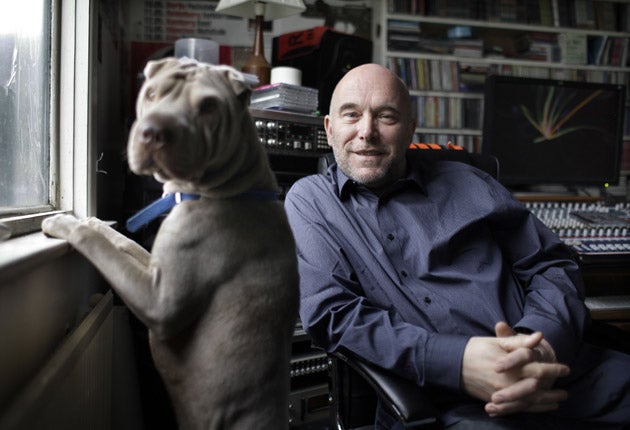
Not much reggae music came out of the Home Counties during the early 1970s, but an awful lot went in.
More than you might think. Quite a lot of it made the journey from London in the record bags of Adrian Sherwood, would-be reggae rebel, junior DJ, and pale-faced teenage entrepreneur of the skank, a boy so transfixed by Jamaican rhythm and its culture that, by the age of 15, he'd already committed himself to the life while skulking around the clubs of Luton, Dunstable and High Wycombe, getting off on the "better and better, madder and madder" threads of reggae's Seventies narrative.
"It was the sheer diversity of it," he reflects ardently in 2011, settled in his management office in Bloomsbury, one of the several places that serve as a nerve centre for his 30-year-old On-U Sound operation. "People say reggae is just ooom-chicky, ooom-chicky, but by the mid-Seventies there was a fantastic range: the mellow stuff, stuff for grown-ups, stuff in the American vocal group tradition, beautiful solo singers, the DJs, the mad stuff, early dub. And then there was the Rastafarian movement. It was like entering a whole other world: the weed, the Special Brews, the sound systems, the parties, the lifestyle, and this image of a place that was far away and better than where we lived."
Reggae music was then a segregated art form, regarded as second class, its sales figures far outweighing its national chart impact. "Records would sell 100,000 copies and still not make the charts," rasps Sherwood, "because of where they were sold – outlets like Baba's in Dalston Market and Bailey's in the Bullring in Birmingham. You could go to Baba's on a Friday with a load of records and he'd say, 'We'll take 700 copies of that.' The next week, he'd need more."
At 53, he's gearing up for the year-long 30th birthday celebrations of his label, an institution that was as groundbreaking in its time as it was passionate. But at 19 he was just one small stitch in the cultural gash which scabbed over to form punk's affinity with roots reggae.
Back then, for enterprising youths, there was no division between business and fun. Sherwood involved himself in start-up independent labels, and graduated to production work. He was closely involved in several key sessions with the heaviest, most biblical of all Jamaican chanters, Prince Far I, and hung out in punky London with Far I, Ari Up of The Slits, and John Lydon, to form a perfect map in human form of the truculent, artful, thunderous roots-rascalism that would come with the onset of On-U two or three years later. Odd connections were made; big ideas were explored on the back of big preconceptions, yet those involved were never "handcuffed", artistically.
The first On-U concept, New Age Steppers, arose from the aggregation of Ari Up, Aswad founder George Oban, the avant-gardist Steve Beresford, and Mark Stewart, the industrial hip-hopper and former Pop Group radicalist. It was peculiar, but interesting. Dub Syndicate saw Sherwood hooking up with the great Roots Radics drummer Style Scott. African Head Charge was an attempt to define "psychedelic Africa" with the percussionist Bonjo Iyabinghi Noah, supported by just about everyone else who'd ever sheltered under the On-U brolly. The noise'n'news assault that was Tackhead grew out of Sherwood's relationship with the hardcore New York funk trio of Skip McDonald, Doug Wimbish and Keith LeBlanc, who would later make themselves more tastefully heard as Little Axe. And on the list goes: Creation Rebel, Mark Stewart & the Maffia, Gary Clail, Little Annie, Singers & Players ....
Not all of these experiments were entirely successful, but they were performed with creative, rather than commercial, outcomes in mind. "I didn't think about what the world might actually want .... I was just taking loads of drugs, staying awake every night, making tunes, robbing Peter to pay Paul. I'd run up massive studio bills, give the record to some other cheap, unsavoury distribution outfit or other, who'd give you the worst contract in the world but take the record off you, and then I'd use that one to pay off the last debt, to keep going."
And keep going he did, becoming an international-eclectic remixer and producer with a fan club as eminent as it was arcane. David Lynch got him in to work on the Wild at Heart soundtrack; he enjoyed tinker-time with Depeche Mode and Nine Inch Nails; Matt Groening declared himself a fan. Sherwood has also recently done the music for the keenly awaited Fire in Babylon documentary, about the the late-Seventies rise of West Indian cricket.

Enjoy unlimited access to 100 million ad-free songs and podcasts with Amazon Music
Sign up now for a 30-day free trial. Terms apply.
ADVERTISEMENT. If you sign up to this service we will earn commission. This revenue helps to fund journalism across The Independent.
Enjoy unlimited access to 100 million ad-free songs and podcasts with Amazon Music
Sign up now for a 30-day free trial. Terms apply.
ADVERTISEMENT. If you sign up to this service we will earn commission. This revenue helps to fund journalism across The Independent.
"From the start, you strive for your own sound. That's the point. Prince Far I used to talk about it. All the great Jamaican producers had their own sound – the sound that stood them out from the pack. I use certain techniques – mix with my fingers and bend the sound while I'm mixing, and do sweeps and delays and phases and things, all of which are mine. Delay, balance, movement. I see it as a picture. And that's something I'm very proud of. I really did succeed in getting a sound of my own."
He half chuckles, half sneers. "A journalist once described me as 'a fan who's got his hands on the mixing desk'. It wasn't meant as a compliment, but it was also like the perfect description of me and what I do."
The chuckle-sneer ends abruptly and he moves on.
Join our commenting forum
Join thought-provoking conversations, follow other Independent readers and see their replies
Comments