Andrea Bocelli: Voice of the people
He has sold 50 million records, but the blind tenor Andrea Bocelli is hoping his latest release will finally win over the critics. Peter Popham meets the singer at his Italian home
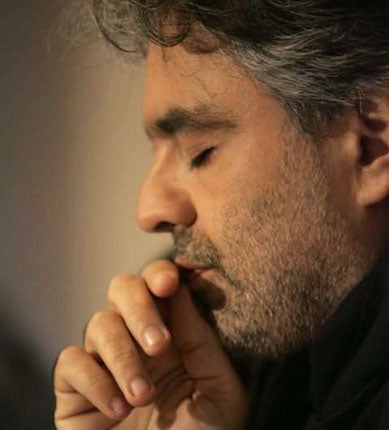
Forte dei Marmi, a neat, rich, regimented seaside resort on the Tuscan coast, possesses little of what the world loves about Tuscany and a lot of the oddly naff elements of Italian resorts: an almost industrial approach to sea bathing, the esplanade lined with shoulder-to-shoulder lidos and their massed ombrelloni and loungers.
And there's something industrial about the promotion of Andrea Bocelli's new album, too: sitting in the garden of the singer's home across the road from the beach waiting in line for an interview, one feels like a battery chicken waiting to be stuffed. The blind Tuscan singer, who turned 50 in September, is releasing a new album, so the media must be serviced. A gaggle of us from different parts of Europe have assembled in the rear of his home, a converted 19th-century hotel. We don't get to see the interior – the weather being balmy, interviews are conducted in the garden – but judging from the outside, it's still more a business premises than a home. The garden is colonised by a car park, and the building at the end of the garden houses Bocelli's production company; apart from a couple of caged canaries and a dog, homely touches are missing. The industry of the musical phenomenon that is Bocelli seems to have swallowed the human being whole.
Bocelli appears before us now in white shorts, brown short-sleeved shirt and suede loafers, himself no more than a humble toiler – though obviously the indispensable one – in this culture factory. He has sold more than 50 million records worldwide. From obscure beginnings crooning in Tuscan piano bars, this Pisa University law graduate born with congenital glaucoma, who lost his sight entirely at 12, has conquered the world. With his classical recordings alone, Bocelli was the world's best-selling classical artist between 1997 and 2004. True to his piano-bar beginnings, he has never been an operatic purist, and his duets with pop singers – Celine Dion, Laura Pausini, Stevie Wonder – have stormed the world's charts. "Time to Say Goodbye", his duet with Sarah Brightman, for example, sold three million copies in Germany alone, becoming the biggest-selling single of all time in that country. "We know there's a sleeping giant of a mass audience that bought The Three Tenors and the Benedictine monks," Danny Goldberg, the chief executive of Mercury Records, told Billboard magazine back in 1997, as the Bocelli machine was tuning up. This mass audience, Goldberg went on, is a tricky one, because it doesn't buy records on a regular basis – but it "can occasionally be activated" by the right artist. Bocelli was such an artist, as Goldberg recognised. "We look upon [Bocelli]," he said, "as an incredible opportunity to sell millions of records here."
What's the formula? It's both as simple and at the same time as subtle as Coca-Cola. Bocelli's perpetual coy boyishness is part of it; the vulnerability and pathos that go with being unsighted – the Mediterranean hunk without the shark-like aspects of the sighted variety. Then the voice: it's a big, barnstorming, PA-shattering Italian stage voice when required, then on cue it shrinks to a husky, wistful crooner's gasp. He's got the ballad-shouting appeal of a Tom Jones but with bags more class and the exotic allure of foreign goods.
So what does it matter if some of the top opera critics in the world have been horrible to Bocelli? In 2006, The New York Times music critic Bernard Holland had this to say: "The tone is rasping and thin and, in general, poorly supported. Even the most modest upward movement thins it even more, signalling what appears to be the onset of strangulation. To his credit, Mr Bocelli sings mostly in tune. But his phrasing tends towards carelessness and rhythmic jumble... The diction is not clear."
Who cares about such carping? Well, Bocelli does. And if his career has seen him moulded by the crafty hands of Goldberg and his ilk, pairing him with popsters and letting him loose on mawkish standards, Bocelli has seized the opportunity offered by his 50th birthday and his worldwide success to declare, this is where I came from, this is what I admire, this is what I aspire to do.
The record is called Incanto, which means "enchantment" in Italian but has a suggestion, too, of "cantare", meaning to sing, and"bel canto" ("beautiful singing"), the lyrical singing tradition in which, on this album, Bocelli locates himself. "This is a record that originates from my earliest childhood," he says. "That was the time I really found a passion for opera, but above all I was passionate about the great voices. It was through my passion for voices that I discovered my passion for opera, not the other way around."
By "great voices", he explains, he means the world-famous tenors produced by Italy in the early- to mid-20th century: Caruso, Beniamino Gigli, Franco Corelli and the like. "All these great tenors of the last century had an extraordinary passion for songs," he continues, "and in particular for songs derived from opera, known as 'la piccola lirica' or 'little opera'."
These are the hoary old favourites with which Bocelli has filled Incanto: "Funiculì Funiculà", "Un Amore Così Grande", "Mamma", the old Neapolitan favourite "'O Surdato 'Nnamurato". And recorded with the sort of old-fashioned brassy arrangements that whisk one back in time to Workers' Playtime and the Light Programme before it became Radio 2. "These songs fill you with energy," Bocelli tells us. "I hope that in listening to this record, the public, and in particular the youthful public, will discover this repertoire and will have the curiosity to dig out the original versions. It's a very important part of our Western cultural heritage."

Enjoy unlimited access to 100 million ad-free songs and podcasts with Amazon Music
Sign up now for a 30-day free trial. Terms apply.
ADVERTISEMENT. If you sign up to this service we will earn commission. This revenue helps to fund journalism across The Independent.
Enjoy unlimited access to 100 million ad-free songs and podcasts with Amazon Music
Sign up now for a 30-day free trial. Terms apply.
ADVERTISEMENT. If you sign up to this service we will earn commission. This revenue helps to fund journalism across The Independent.
The result is an album that will no doubt be dismissed by snobs as Bocelli once again "warbling his way through the Shmaltzmeister's Songbook" – as a recent critic described him, less "bel canto" than "can belto". Yet it is an album in which, after all the dalliances and collaborations of his past albums, Bocelli declares his true love. It is an uncompromising work, and as such it will be interesting to see whether it repeats the success of what he has done to date.
Because operatic bellowing giving way suddenly to husky intimacy has always been part of the Bocelli-Cola formula. And now he wants none of that. "When you sing using a microphone, the mic is like an ear," he tells me. "It's like singing in a baby's ear. It's a completely different way of expressing oneself. In this way there is no 'arte del canto', no 'art of song'. And it's a pity to lose it."
__
'Incanto' is released today on Universal
Join our commenting forum
Join thought-provoking conversations, follow other Independent readers and see their replies
Comments