Battle stations: The fight for pirate radio
As a new film celebrates the Radio Caroline generation, Ian Burrell tracks down the DJs at Britain's hottest illegal station, and finds a band of modern-day buccaneers desperate to be part of the establishment – if only the authorities would listen
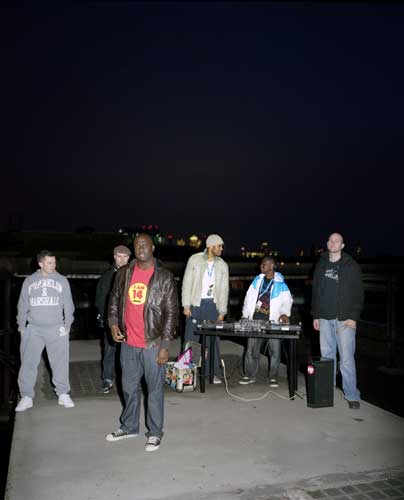
We're starting the weekend, let's roll. UK Funky taking over. This is the biggest underground station, Rinse FM, if you're a DJ or an MC and you're not on this station, keep trying!" It's Friday on Rinse FM, the unquestioned king of unlicensed radio in London, Britain, the world. "Big up the Sweden crew locked on," says MC Versatile, reaching out to the station's Scandinavian devotees, listening online to Rinse's drive-time show. "Big up Geeneus, big up Rat, easy Sarah, all Rinse family... let's go!"
A few days later, Geeneus steps into the lobby of the Hoxton Urban Lodge, a hotel in London's clubland. Sarah Lockhart is at his shoulder. Neither quite fits the image that the more conservative elements of the broadcasting industry like to paint of the controllers of pirate radio.
Geeneus founded Rinse in 1994 and has devoted his life to it ever since, underpinning the rise of a succession of dance-music genres, and playing a pivotal role in the social lives of a generation of Londoners. Lockhart, 34, has been working with him for the past five years after she quit her job at a major record company to dedicate herself to Rinse. Both talk about their station with a level of intensity and passion that I've never encountered in many years writing about the licensed radio sector.
Under the tutelage of Geeneus, who was 16 when he founded the station, Rinse has championed jungle, UK garage and grime, giving a first break to some of the most important British urban artists of the past decade, most notably Dizzee Rascal and Wiley. It is now the undisputed home of London's Dubstep and UK Funky scenes, and gives its support to Bassline house, a genre originating from Sheffield. Since Lockhart came on board, the station has expanded its footprint (now broadcasting beyond south-east London to parts of Essex). Rinse has also launched a range of branded CDs, each dedicated to one of its presenters. The station is linked to three respected London club nights and broadcasts around the world via its website, www.rinse.fm, while some listeners go straight to iTunes and download podcasts of their favourite Rinse DJs. It remains committed to broadcasting – illicitly – on 100.4FM.
There's just one thing missing, as Lockhart acknowledges: "I do not wish to be unlicensed. I would do anything to be licensed, whatever is necessary." Far from living in the shadows, she tries to maintain a dialogue with Ofcom, the broadcasting regulator. "I'm talking and having correspondence with them on a fortnightly basis," she says. "What we're saying is that we aren't going anywhere and you can't get rid of us, so shouldn't we be working with you to make our broadcasts as safe as possible? You're so stuck in a rut with your old-school mentality. You're sending a team of people out to look for me when I'm emailing you that I'm the person you can call at any point and tell me if there's a problem." Lockhart says Rinse has had its equipment confiscated "hundreds of times" over the years. The reasons why Ofcom will not grant Rinse a licence are partly technical, but boil down to the regulator's insistence that there isn't enough room on the FM dial for Rinse.
The station, Lockhart is also keen to confirm, is not after a licence so it can make money as a traditional commercial station. "I don't want a licence that means I can sell it – if you can't make the licence work you should give it back because there are a limited number of spaces on the FM dial. It's completely ridiculous that you can just sell it to somebody who turns it into another generic station."
Aside from Ofcom, she is in direct contact with "Scotland Yard commanders" who "acknowledge we are an important link" to difficult-to-reach youth groups, and Boris Johnson, the London mayor. "I reckon Boris ' would like Rinse; we could stop a lot of kids from killing each other. I did send him an email saying that if he really is interested in using the media that they actually listen to, he should give us a shout."
Geeneus leaves most of this talk to Sarah. His thoughts are dominated by the music. "I haven't spent one day in the past 14 years without doing something to do with Rinse. Rinse is like a life and I have to check everything and make sure it's eating, it's breathing," he says. The first thing he does when he wakes up is checks the Rinse output. When he hears something he really likes, he drives to the station's secret studio, just to be in the room. He is out and about across the capital almost every night, taking the pulse of the ever-evolving sound of the underground.
The scene in Brixton, south London, is his current focus. "It's at the very point where I can see it going somewhere else. At the minute they're calling it Dubbage. It's nice, like house but with more energy." He has spotted so many trends you wouldn't bet against him. "Most people will say the music comes from London, but we can break it down further. Like between Roman [Road, east London] and Isle of Dogs comes grime. Croydon is Dubstep. That's the very beginnings, d'you know what I mean?" He says he can pinpoint a grime rapper's locality by the style of his delivery, "I could break it down to Plaistow, Leyton, Hackney, Bow, straight away."

Enjoy unlimited access to 100 million ad-free songs and podcasts with Amazon Music
Sign up now for a 30-day free trial. Terms apply.
ADVERTISEMENT. If you sign up to this service we will earn commission. This revenue helps to fund journalism across The Independent.
Enjoy unlimited access to 100 million ad-free songs and podcasts with Amazon Music
Sign up now for a 30-day free trial. Terms apply.
ADVERTISEMENT. If you sign up to this service we will earn commission. This revenue helps to fund journalism across The Independent.
But Rinse is international now, thanks to the internet and the station is playing a role in exporting British creative culture. "It's cool," says Lockhart, "when you're driving along and you hear the DJ say 'Big up' to someone in Hackney and then 'Big up' to someone in Estonia, or Detroit, it sounds crazy."
They say that going straight wouldn't change the sound of Rinse. "If we had a licence," says Geeneus. "I'd say, 'Great, let's stick it on the wall and crack on.'" Lockhart puts it differently: "The point of what we're doing is we're doing pirate; licensed or unlicensed, the culture is pirate broadcasting."
This is a British tradition that did not end with the offshore radio station that inspired Richard Curtis's knockabout movie The Boat That Rocked. Pirate culture has endured despite the founding of BBC Radio 1 in 1967, which gave lawful employment to many pirate presenters. It survived, too, the introduction of commercial radio licences in 1973.
Legal radio has always struggled to keep pace with the ever-changing musical tastes of the biggest British cities. Among the best known of the 1980s pirates, which broadcast not from the sea but from inner-city tower blocks, was the Dread Broadcasting Corporation, set up in west London in 1981. Branding itself "rebel radio", it gave a platform to presenters such as Ranking Miss P (who would later join the BBC) and the soon-to-be singing star Neneh Cherry.
Pirate radio still felt "revolutionary" to Gordon Mac when he founded Kiss FM in London 1985. "Before, the pirates were playing pop and now all of a sudden it was dance music," he says. "I had some of the best times of my life running a pirate – though it wasn't as glamorous as everyone thinks."
Kiss gave a chance to such broadcasting talent as Judge Jules, Trevor Nelson and Tim Westwood, all now fixtures of the BBC schedules. The station's magazine programme was hosted by Ekow Eshun, now artistic director of the Institute of Contemporary Arts. As DJ Norman Jay points out, "In most places in the world you couldn't envisage running a pirate station," but in Britain it was part of the culture. "My peer group all graduated through the pirate platform and without it Radio 1 would have looked a different animal."
Kiss was so successful that the radio authorities decided to grant it a licence in 1990, hoping its new status might extinguish the demand for the flotilla of pirates that had brazenly hoisted their colours along the FM dial in London. "The authorities thought if it made that one legal all the others would come off air. But that wasn't the case," recalls Mac. Kiss was eventually sold to the media giant Emap (and is now owned by German company Bauer) and its mainstream, middle-of-the-road output bears little relation to its edgy origins. Yet today there are estimated to be more than 80 pirate stations still operating in London, with dozens more in other British cities.
Mac, who now presides over the legal station Colourful, thinks technology is about to sink the pirates. "In five or 10 years' time, when you can receive the internet in every car, there won't be any need for pirates or FM radio any more," he says. But Danny Blaze, a former pirate veteran who has now moved into artist management and DJing, says that some pirates are reluctant to switch to the web ("you have to put the telephone in another name and you have to get the right software"). Instead, pirate stations stay on FM, many using a series of computers and equipment taken from a TV satellite dish and a traffic light. A microwave link box – similar to that used in TV outside broadcasts – transmits to the aerial or rig, which will typically be many miles away from the studio on the roof of a tower block.
Matt Mason, a former pirate-radio DJ and author of The Pirate's Dilemma, which explains the influential role of pirate culture within the British creative industries in the pre- and post-digital eras, explains: "FM radio is still the easiest way to listen to pirates when driving around; it's easier to turn on your radio in the car than fire up the internet on your laptop."
There is also the thrill of something illicit. "There's something a bit naff about just being an internet station, whereas a pirate is a pirate. It's like if you are a graffiti artist, you don't want to be working on the wall designated by the council, you'd rather be doing a huge piece hanging upside down off a building somewhere," says Mason, who is now based in Brooklyn, New York, but still listens to Rinse.
Meanwhile, Rinse, as it seeks a community licence, still has to convince the authorities that it is something other than a money-making exercise. "When they interviewed me at Ofcom they said, 'Why do you want a licence?'" recalls Lockhart. "Because I love it – what do you think I'm doing it for? I like being in the radio industry, hearing broadcasts, seeing people DJ and how it makes them feel. They couldn't possibly believe it would be that, and that I don't do it to get advertising from British Gas."
The boat show: When Caroline ruled the waves
In the 1960s, "pirate" radio stations really did live up to their name. Due to a loophole in the legal system, stations were able to broadcast from international waters – in this case, ships in the North Sea – to listeners in Britain and Europe. Richard Curtis's latest comedy film, The Boat That Rocked, is about that era of pirate radio: it tells the story of an offshore station that conquered the airwaves, and stars Phillip Seymour Hoffman, Bill Nighy, Rhys Ifans and Kenneth Branagh.
Although fictionalised, the film is inspired by the story of Radio Caroline, which, in its heyday, commanded up to 23m listeners. Founded in 1964 by the Irish businessman Ronan O'Rahilly and wannabe politician Oliver Smedley, the station (which is named, bizarrely, after JFK's daughter) started broadcasting out of a former passenger ferry anchored off the coast of Suffolk. Chris Moore presented its first show – other DJs at the station included Tony Blackburn, as well as Johnnie Walker and Robbie Dale.
When Radio Caroline was launched, it had virtually no competitors, but within a couple of years, the North Sea was crammed with rivals, including Wonderful Radio London (where John Peel began his career), Britain Radio and Swinging Radio England. Radio Caroline, however, was the most successful of them all. In 1964, the station joined forces with Radio Atlanta and began broadcasting from two ships, which allowed them to cover most of the UK and much of western Europe.
In the summer of 1966, the station was set to merge with yet another rival, Radio City. Amid acrimonious circumstances, the deal fell through and a struggle ensued between Smedley and Radio City owner Reginald Calvert, during which the latter was shot dead. Smedley was acquitted of all charges on the grounds of self-defence.
A year later, the Government passed the Marine Broadcasting Offences Act, which made offshore radio stations illegal. Caroline briefly survived by moving to the Netherlands, but when ad revenues plummeted, its ships were seized as payment for unpaid bills.
Around that time, Radio 1 was born, providing employment for several pirate-station DJs, including Blackburn. Caroline eventually made a comeback (or two), and still broadcasts, albeit from legal, on-shore premises. Luiza Sauma
Join our commenting forum
Join thought-provoking conversations, follow other Independent readers and see their replies
Comments