Glastonbury: Coldplay and U2 almost spoil the party
The headliners split the crowds, but this year's Glastonbury showed that the Seventies dream lives on at Worthy Farm
This year's Glastonbury Festival was notable for weak headliners, rain, mud, baking sun and a sense that, in its 40th year, this unlikely survivor from days of hippie idealism is still true to itself: a vital, alternative place to escape to, leaving worries and restrictions at the gate.
U2's controversial headlining set on Friday proved the festival's unique requirements and possibilities, by falling so far short of them. The highly publicised protest at the band's decision to base their business in Holland, where it will be virtually untaxed, was invisible and soon forgotten, the campaigners' one inflatable banner quickly, and by some accounts too forcibly, removed.
Bono's struggles to engage in a show he clearly felt to be both important and very far from his stadium-rock comfort zone was far more fascinating. This seasoned star, who has played to far bigger crowds than even the Pyramid Stage, was nervous, his voice strained and weak throughout. On the a capella assault on "Jerusalem" which was his main attempt to reach out for some Glastonbury-shaped version of old Albion, he sounded desperately ragged, a man flailing towards a shore destined to stay out of reach.
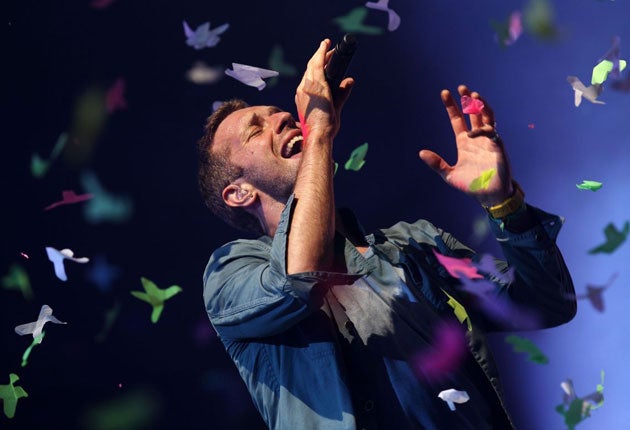
Disappointment was universal with everyone I spoke to. But so was the sense that U2's travails weren't of the slightest significance to anyone else's mood. Coldplay went down better on Saturday, though their bland platitudes and second-hand music made me want to retch, while Beyoncé's pumped-up, Hollywood superstar-style Sunday show was the most enjoyable of all; when she adopted her Sasha Fierce alter ego, her pounding drops to her knees and tossing of leonine tresses were mock-ferociously sexy, compensating for the mostly rotten songs.
The absence of a truly historic, heart-wrenching and unrepeatable headline set, such as Blur's reunion in 2009, which made Damon Albarn fall weeping on the floor, or Pulp's career-crowning 1990s performances, made 2011 a less than classic festival. Headliners were established, familiar pros, wheeled in to do a job. But such shows are only one high-profile marker of what happens at Glastonbury and not the most important.
The sense of scale of the 15-mile site, so overwhelming when you first arrive, and the sheer number of stages and performers, allows for drift and discovery. On the way to see Radiohead's "surprise" set at the faraway Park Stage (towards which half of Morrissey's crowd also seemed to be heading, to his apparent disgruntlement), I walked past the tiny Bandstand. Raghu Dixit, a star of Indian independent music almost unknown here, had just started an impromptu solo show. His own band had gone AWOL, it turned out, because they had earlier walked straight past the little, park-style stage, not believing that it could possibly be meant to play it.
The liberated energy of Dixit's performance was grasped by the hundred or so passing festival-goers who paused to listen and soon found themselves leaping and dancing with the irrepressible singer. When I arrived for Radiohead, their relaxed gig, drawn almost entirely from the last two albums, disappointed everyone I spoke to just as much as U2's. But I enjoyed its unpressured, contemplative nature, a million miles from career cares. Dixit and Thom Yorke's men were simultaneously benefiting from Glastonbury's freeing ambience and benign, curious crowds. It is the only rock festival with some of Womad's interest in musical investigation. Most people seemed up for anything good.
Jarvis Cocker wryly summed up the stupidity of attempts by the straighter world outside to interfere in the festival's running. Commenting on a police request to test Glastonbury's sewage for drug content, refused by Michael Eavis, Cocker wondered who exactly would get the job of rooting through the festival's notorious toilets. "And secondly," he said to cheers. "This is a field where people gather to have a good time. Just leave us alone. It's nobody's business."
The relatively tiny number of arrests in a suddenly assembled community of more than 100,000 proves that the fabled spirit of Glastonbury is self-regulating. Though a few utterly zonked drunks were stumbling through the Pyramid Stage's vast grass arena by Sunday's Beyoncé finale, most were being steered by patient friends. The lack of aggression in such a mass of often-inebriated Britons was a sort of miracle – and a tribute to Glastonbury's vast, improvised, successful society.

Enjoy unlimited access to 100 million ad-free songs and podcasts with Amazon Music
Sign up now for a 30-day free trial. Terms apply.
ADVERTISEMENT. If you sign up to this service we will earn commission. This revenue helps to fund journalism across The Independent.
Enjoy unlimited access to 100 million ad-free songs and podcasts with Amazon Music
Sign up now for a 30-day free trial. Terms apply.
ADVERTISEMENT. If you sign up to this service we will earn commission. This revenue helps to fund journalism across The Independent.
The weather was, predictably, one of the few restricting elements. Rain on Thursday and Friday, whipped in by the wind at times, left the site a swamp. Sunday's heatwave reduced people's energy in a different way, but the almost magical drying of previously impassable paths opened up the whole site to exploration.
I finally made it to the Fields of Avalon, where The Low Anthem were kicking up a storm of their own, enjoying themselves to an almost fevered extent in front of a small, devoted crowd. Their look of delight was one I saw on many musicians' faces over the weekend. Playing to this audience seems to be as special as being in it. A little further along, children leapt around a stage set aside for the public. I didn't quite get to the apparently debauched, illicit zone of Shangri-La, deeper still into Glastonbury's far borders.
There were times in my first couple of days there when I wondered whether the festival had lost its way; whether it was simply too big, too unmanageable and too resistant to the intimacy that can be had at smaller, more focused festivals such as Dorset's End of the Road. The huge, behind-the-scenes commercial deals (it took four days of diligent investigation to find a cider not brewed by Gaymer's) also mean it isn't quite the pure Utopia it seems superficially. But at its end I looked at the vast, dark fields, emptying with startling speed and carpeted with the debris of a retreating army.
I felt I was crossing the border of a country whose rules I was just starting to learn, which was ceasing to exist, like a stage-set or dream, as I turned my back. Michael Eavis should be knighted; or maybe just thanked.
Points of view: the hits and the misses
HITS
Elbow
When Guy Garvey sang "One Day Like This", the mutual affection with an elevated crowd as they sang along was this year's great Glastonbury moment.
Don McLean
The veteran singer-songwriter's take on "American Pie" on Sunday morning, with multiple extra choruses, was another heartwarming, communal high.
Pulp
The biggest crowd the Park Stage has ever seen, 30,000, turned up for Saturday's "surprise" guests (heavily rumoured all day), who responded with relaxed warmth and great songs.
Eels
Mark Everett's band of backwood, bearded oddballs smuggled profound affection for outsiders and losers into a soulful, funny, crowd-winning show.
The Low Anthem
Their second set of the weekend was at the obscure Avalon Stage, where they finished a long tour with a last exhilarating blast of atmospheric Americana.
MISSES
U2
Bono sang "Jerusalem" (badly), honestly trying to locate the spirit of Glastonbury. But their blustery, slick stadium music left the crowd cold.
Coldplay
Chris Martin and co went down much better as Saturday's headliners. But for me their songs remained too lightweight to truly move.
Janelle Monae
The former Outkast member can be an exhilarating singer-dancer, crossing James Brown, Prince and Fred Astaire. But her absurdly loud set's music signified disappointingly little.
The Wombats
UK indie at its most ordinary: bouncy, perky, eager to please, and utterly disposable – a makeweight in the Glastonbury bill.
Cage the Elephant
The Kentucky rockers really went for it, but singer Matthew Shultz's assiduous study of Jim Morrison's 1960s school of rock theatrics felt forced.
Join our commenting forum
Join thought-provoking conversations, follow other Independent readers and see their replies
Comments