How rock'n'roll stopped into a church...
Many US indie acts have a secret member – God. Nick Hasted sermonises on an obsession that runs from Jerry Lee Lewis to J Tillman, Cat Power and others
Just after midnight last summer, in a tent in Dorset's End of the Road Festival, a Biblically bearded Texan is talking to God. Josh T Pearson looks like a terrifying preacher, and as he comes to the climax of his song's violent guitar noise, his pleading look to the heavens is more than theatrics. This is a man who seems truly to be wrestling for his soul while playing rock'n'roll. It is as if nothing's changed since the August 1957 day in Sun Studios when Jerry Lee Lewis entered into impassioned theological debate over whether recording "Great Balls of Fire" would send him to hell.
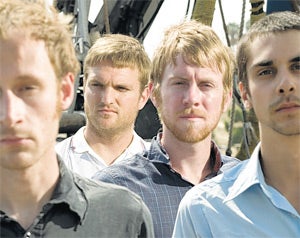
This may sound bizarre to most British rock fans. But look at the cream of current US indie musicians, and Christian backgrounds are often at the core of their work. Fleet Foxes' J Tillman, Conor Oberst, Cat Power, Sufjan Stevens, Cold War Kids, Micah P Hinson, Cage the Elephant, Mountain Goats, The Low Anthem's Ben Knox Miller and DM Stith are all current or painfully lapsed believers.
Not that their UK PR people want you to know. The instinctive hostility of our more secular country was summed up by the Independent on Sunday's Simon Price who, reviewing Cold War Kids, felt a "chill" as he wondered: "When singer Nathan Willett looks us in the collective eye, is it paranoid to wonder, does he want to entertain us, or save us?"
In the UK, rock songwriters, from Ray Davies to Alex Turner, have tended to find beauty in the prosaic and provincial. The minutiae of Saturday nights out seem a bottomless theme. But Jerry Lee Lewis's sense of his soul being at stake for singing rock'n'roll, Pearson and Cat Power's fraught upbringings by Southern preacher-men, or the way Conor Oberst's loss of faith in an after-life left him shattered, are crises in a language few of us speak. While most British indie bands thrash out home truths on Clash-style chords, grander forces are felt to be at work by their American peers. Compare Jamie T's earthy "Sheila" and Fleet Foxes' supernal "White Winter Hymnal". Both are fine, but a cosmos apart.
The lyrical stakes in Christian-rooted rock are higher, Mountain Goats' John Darnielle, a largely lapsed Catholic, believes. "This pass-key of The Bible and the church can open up doors to weighty themes," he says. "If I'm suffering in a Godless universe – which I am! – then my suffering is trivial, a drop in an endless ocean of it. But in a cosmology in which there's gravity to individual suffering, then that suffering is richer. The other thing is, it's a doorway out of the narcissism where you always write about yourself."
There's been no proselytising from any of these musicians. The evangelical Christianity George W Bush rode into the White House was savaged in Oberst's "When the President Talks to God". "Do they drink near beer and go play golf/ while they pick which countries to invade/ Which Muslim souls can still be saved?" he sang with disgust. Even in explicitly Biblical albums such as Sufjan Stevens' Seven Swans (2004), or Mountain Goats' The Life of the World to Come (2009), religion is a subtle layer. And when you listen to Darnielle's confronting of his step-father's violent abuse on The Sunset Tree (2005), or Stevens' playful exploration of Midwest history on Illinois (2005), Christianity is invisible.
Pained doubt, more than faith, animates this music. "Am I creating for myself? For a public? For God?" Sufjan Stevens agonised aloud to Stool Pigeon magazine last month. "Are all the sounds we create being consumed by a vacuum? These are probably juvenile existential questions – but I can't help it." Still, he was certain music was "mysterious and mystical": "an ecstatic form". His belief that he works in an ineffable medium is shared by J Tillman. "Music is such a large part of how religious people express and explore their faith, but it's also the most easily commodified art form," he told Uncut of his softly spiritual latest, Year in the Kingdom. "It [music] had too many answers for me. I like using Biblical imagery in an environment without answers. Most music is inherently mysterious."
Josh T Pearson's wracked self-doubt has stopped him releasing anything since his cult 2001 album with his band Lift to Experience, The Texas-Jerusalem Crossroads (though a new record is being readied). Speaking to me then, he gave a powerful account of how Christianity can become inseparable from thunderous rock. "People say, 'Are you influenced by Mogwai?'," he said. "But Pentecostal hymns were more important. I grew up with church services where singing, clapping, speaking in tongues would go on for hours, and would lift to epiphanic, ecstatic moments of trance, where all the players in the band would start playing chords randomly, the music would swell higher, and all the voices in the crowd would be singing their own tunes to God at the same time. The sense of apocalypse and wrestling with angels in our songs comes from that. Pentecostal preaching is all about transcending suffering in the end, and the only thing that brought me close to that escapist feeling was rock'n'roll, so I ran to it. The Southern black church is where rock'n'roll began."
It's the schism which rock and soul music tore in 1950s Southern churches – when Sam Cooke switched from gospel to soul, and Lewis roared, "Great balls of fire!" – which gave that primal wave of modern pop much of its atom-splitting force. Such explosiveness had no context here, where punk's faith in social rebellion replaced religion's extra-musical power. You can see the difference in the way Elvis made black gospel singers integral to his 1970s US tours' pan-American music, and the shifty, embarrassed use of a similar choir by Spiritualized's Jason Pierce in the UK. Even Britain's most broad-minded musician, Damon Albarn, who was "talking in spiritual terms" when making Blur's "Tender" with the London Community Gospel Choir, its producer William Orbit told me, frames his higher feelings in terms of the shipping forecast of "This Is A Low", not heaven or hell.

Enjoy unlimited access to 100 million ad-free songs and podcasts with Amazon Music
Sign up now for a 30-day free trial. Terms apply.
ADVERTISEMENT. If you sign up to this service we will earn commission. This revenue helps to fund journalism across The Independent.
Enjoy unlimited access to 100 million ad-free songs and podcasts with Amazon Music
Sign up now for a 30-day free trial. Terms apply.
ADVERTISEMENT. If you sign up to this service we will earn commission. This revenue helps to fund journalism across The Independent.
Darnielle sees the American Church's troubled history at the root of his nation's pop. "The black American Church is special in coming from slavery," he explains. "It was where a person whose life was being made unliveable could find hope. An utterly unique tradition, fortunately for the world. All the singers from the most important American music of the Sixties, Motown, came from that. The history of Southern church teaching is that you have to beat physicality back, but the 1950s raised in that a simple teenage question – why does it feel good, then? Jerry Lee's music embodies that struggle. Jerry Lee's your classic conflicted American, he's the body and the spirit."
Think of all that, and of Texas's evangelical Trinity Broadcasting Network, beaming its message right across Pearson's home state, and the reason so many hip young American musicians are Christian seems simple. It's the same reason pop acts such as Tennessee's Paramore or Diane Birch are quietly Christian, and the most nihilistic gangsta-rappers thank God in their album credits. Even Eminem leads a prayer circle before each gig. This ruggedly religious country produced monuments of battered faith such as Johnny Cash.
Even in America, the main fault of a strand of fine indie bands led by Grizzly Bear is making beautiful music that's rarely about anything more than itself. But Darnielle has a theory on why so many US indie intellectual misfits find Christianity fascinating. "I think it has to do with American literature," he says, "which has an aggressively spiritual tradition. Ground zero is Hawthorne and Melville grappling with questions about body and spirit. So what we receive as American songwriters of religion has less to do with a daily-life thing, than that, if you're a serious writer, you grow up thinking you're going to have to eventually think about God and spirit. The 20th-century European tradition is to assume that if you're a grown-up you've already decided that it's all nonsense. You begin with the assumption that we're past all that. The American tradition is to begin with the assumption that you can't get past anything. Faulkner has that great line: 'The past isn't dead. It's not even past.' And Faulkner's a huge writer for a lot of us."
This generation of indie singer-songwriters and bands are reaching for something bigger than themselves. You don't have to be religious to admire the transcendent, but always humbly human, results.
Join our commenting forum
Join thought-provoking conversations, follow other Independent readers and see their replies
Comments
Bookmark popover
Removed from bookmarks