Never mind the Buzzcocks: The re-emergence of Howard Devoto
He abandoned one of the great punk outfits to start the best band you've never heard of. And then he got an office job. Howard Devoto tells Simmy Richman why the time is finally right to reform Magazine
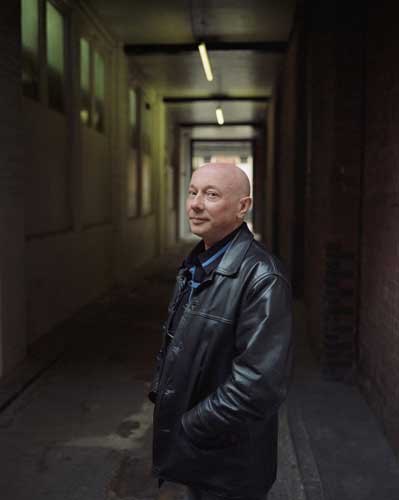
Looking back, it all seems awfully po-faced. It was not inapprop-riate in some ways, but these days I try not to look desperately earnest and solemn in photos." Howard Devoto, punk pioneer, post-punk progenitor and obscure figure of hero worship, is in a photographic studio in east London waiting for another round of close-ups in which he will do his best to look not the least bit intense.
But before we get ahead of ourselves, let's recap exactly why Devoto means so much to a select few. It is 1976 and Devoto (then Howard Trafford) and his student friend Pete McNeish see an article that will change their lives. The headline reads: "Don't look over your shoulder, the Sex Pistols are coming." Galvanised before hearing a note of music, Trafford borrows a friend's car and drives from Manchester to London to see the Pistols in action. Afterwards, he introduces himself to the band's manager Malcolm McLaren and books the group to play in Manchester. The show, on 4 June at the Lesser Free Trade Hall, is to have a profound effect on the handful of curious locals who see it. In the audience that night are Morrissey, Mick Hucknall, Ian Curtis, Tony Wilson (Factory Records) and Mark E Smith (the Fall).
In order to play on the same bill as the Pistols when they will return to Manchester six weeks later, Devoto and McNeish (now Pete Shelley) form the Buzzcocks. Within six months and with £500 borrowed from friends, they release "Spiral Scratch", the world's first independent (that is to say, without the support of a label) record. This short burst of activity in Devoto's life would leave its mark on popular culture for decades to come (see sidebar). So what was it in that Sex Pistols review that so captured his imagination? "It seemed an interesting bunch of elements: aggression, sexuality, the name of the group, that line 'We're not into music, we're into chaos' and the fact that they namechecked the Stooges.
"If you're thinking of forming a band, as me and Pete were, you're not going to pick the biggest thing going as your reference points. You'll rarely say, 'Yeah, the Beatles and David Bowie are really inspiring.' If you are a serious music fan, you want to discover the group with only five people going to see them. You like to have your little pet projects."
"Spiral Scratch" reached number 31 in the charts but, on the eve of its release, Devoto was off, bored with punk and seeking fresh challenges. Today, he can look back on such pivotal moments with the pride and detachment of an old soldier who has served his country well. "I have never regretted for a second leaving the Buzzcocks," he says. "It hoiked things up a few levels having a record that people liked and saw as pioneering, but I was concerned about my college course. I'd already fucked up a psychology degree and in my final year of humanities I didn't want to bottle out again. That, and the fact that I didn't really like punk any more; it had got aesthetically ugly."
Degree in the bag, Devoto would soon return to music with his new band, Magazine. Punk's three-minute bursts of anger and energy were replaced by something far more considered, complex and even cold. Adding a keyboard player to the guitar/bass/drums formula may not seem that radical in 2009, but back in 1978 it was tantamount to saying you wanted to be Emerson, Lake & Palmer. Yet the first three Magazine records (Real Life, Secondhand Daylight and The Correct Use of Soap) have not so much stood the test of time as improved with every passing year.
This week, for the first time in 28 years, Magazine will play together live for five shows. The reunion came about when Magazine's keyboard player, Dave Formula, wrote an email to Devoto under the heading: "Howard, it's your last chance to be venerable." Tickets for the London shows sold out within hours of the dates being announced.
Is Devoto daunted by the prospect? He considers the question by throwing his head back, furrowing his brow and emitting a loud "Errrrr" sound that he will employ whenever a question requires more than a cursory response: "The songs should sound fine and I'm enjoying stepping back into them more than I imagined. We haven't rehearsed as a full band yet and, inevitably, things will all change once everyone gets their own endocrine system going."
Can Devoto – whose lyrics specialise in a certain detached disdain (sample: "Got this bird's eye/ And it's in my brain/Clarity has reared/ Its ugly head again") – still connect with the words he wrote all that time ago? "Outside of the songs I'm a very different person, but inside them I'm a sort of mixture. I get a little bit of that 'Was that really me?' feeling and quite often it's a pleasant surprise. Having said that, at this stage one feels that the material has proved itself, so there are no worries on that front."

Enjoy unlimited access to 100 million ad-free songs and podcasts with Amazon Music
Sign up now for a 30-day free trial. Terms apply.
ADVERTISEMENT. If you sign up to this service we will earn commission. This revenue helps to fund journalism across The Independent.
Enjoy unlimited access to 100 million ad-free songs and podcasts with Amazon Music
Sign up now for a 30-day free trial. Terms apply.
ADVERTISEMENT. If you sign up to this service we will earn commission. This revenue helps to fund journalism across The Independent.
When Magazine split in 1981 (its musicians had been poached by Siouxsie and the Banshees and, weirdly, Visage, whose "Fade to Grey" would be a bigger chart hit than Magazine would ever experience), Devoto was in a dark place. Not only had his band – who created the template for post-punk music for the foreseeable future – fallen apart, but his father had died while Magazine were trying to crack America in 1980.
Devoto beat a slow retreat from the music industry, eventually getting a job at the Network photographic agency in London, where he would stay for 16 years. "It was a
completely different environment," he says. "It was a world of photographers who were like, 'So you're a musician. Big deal.' My role was quite administrative and it learnt me computers, for which I'm very grateful. It was a great relief just to have a regular buck, although the buck was not that big."
Did the death of his father affect him so profoundly because they were particularly close? "Errrrr, I was a rebellious teenager, but by 1979 I was trying to get closer to him. It's funny, for some reason I often end up talking about him, and I wouldn't want anybody to think I'm still hung up about him 30 years on. But it did have a big effect on me and it changed me quite a lot, which played its part in [guitarist] John McGeoch leaving the band."
When the Network agency closed down four years ago, Devoto – who is fond of describing himself as "fairly liquid" – returned to Yorkshire, where he had grown up. Now 56, and recently single ("Life's turned that way again; I suppose I am what you might call a serial monogamist"), he has gone back, he says, because "that's where I spent my teenage years and I still have family and friends there. My mother is still with us and she's making noises about wanting to come along to these shows. I told her that they are filming one of them and that she could watch that, bless her."
To add to the whole "poet in exile" mystique that has built up around Devoto, he has, for the past decade or more, been working on a spoken-word autobiography to be left to the National Sound Archive after his death. Ten chapters in, Devoto had barely reached the mid-1970s. When his "remembrance of things past" eventually reaches the Magazine reunion shows this week, there is one thing you can be sure Devoto will put on the record: that's the fact that he is doing this now because it is the right time and because he feels his band are owed more than they have ever been granted. "Look," he says, "I'm not doing this for the money. I live very modestly and I've never really chased the buck."
But, surely, after 16 years of clocking in and out it will be useful to pick up the kind of paycheck that comes only with the business of show? "Well, that's part of it, I suppose," he sighs. "Errrrr, it's enough that I shall say hello to the audiences very warmly."
Hopelessly Devoto: The enduring influence of Magazine
Colin Greenwood, Radiohead
"We all got excited at the end of recording Hail to the Thief because Nigel [Godrich, producer] was trying to get Jonny to play like [Magazine guitarist] John McGeoch. All the old farts in the band were in seventh heaven"
Paul Morley on Magazine's debut single 'Shot By Both Sides' ( NME, 1978)
"Hero, you come at last"
Morley on the Magazine reunion ( The Observer, 2008)
"I thought hell would freeze over before Magazine materialised again"
Momus from the song 'The Most Important Man Alive' (1998)
"Mr Devoto... it was you who taught me how to hammer out a manly turn of phrase/ You are, quite simply, the most important man alive/ I'd like to thank you for simply being in my life'
Morrissey on Magazine's split in the early 1980s
"Presently in mourning over the death of Magazine. So tragic. My life will change"
Morrissey in 1997
"In assessments of Manchester, they never mention Magazine. I don't know why. An excellent group, very strong..."
The Magazine reunion concerts begin this week in London, see www.wire-sound.com. A best-of compilation, 'Touch & Go', is released tomorrow on Virgin. 'Live and Intermittent', a collection of unreleased live recordings, is available from www.wire-sound.com
Join our commenting forum
Join thought-provoking conversations, follow other Independent readers and see their replies
Comments
Bookmark popover
Removed from bookmarks