The Skatalites - Ska legends
Sign up to Roisin O’Connor’s free weekly newsletter Now Hear This for the inside track on all things music
Get our Now Hear This email for free
Maybe she was late, maybe it was malice. As Marguerita Mahfood grabbed her sequinned dress and ran out of her flat, she left her boyfriend sleeping. She was “Rhumba Queen” of Jamaica, he was Don “Cosmic” Drummond, the erratic trombonist in the island’s first ever supergroup. That night Don missed his gig, and later, apoplectic and unmedicated, he put four stab wounds in her chest.
That morning, after Drummond was taken away, Lloyd Knibb, The Skatalites’ drummer, crept into the bloodstained apartment and grabbed all the music he could find. The group had hit a rich seam running up to that night, and Drummond’s last work still resonates in living rooms 41 years after he died in his asylum.
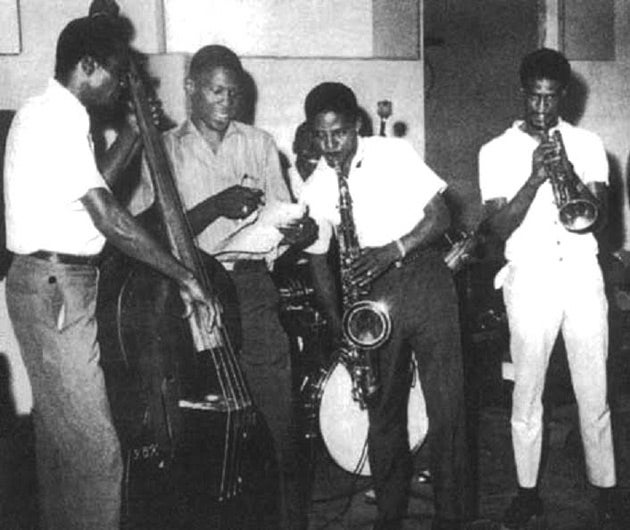
That night in 1964 put an end to The Skatalites. They had formed little over a year earlier, an impossible grouping, creaking under the weight of its talent and ego. Names like Roland Alphonso, Tommy McCook, Don Drummond and Lloyd Knibb rank high on the podiums of the Jamaican sound; to keep them together for that long was an achievement; what they recorded in that time is ska’s heirloom.
Today, two Grammy nominations, countless tribute bands and several reformations later, the group abides, although the egos are still there. “Back then it must have been another level, between the clashes, personalities and rude boys. With the stuff I’ve seen now, I can only imagine what it was like when they were all in their twenties. It must have been crazy. It has to do with the level of talent too – they say there’s a fine line between genius and insanity” says Ken Stewart, a Skatalites member for almost a quarter of a century.
The Skatalites invented ska. Without The Skatalites there would be no Bob Marley, no Clash, no MA-1 flight-jacketed mods and indeed no Madness [nobody’s perfect]. It is easy to identify ska’s source as the record industry in early sixties Kingston was run from only two or three studios.
“It could only have been them who invented the genre, because they were virtually the only ones doing that” says Stewart. However at the all-important World Fair of 1964, The Skatalites were overlooked in favour of the Byron Lee’s ersatz copycat ska, largely because as Jimmy Cliff says: “[Lee] didn’t smoke ganja like all the other musicians.”
Forget the cliché of 1960s ska musicians as dickie-bowed crooners, rockabilly aspirants for the charity gala. Several of the group wore fully-fledged Rastafarians – there was still an amusing tension between the jazz vibe of several of the group and the west African hue of the dreads in the Wareika settlements above Kingston - “Guys like Tommy [McCook] and Roland [Alphonso] would actually drag their horns up into the hills and play ska and jazz in the drumming circles. Drummond was the guy who instigated it” says Stewart.
Knibb, the drummer and recognised rhythm pioneer in ska [he claims to have invented the rhythm singlehandedly] was brought up playing two cans of condensed milk between his feet. He lived in Trenchtown, Kingston which in the 1940s was a hotbed of clandestine Rastafarian activism. He would later incorporate their buru drumming into the ska beat, and still drums for the group today.
The Skatalites also incorporated latin, jazz and rock ‘n roll into their sound. Their first album, Ska Authentic covered just about every song from a Mongo Santamaría album – and indeed McCook and Alphonso were born in Cuba. With McCook as band leader, the band took on a markedly jazz-based sound – McCook had been deeply affected by seeing John Coltrane in the US.

Enjoy unlimited access to 70 million ad-free songs and podcasts with Amazon Music
Sign up now for a 30-day free trial
Enjoy unlimited access to 70 million ad-free songs and podcasts with Amazon Music
Sign up now for a 30-day free trial
At dances however, the syncopated, springing ska beat was king, and could be remorseless. During a Skatalites dance in Falmouth, a local nurse danced herself to death, whilst a fringe member of the band, Dennis “Ska” Campbell, apparently ended up dying from the strain of marking every beat with a blast from his sax.
Another former member is bass player Lloyd Brevett, a committed Rastafarian who adopted a Knibb-like DIY attitude towards his instruments. Together with his father, he would go around and collect fine wire for the strings of the bass, before carefully waxing them and wrapping them in rough hemp. Once his father was playing a homemade bass and a string young Lloyd had attached began to unravel – a hiding was on its way for Brevett Jr.
The group today is as frenetic and has heralded in the ‘third wave of ska’ [the second being its take-up with the mods and skinheads in the 70s and 80s]. Recent London gigs have seen a queue of luminaries at the dressing room door, tells Stewart: “When we played at the Jazz Cafe we’ve had Desmond Dekker show up in the dressing room and then on stage, Courtney Pine, Gary Crosby – it’s like old home week.”
Skatalites tribute bands exist in virtually every European country, and even Japan [The Ska Flames] – always a follower of Jamaican music. Stewart is understandably aggrieved at being twice nominated then overlooked for the Grammys, in 1996 and 1997, although they triumphed vicariously after their spot on The Toots & the Maytals’ Grammy-winning True Love.
The tangled Skatalites story begins with one strand: Alpha School for Boys. This Catholic institution run by Sisters of Mercy nuns nurtured the talents of Don Drummond, Johnnie “Dizzy” Moore, Tommy McCook and Lester Sterling. The institution is famous in Jamaica and beyond for its reggae laureates, which include, other than the Skatalites boys, Desmond Dekker and Yellowman. The school was ostensibly for wayward boys - Moore apparently pulled pranks specifically to get in to the school and Drummond enrolled as his mother could “no longer tolerate his truancy”.
At school however Moore remembers Drummond as a peaceful boy forever buried in his music. Moore’s is perhaps the fitting epitaph to his brief, violent life: “He played trombone, but that’s how I remember him – sitting under the dibby-dibby tree studying that piano book for hours.”
The Skatalites play at Bloomsbury Ballroom, London tonight.
Subscribe to Independent Premium to bookmark this article
Want to bookmark your favourite articles and stories to read or reference later? Start your Independent Premium subscription today.
Join our commenting forum
Join thought-provoking conversations, follow other Independent readers and see their replies