Why the best rock docs bend the truth
The new Kings of Leon documentary is both strange and true. But, says Simon Hardeman, the best rock movies, from The Beatles to Bob Dylan, often play fast and loose with the facts
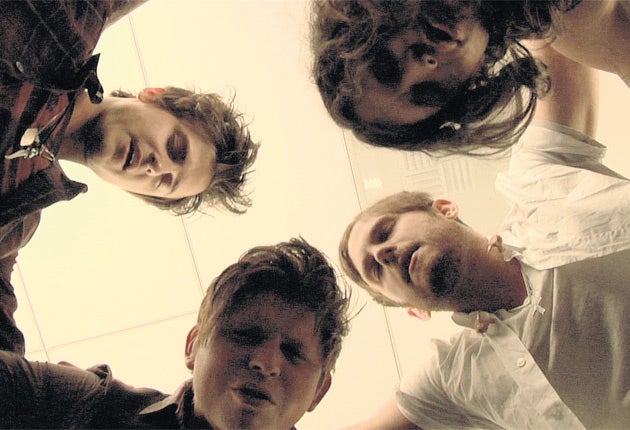
The Kings of Leon documentary, Talihina Sky, asks a key question about movies on pop stars: how real should they be? The film, which has been simulcasted on the internet and in cinemas, is the latest expression of a relationship between pop music and celluloid that goes back to the mid-1950s. In 1955, Blackboard Jungle used Bill Haley's "Rock Around the Clock" as its theme tune and, as teens danced in the aisle, producers realised the power of rock'n'roll to get youngsters past the box office, while musicians recognised that the silver screen would allow them to simultaneously perform their music to audiences from New York to Newcastle, night after night. Within months studio bosses had produced a fictionalised history of Haley (called Rock Around the Clock) that reportedly led to frenzies of cinema-seat-ripping.
Haley, by this time in his thirties, portly, with a brilliantined kiss-curl that was a sorry precursor to Elvis's priapic quiff, needed to be sexed up. Kings of Leon, by contrast, have a back-story that is so unlikely that their movie might simply be seen as a way of saying: "No, we really ARE that weird!" The children of a fundamentalist preacher who spent their early years bashing drums after his sermons across the Bible Belt, and whose home life is populated by characters even the Coen brothers would reject as unlikely, they are shown struggling with this hellfire-hick heritage in a way that is far too realistic for us to doubt their bona fides any longer.
Pop stars' lives promise to be fascinating in so many ways to both directors and audiences. In one respect these demigods have everything we all want – money, power, sex, success – but in another they can be infantile creatures full of pathos: enormous eggshell egos caught between creative heights and bathetic lows. Julien Temple, who has made films about the Sex Pistols, Madness, Doctor Feelgood, and many more, said of his film about the Clash's Joe Strummer: "...you [Strummer] are doing a deal with the devil and you have to live with that and you don't like it. That's part of why Joe is really interesting. On a bigger level, he [Joe] wrestled with that. And that's the drama of the film: that struggle with what you want and what you get."
The struggle with what you want and what you get is perhaps best illustrated in Sacha Gervasi's Anvil! The Story of Anvil. Here is a Canadian band who inspired the greats of modern heavy metal – Metallica, Anthrax, et al – but whose leader, "Lips" Kudlow, now packs school lunches while his soulmate and drummer, Robb Reiner, is a sandblaster. The film shows these Canadian fiftysomethings on what appears to be their last tilt at success, on a European tour that involves playing to 174 people in a 10,000-capacity arena in Transylvania, not getting paid when only seven people stay to see them arrive late in another venue, and missing their train as their barely intelligible, over-made-up tour manager spends her time getting off with the guitarist rather than booking tickets. Lips's sister then gives him £13,000 to make an album, but that founders when he and Reiner fall out like an old married couple. "How much love could one person put into something?!", Kudlow rails at one point.
Well, when it's the director, the answer is: a lot. Gervasi, a Hollywood scriptwriter by trade, was a long-time Anvil fan, and made the movie as a labour of love. "I hooked up with Lips again, 25 years after I first saw the band," he explained at the time. "It was really blind trust on their part... It was a huge favour to trust this kid, who they hadn't seen in 20 years, to make a film that he was saying was going to help them."
Many directors end up making music movies because they are fans like Gervasi. Along with Temple, perhaps Martin Scorsese is the most notable. Between Taxi Driver and Raging Bull he made 1978's The Last Waltz, often said to be the greatest concert movie ever made, about The Band's star-studded farewell gig, while his passion for the blues, Bob Dylan, and The Rolling Stones has led to a clutch of film and television shows; his documentary about George Harrison, Living in the Material World, is currently in post-production.
But Scorsese himself is ambivalent about how much his approach can reveal. Of his 2008 Rolling Stones concert movie, Shine a Light, he said: "I didn't do any interviews!... Forty years they've been shot on film... I mean, what more could you know from them? Except the music and the performance... This is something that I found inspiring. So I decided not to interview anybody."
And, of Scorsese's 2005 Dylan documentary, No Direction Home, the critic Roger Ebert said it creates "a portrait that is deep, sympathetic, perceptive and yet finally leaves Dylan shrouded in mystery." Perhaps this is why Todd Haynes's 2007 Dylan film, I'm Not There, chose a fictionalised approach, where six actors – including Cate Blanchett, Heath Ledger and Ben Whishaw – played "aspects" of the Zimm to explore him more effectively.
Indeed, unless they're making a concert film, the fictionalised approach has been the regular go-to format for directors. From The Great Rock'n'Roll Swindle on, Julien Temple has often used it, though the fiction has grown more subtle recently. His wonderful Oil City Confidential turns Dr Feelgood's bug-eyed guitar-chopper Wilko Johnson into such an unusual figure than he got a part in Game of Thrones on the back of it, while his Ray Davies documentary, Imaginary Man, turns the admittedly melancholy Davies into a kind of living ghost.

Enjoy unlimited access to 100 million ad-free songs and podcasts with Amazon Music
Sign up now for a 30-day free trial. Terms apply.
ADVERTISEMENT. If you sign up to this service we will earn commission. This revenue helps to fund journalism across The Independent.
Enjoy unlimited access to 100 million ad-free songs and podcasts with Amazon Music
Sign up now for a 30-day free trial. Terms apply.
ADVERTISEMENT. If you sign up to this service we will earn commission. This revenue helps to fund journalism across The Independent.
At its best, this fictional approach is a way of employing a coherent filmic narrative to show the truth of a band, and has worked from The Beatles in A Hard Day's Night through Slade in Flame to Eminem's 8 Mile. Indeed, it is curious how musicians who might be self-conscious playing themselves on film find it easy to play fictional musicians who they are as similar to as plectrums in a gig-bag.
Meanwhile, Talihina Sky has taken some flak for its lack of coherent structure and lazy egotism. Perhaps the Kings of Leon have missed a trick. Instead of telling the truth, they should have played a fictional band who rise from poverty-stricken religious fundamentalism, where children speak in tongues and barely literate relatives chase snakes, to discover sex, drugs, stylists and Kate Moss, while becoming the biggest band on the planet. Who then, obviously, go on to make a film about themselves...
Screen idols: six great rock films
Anvil: The Story of Anvil (2008)
A wonderfully touching, human, life-affirming account of a band who, if there were any justice, would be where Metallica are and vice-versa. (For a fascinating comparison, check out the hilarious 'Metallica: Some Kind of Monster'). The only one of these six films that doesn't feature fantastic music. But it doesn't matter.
A Hard Day's Night (The Beatles) (1964)
Exuberant, witty, full of hope and invention as well as peerless tunes, director Richard Lester and the Fab Four created a blueprint for Swinging-Sixties-ness which influenced TV, music, movies, and is still there in pop videos. They were born lever-pullers.
Gimme Shelter (The Rolling Stones) (1970)
The film that marks the death of the Sixties. When The Rolling Stones played free to 300,000 people at the Altamont Speedway in late 1969, they called on the Hells Angels to keep order. This fly-on-the-wall doc follows the organisation, actuality, and aftermath of that fatal mistake. If you wonder why Glastonbury is so numbingly corporate, the reason started here.
Slade in Flame (1975)
Forget the fluffy fantasy of 'Velvet Goldmine', this is the gritty reality of what led to glam-rock, as portrayed by the mega-selling, platform-booted quartet from Wolverhampton. Mark Kermode has called it "the 'Citizen Kane' of rock musicals". Gudbuy t'Rosebud.
Don't Look Back (Bob Dylan) (1967)
D A Pennebaker's 1967 document of Bob Dylan's 1965 tour of the UK shows the young singer-songwriter to be sharp, witty and combative – not least in his dealings with a 'Time' journalist but also, in my favourite moment, when Donovan plays Dylan a lightweight new song. Dylan responds with "It's All Over Now, Baby Blue". Ouch.
Hail! Hail! Rock'n'Roll (Chuck Berry) (1987)
The greatest rock'n'roll songwriter and pioneering guitarist had never, thought Keith Richards, had the band his music deserved. So the Rolling Stone put together the greatest back-up ever, with Eric Clapton, Robert Cray, Etta James, Bobby Keys, Linda Ronstadt and many more. Berry still wasn't satisfied.
Join our commenting forum
Join thought-provoking conversations, follow other Independent readers and see their replies
Comments