Love Music Hate Racism Carnival, Victoria Park, London
Another clash between rock and racism as Paul Simonon returns to the front line
Thirty years ago, The Clash were in Hackney’s Victoria Park, part of a concert which became a defining moment in Rock Against Racism’s successful stand against the National Front’s late Seventies spread.
The Clash’s Paul Simonon was back yesterday, alongside Damon Albarn in their band The Good, The Bad and The Queen, Hard-Fi and many more, to restate the case against fascism.
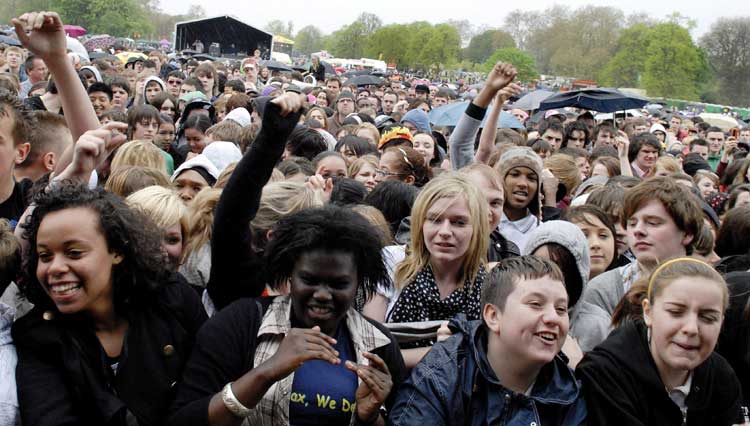
Persistent rain has probably kept the crowd below 1978’s 100,000. But the spirit in the park feels like a return to those times, as many thousands of Londoners of most races and ages mingle with Union representatives, Socialist Worker sellers, and socially committed pop stars.
This is Hard-Fi’s only festival. “It strikes us as the most important,” explains singer Richard Archer, shortly before “Suburban Knights”’ rallying cry stokes the mosh-pit. “Cash Machine” gives electronic ballast to their appropriately Clash-style guitar pop. The sentiment of “We Need Love” seems to embarrass the crowd, when they’re asked to join in; but it’s vulnerable idealism suits the day.
The Union leaders and politicians (Tony Benn and Ken Livingstone included) who speak between songs cause many to flee, but others to stand and cheer blunt anti-Nazi statements. Hearing reggae singer Natty describe cultural alienation over fat fairground organ in “No Place for I and I”, or Jay Sean interrupt his sweet-voiced R&B to proclaim his British Indianness, make such messages easier to swallow. The fact of a bill in which skinny indie bands such as The Paddingtons, a heaving dance tent and Roll Deep’s Wiley-featuring grime crew can co-exist, in the East End’s heart, is perhaps anti-fascist statement enough. The utter impossibility of the BNP raising such a crowd in London is suddenly glaring.
The ghosts of 1978 start to walk during a guest-heavy set organised by Babyshambles’ Drew McConnell. X-Ray Spex’s Poly Styrene bursts on for a joyful “Oh Bondage, Up Yours!” And though Sham 69’s Jimmy Pursey repeating his 1978 version of The Clash’s “White Riot” may have sent Joe Strummer spinning in his grave, it is well-received, and well-meant. The Guillemots’ Fyfe Dangerfield singing Springsteen’s “Dancing in the Dark” is less contentious.
Jerry Dammers, ex-leader of Britain’s greatest multi-racial group The Specials, who were inspired by Rock Against Racism, spins dub 45s, a Union leader invokes Paul Robeson and Woody Guthrie, and bright sun finally appears: all fine omens for The Good, The Bad and The Queen’s climactic set.
Paul Simonon saunters on like a spiv, with his pork pie hat and perfectly angled cigarette, looks out at the by now huge crowd, gives a short nod of approval, and says: “It’s good to be back.” Damon Albarn looks delighted to be with him. “Kingdom of Doom”, an Iraq-inspired “love song for the collaboration”, grows into a close, dubbed-up cousin of The Clash’s “London Calling”. Albarn’s alternately classical and cockney piano, rumbling bass, subtle strings and a guest Arabic rapper all add to the band’s frail folk songs for the capital. Dammers caps things by leading them and The Specials’ trombonist Rico in a spooked, heavy, hymn-like “Ghost Town”, surely his first performance of it in 20 years. London feels better to be in, as they leave.
Join our commenting forum
Join thought-provoking conversations, follow other Independent readers and see their replies
Comments