Endgame - Truth and reconciliation
The man who was a key player in bringing South Africa's bitter political rivals together tells Gerard Gilbert how a new TV drama captures the tension of the apartheid era
The Nelson Mandela 70th Birthday Tribute concert at Wembley Stadium on the 11th of June 1988 was one of the most influential of its kind – arguably more effective than Live Aid for being so tightly focused. But what the 70,000 revellers chanting along to Jerry Dammers's exultant protest song "Free Nelson Mandela" – or indeed the world-wide TV audience of 600 million – could not have known was that 100 miles away in deepest Somerset, secret talks had already started to find a peaceful exit from apartheid in South Africa.
These clandestine "talks about talks" had been the brainchild of Michael Young, an executive at the British mining company Consolidated Goldfields, who, with great personal bravery, put out feelers to both sides in South Africa. The result was that bitter enemies found themselves as fellow guests at a quintessential English stately home near Bath, Mells Park, partaking of structured talks during the day and tumblers of whisky by night, in what one of the participants later dubbed "Glenfiddich diplomacy".
What is extraordinary is that these vital discussions might have remained a hidden footnote to the history of apartheid had not David Aukin, head of drama at Mentorn productions and former head of Film on Four, had a chance encounter with Young. The meeting led Aukin to commission a script from the respected screenwriter Paula Milne (The Politician's Wife, The Virgin Queen), which was to become Endgame, a gripping Channel 4 drama starring William Hurt and Chiwetel Ejiofor as the lead negotiators.
"I felt one of the best ways of going in to it was as a political thriller," says Milne. " Michael Mann's The Insider was my sort of template, an intelligent thriller, which was very much about politics."
Endgame begins with a racy sequence in which Michael Young (played by Jonny Lee Miller) is smuggled into the South African townships to make contact with the ANC. Simultaneously, he must seek out out likely members of the Afrikaner intelligentsia. I asked the film's director, Pete Travis, whether Endgame had been given this Jason Bourne-style beginning because, once the talks themselves begin, Young somewhat disappears into the background of the story.
"Not at all; it's actually true. Michael secretly hid in the back of a car five or six times," says Travis. "Even his own company didn't know he was there."
Young himself is rueful about his youthful bravery. "You don't discount the danger, but I think you sublimate it when you're younger," he says, mindful of the fact that since only the chairman of Consolidated Goldfields (played in the film by Derek Jacobi) knew what he was doing, he could easily have been "disappeared" into the veld.
"My phone was tapped, and it was very clear I was being followed," he says. "I received phone calls telling me they knew what I was doing and I better watch my back. I was taught how to check under my car for booby-trap devices and so on."
But surely a company like Consolidated Goldfields had vested interests in maintaining the apartheid regime, not changing it? "Things were definitely going to change in South Africa and it was simply a matter of how long the incumbent regime could last," says Young. "My job at Goldfields was a strategic role, where I had to try and work out how our gold-mining house could remain in South Africa for the long haul. So my chairman agreed in principle that I should begin to forge links with the ANC in exile, just to see what they were like and what they wanted."

Watch Apple TV+ free for 7 day
New subscribers only. £9.99/mo. after free trial. Plan auto-renews until cancelled.
ADVERTISEMENT. If you sign up to this service we will earn commission. This revenue helps to fund journalism across The Independent.
Watch Apple TV+ free for 7 day
New subscribers only. £9.99/mo. after free trial. Plan auto-renews until cancelled.
ADVERTISEMENT. If you sign up to this service we will earn commission. This revenue helps to fund journalism across The Independent.
Young eventually managed to get the ANC, its team led by Thabo Mbeki, the future President of South Africa, and a delegation of Afrikaners (led by the respected academic Willie Esterhuyse) to a series of meetings at Mells Place in Somerset. These discussions are where Endgame could have become bogged down in "talkiness", but a combination of Milne's intelligent script and some top-notch casting means that the drama is rarely less than absorbing.
The film's British director, Pete Travis, brought William Hurt on board as Esterhuyse, having worked with the actor on Vantage Point, the recent hit political thriller in which Hurt played an assassin-stalked US President.
"When I told Channel 4 that William Hurt's going to do it everyone looked at me as if I was an idiot", says Travis. "We forged a really good relationship on Vantage Point and William said he would do anything for me, and he was as good as his word. He loved the script and really threw himself into the part."
The commitment included mastering the notoriously difficult Afrikans accent. "Some of the South African crew couldn't believe how he got it down to a tee," says Travis. "He brings huge pathos and dignity to the role, because in a way he's the bad guy – he's the racist who has to change; Now I've done it with him I couldn't imagine anybody else doing it. He imbues it with a huge emotional power."
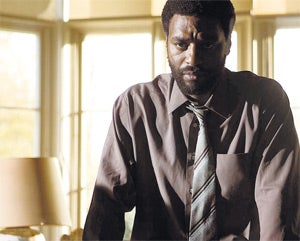
Indeed, in the actor's usual subcutaneous way, he does – and Hurt has an excellent foil in Chiwetel Ejiofor, who plays Thabo Mbeki, his ANC counterpart at the secret talks. Ejiofor, one of the great stage Othellos of recent times, matches Hurt's emotional intelligence stride for stride.
"Having William and Chiwetel against each other was really exciting," says Travis. "You've got an Oscar winner who's a kind of icon against the up and coming newcomer, someone who's equally good but at a different stage of his career. When they were in that room sparking off each other it was really electric."
Another clever piece of casting is Clarke Peters from The Wire as Nelson Mandela. Casting Mandela, I suggest to Travis, must be as tricky as finding the right actor to play the Queen. "It's actually a bit more tricky. Mandela must be one of the most famous men in the whole world.
"I'm a huge fan of The Wire and Clarke had what I was looking for – a dignity and a kind of stillness. There's just a huge dignity about Mandela that it's almost impossible for an actor to pull off but I think Clarke managed it really well."
Every thriller needs a baddie - and in Endgame that role is filled with suitably venomous menace by Mark Strong, the British actor who has made something of a speciality out of heavies since 2004's The Long Firm. Strong plays Dr Neil Barnard, the former head of South African intelligence.
"He's the guy who holds all the cards because he knows exactly what's going on both in Botha's government, while keeping an eye on Nelson Mandela as well as having a spy at the secret talks down in Somerset. He's pulling all the strings."
Strong says he was moved by filming in real locations in South Africa, including P W Botha's former office in the parliament building (Timothy West plays Botha), Pollsmoor Prison near Cape Town, where Mandela was held after his move from Robben Island, and the more luxurious gilded cage of Victor Verster Prison, where Mandela was held (and spied upon) until his release in 1990.
"It was an astonishing feeling", says Strong. "The furniture at Victor Verster is the furniture that was in there when Mandela was in there." Adds Pete Travis: "It's really quite eerie. There's an umbrella in the garden and you can still see the holes where the secret cameras were. And in the corner of Mandela's bedroom there's still a hole where another secret camera was. "
If some of the props in Endgame could belong in a museum, all concerned with making the drama are adamant that it is not a mere museum piece. "I didn't want to write a curiosity piece on history... a kind of side-show, significant though it may be," says Paula Milne. "I wanted to write something which would be inspiring for the future, to show what potentially could be achieved if two enemies can eschew bitterness and sit across a table from each other."
Indeed, the film ends with a series of captions that inform us how, when the IRA wanted to open negotiations with the British Government, it approached the ANC to see how it managed its own peace settlement. And now it seems Hamas has in turn approached the IRA for similar advice.
"It was kind of the captions at the end that made me want to do it," says Pete Travis, whose earlier credits include Omagh, the 2004 Channel 4 drama about the Omagh bombing. "When I was growing up it always felt that the Irish conflict was totally intractable and similarly as much as we campaigned for the end of apartheid, none of us thought it would actually end. It was the way in which a few brave people dared to stick their heads above the parapet and look their enemies in the eye and say 'shall we talk?' and secretly changed both of those conflicts."
'Endgame' is showing on 4 May at 9pm on Channel 4
Join our commenting forum
Join thought-provoking conversations, follow other Independent readers and see their replies
Comments
Bookmark popover
Removed from bookmarks