Carbon cuts 'only give 50/50 chance of saving planet'
As states negotiate Kyoto's successor, simulations show catastrophe just years away
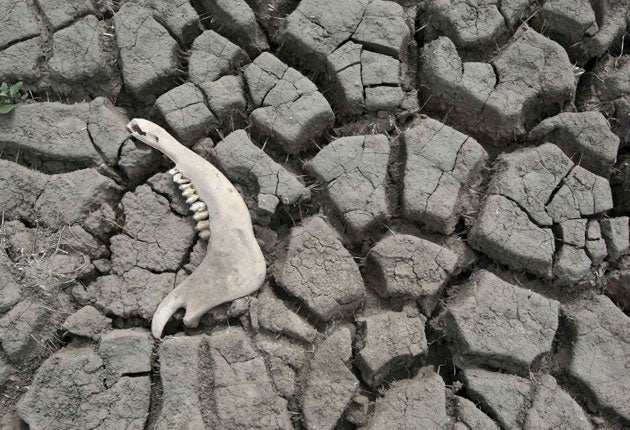
The world's best efforts at combating climate change are likely to offer no more than a 50-50 chance of keeping temperature rises below the threshold of disaster, according to research from the UK Met Office.
The key aim of holding the expected increase to 2C, beyond which damage to the natural world and to human society is likely to be catastrophic, is far from assured, the research suggests, even if all countries engage forthwith in a radical and enormous crash programme to slash greenhouse gas emissions – something which itself is by no means guaranteed.
The chilling forecast from the supercomputer climate model of the Met Office's Hadley Centre for Climate Prediction and Research will provide a sobering wake-up call for governments around the world, who will begin formally negotiating three weeks today the new international treaty on tackling global warming, which is due to be signed in Copenhagen in December.
The treaty, which is due to replace the 1997 Kyoto Protocol, is widely seen as the Last Chance Saloon for the community of nations to take effective action against the greatest threat the world has ever faced. But the Met Office's new prediction hits directly at the principle guiding all those hoping for an effective agreement, with the European Union in the lead: that of stopping the warming at two degrees Centigrade above the "pre-industrial" level (the level of average world temperature pertaining two hundred years ago).
Today, world average temperatures stand at about 0.75C above the pre-industrial, and many scientists and politicians agree that further increases have to be stopped at 2C if catastrophic impacts from the warming are to be avoided, ranging from widespread agricultural failure and worldwide sea level rise, to countless species extinctions and irreversible melting of the world's great ice sheets.
But the Hadley Centre's simulation indicates that even if global emissions of carbon dioxide, the main greenhouse gas causing the warming, were to be slashed at a very high rate the chances of holding the rise at the C threshold are no better than even. The scenario, prepared for Britain's Climate Change Committee, the body recommending the UK's future carbon "budgets", visualises world CO2 emissions peaking in 2015, and then falling at a top rate of 3 per cent a year, to reach emissions of 50 per cent below 1990 levels by 2050.
At the moment, global emissions are thought to be rising at nearly 3 per cent a year – so turning that into a 3 per cent annual cut would be a gigantic slashing of what the earth's factories and motor vehicles are pumping into the atmosphere. There is as yet nothing remotely like that on the table for potential agreement in Copenhagen, and if a deal of this ambition were to be done, it would be regarded as a triumph.
Yet even with that, the Hadley Centre research suggests, the chances of keeping the rise down to about 2C by 2100 would be only 50-50. Furthermore, the simulations suggest that there is a worst-case scenario – about a 10 per cent chance – of the rise by the end of the current century reaching, even with these drastic cuts, a level of 2.8C above the pre-industrial, which is well into disaster territory.
With any action that is slower than the scenario above, the likeliest outcome is a much higher eventual temperature – and in fact, the model indicates that each 10 years of delay in halting the rise in global emissions adds another 0.5C to the likeliest end-of-the-century figure. So if emissions do not peak and start to decline until 2025, we can expect a 2.6C rise by 2100, and if the decline only begins in 2035, the figure is likely to be 3.1C – even with 3 per cent annual cuts.
These new figures suggest quite unambiguously that the world is on course for calamity unless rapid action can be taken which is far more drastic than any politicians are so far contemplating – never mind the general public.
If action is sluggish or non-existent, the model suggests that climate change is likely to cause almost unthinkable damage to the world; under a "business-as-usual" scenario, with no action taken at all and emissions increasing by more than 100 per cent by 2050, the end-of-the-century rise in global average temperatures is likely to be 5.5C, with a worst-case outcome of 7.1C – which would make much of life on earth impossible. "Even with drastic cuts in emissions in the next 10 years, our results project that there will only be a 50 per cent chance of keeping global temperatures rises below 2C," said Dr Vicky Pope, the Met Office's Head of Climate Change Advice.
"This idealised emissions scenario is based on emissions peaking in 2015 and changing from an increase of 2-3 per cent per year to a decrease of 3 per cent per year. For every 10 years we delay this action another 0.5C will be added to the most likely temperature rise. If the world fails to make the required reductions, it will be faced with adapting not just to a 2C rise in temperature but to 4C or more by the end of the century."
Join our commenting forum
Join thought-provoking conversations, follow other Independent readers and see their replies
Comments
Bookmark popover
Removed from bookmarks