'Only 50/50' chance that 2C climate target will be met
Limiting the global temperature rise will require a huge effort
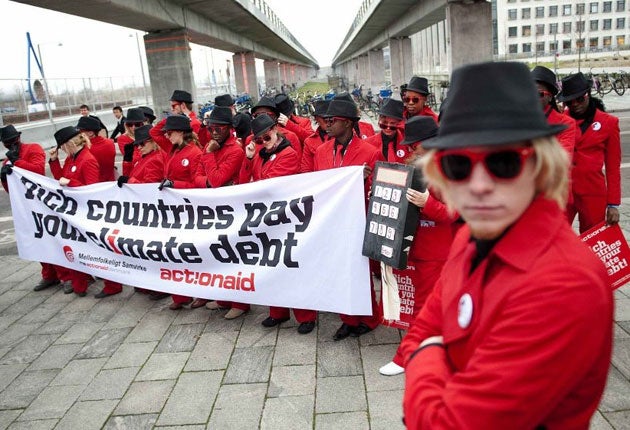
Keeping the global temperature rise caused by climate change to C, which is widely regarded as the limit of what the Earth can safely stand, is going to be extremely difficult and will involve an enormous effort by the world, new research by British scientists indicates.
The C target, first proposed by the European Union in 1996 and now seen as a norm, is likely to be adopted by the international community as a whole next week at the end of the UN climate conference in Copenhagen.
But the new study, unveiled at the conference yesterday, shows that hitting the target is crucially dependent on the year in which global emissions of greenhouse gases peak, and the later the peak, the more drastic the emissions cuts will have to be.
Furthermore, even the earliest potential peaking date now offers only a 50/50 chance of staying below the C threshold, the study suggests.
The C figure refers to the rise above the global average temperature before the Industrial Revolution, when large-scale burning of fossil fuels began to produce big emissions of greenhouse gases.
The global temperature currently stands at about 0.75C above the pre-Industrial level, and the carbon dioxide already in the atmosphere is thought to have committed the world to a further rise of about 0.6C – so there is only just over half a degree left before C is hit.
Keeping the world to that level, although technically possible, will be "very challenging", the lead author of the new research, Dr Jason Lowe of the Met Office's Hadley Centre for Climate Prediction and Research, said yesterday.
The findings are from a new government-sponsored research project entitled Avoid, involving several scientific institutions and focusing on the emissions pathways necessary to keep control of the expected temperature rise.
It shows that if the world's carbon emissions as a whole were to peak and start to decline in 2016 – which many observers consider highly unlikely – it would be necessary to cut them back by at least 4 per cent a year to have a 50/50 chance of staying below the danger threshold.
The world's emissions surged after 2000, largely as a result of the exploding industrialisation of China, and before the recession they were thought to have been running at about 3 per cent a year.
The economic downturn will have lessened the rate but it is likely to shoot back up when the world economy recovers.
Turning a 3 per cent annual rise in CO2 emissions into a 4 per cent annual decline is an enormous task and one not currently envisaged by the potential Copenhagen agreement to be signed next week, which would allow China (the world's biggest emitter) and other big rapidly industrialising countries such as India to carry on increasing their emissions (although their rate of growth would slow).
But that is only the best-case scenario envisaged in the research. The rate of decline would have to be even steeper with a later peak, say 2020 – which has been suggested as a target by Britain's Energy and Climate Change Secretary, Ed Miliband, and which is mentioned in a draft of the Copenhagen agreement (although in square brackets, which means it has not yet been generally agreed).
A 2020 peak would mean cutting emissions at 5 per cent a year to have a 50 per cent chance of staying at C, the Avoid research suggests.
This is not only an even bigger demand for the world – but the 2020 peak itself is far from certain. Earlier this week, Professor Kevin Anderson, one of the world's leading experts on CO2 emissions rates, wrote in The Independent that his analysis of "what was on the table" at Copenhagen indicated a global peak some time between 2020 and 2030.
The research suggests that the emissions reduction rates required after a peak later than 2020 "may be beyond economic and technological feasibility".
Does this mean that keeping to C is now, in practical terms, impossible? Dr Lowe said: "None of the climate modelling I have seen has an easy answer to the question of limiting temperature rise to C. There are pathways which lead to it, but in terms of the timing and rates of emissions reductions, these pathways are very challenging."
Join our commenting forum
Join thought-provoking conversations, follow other Independent readers and see their replies
Comments
Bookmark popover
Removed from bookmarks