Waste not... Britain is lagging behind other countries in renewable sources
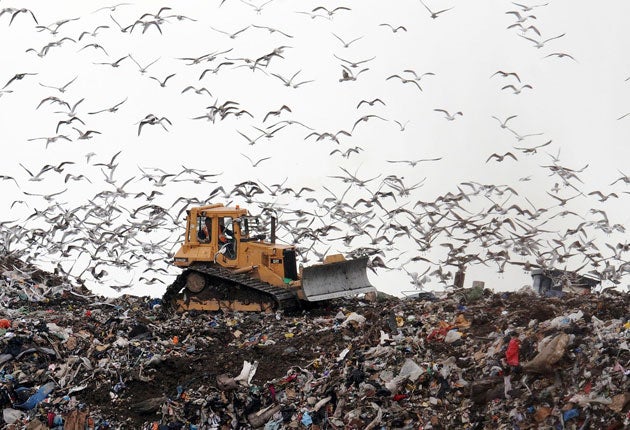
One of the most promising solutions to the UK's mounting waste problems is under threat after the Government set the price it will pay for electricity generated from organic waste too low, green campaigners claimed yesterday.
Farmers are aborting plans to build anaerobic digestion plants to convert animal slurries, manure and rotting vegetables into energy after the Government's climate change department made the proposed plants commercially unviable, according to the Renewable Energy Association (REA), which represents the industry.
The setback comes on the eve of a major "Energy Into Waste" conference taking place in London this week and raises question marks over the Government's commitment to increase the proportion of electricity from renewable sources from 5.5 per cent to 30 per cent by 2020.
David Collins, the REA's expert on anaerobic digestion, said: "All the momentum has been knocked out of the system. There just won't be any plants built unless they are supported commercially... [but] the new tariffs are not high enough to support any of the small plants."
A separate government department had hoped Britain could build 1,000 anaerobic digestion plants by 2020, but this target now looks unlikely to be met, campaigners added.
"It's a complete mess," said Jonathan Scurlock, the National Farmers' Union's chief adviser on renewable energy and climate change. There are only about 30 anaerobic digestion plants in Britain, compared with more than 4,000 in Germany. The Department for Energy and Climate Change (DECC) intends to pay 11.5p per kWh up to 500kWh, but the REA said farmers needed at least double that to generate a commercial return on their investment.
Hergen Haye, DECC's director of heat policy, will attempt to allay public concerns about energy from waste plants when he addresses this week's conference. Many people are opposed to the idea of having waste incinerators with the subsequent problems of toxic gas and emissions.
Britain lags behind other European countries such as France and Germany when it comes to turning waste into energy. But technological advances in anaerobic digestion and gasification are fuelling a surge in developing new plants. Major companies, including Tesco, British Airways and Sainbury's, are also backing the drive. Waitrose yesterday unveiled plans to extend an initiative to turn food waste into electricity to more than half of its 222 stores by May.
Here, The Independent on Sunday brings you its guide to the more innovative ways of generating waste from energy, compiled with help from Ines Freesen, managing director of Freesen & Partner, a German environmental consultancy.
* Incinerating waste to generate power, heat and steam has long set the gold standard when it comes to getting energy from waste. Despite a poor public image – residents fret about what's in the smoke – stricter emission controls exist for modern waste incineration plants than conventional power plants. In Lerwick, in the Shetland Isles, Shetland Heat Energy and Power burns domestic and commercial waste from Shetland and the offshore oil industry to heat about 1,000 homes and businesses.
* Biomass power plants, which generate power, heat and steam from waste wood, are becoming popular and use similar technology to waste incineration. The less "contaminated" the waste wood is by varnish or paint, the more efficient the process. Slough Heat and Power uses waste wood to create much of the energy used on Slough Trading Estate, mostly by the chocolate giant Mars. In a virtuous circle, the site's tenants send their waste wood, packaging and cardboard to the plant.
* Anaerobic digestion could hardly be neater: composting biodegradable waste – anything from food to agricultural byproducts – in the absence of oxygen produces a biogas that can generate electricity and heat. Now the UK just needs to build more sites. A lot more sites. A recent one is at Orchard House Foods, a fruit juice supplier in Corby, Northamptonshire. Its anaerobic digestion plant, built by BioWayste, turns its 146,000 tons of annual food waste into enough energy to meet half of its yearly energy needs.
* Hydrothermal carbonisation is all about making "green coal". Think of it as a form of steam cooking. The process requires agricultural waste, from wet grass to sewage sludge, to be "cooked" in an oxygen-deprived pressure cooker. The upshot is carbon-rich black powder, which can be converted into fuel cells or gasoline. Europe's large-scale pilot plant will open this May in Germany.
* Turning landfill gas into energy is another old waste-to-energy favourite. It's popular in the US, where landfills are particularly massive. All 60,000 tons of domestic and commercial residual waste produced on the Isle of Man gets turned into energy, producing 10 per cent of the island's electricity for its 80,000 residents.
* Some plants run on just one type of rubbish, so-called "mono-plants", which use refuse-derived fuel. These make sense for larger industrial sites that have waste streams they want to deal with themselves while generating energy to fuel their own facilities. One plant, in Thetford, Norfolk, runs entirely on chicken litter, generating 38.5MW from the 420,000 tons of poultry poop it consumes each year.
* The cement industry is burning household debris, sewage sludge, plastic waste and old tyres to power its kilns. This "co-incineration" process has environmental and economic pluses, which the cement giant Cemex is putting into practice. It is producing 150,000 tons a year of its own refuse-derived fuel, called Climafuel, which it is using at both of its UK cement plants.
* Crank up the heat and you get pyrolysis and gasification, two other thermal treatment options for waste. They differ mainly in the ferocity of the furnace: pyrolysis is a chemical decomposition of waste at around 200-300C, while gasification needs the temperature to be about 700C. Both create a syngas, which is similar to biogas and can be used to generate power, heat or vehicle fuel, with both processes leaving a solid residue that is rich in carbon. British Airways last week unveiled plans to establish a waste-fuelled gasification plant in east London that will turn 500,000 tons of landfill waste into 16 million gallons of sustainable jet fuel, enough to power all of its flights from London City Airport twice over.
* Although biofuels have – understandably – had a bad press, biodiesel and ethanol can also be made from waste materials. As technologies go in Europe, where taxes and a lack of financial incentives have made it difficult for biofuels to establish a stronghold, this is still pretty nascent. But the bus company Stagecoach uses recycled chip fat to power some of its vehicles in Kilmarnock and Cambridge. Argent Energy supplies the fuel, which it makes from waste cooking oil from industrial users and tallow from rendered animal products.
* Mechanical-biological treatment of waste is perhaps the most controversial. It's a pre-treatment, which leaves large quantities of residues that need to be landfilled or incinerated. But Shanks has several treatment facilities, including in Jenkins Lane, Newham, and at Frog Island, on the Thames, which use the heat generated during biological degradation to dry out municipal solid waste. Fuel is produced from the dried-out material.
Join our commenting forum
Join thought-provoking conversations, follow other Independent readers and see their replies
Comments