Bird symbolising true love fading from the skies
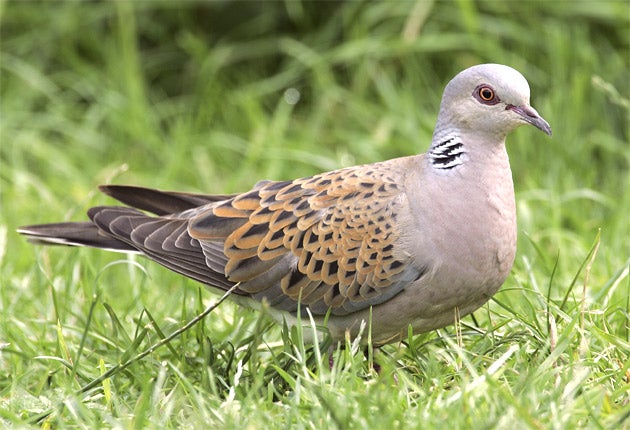
It is the emblematic bird of sexual fidelity – and just like sexual fidelity itself, it is rapidly on the wane.
The turtle dove, famed in folklore and literature as the creature which is always constant to its mate, seems to be on the high road to extinction in Britain, having dropped in numbers by 88 per cent since 1970.
Known once just as the turtle (from the French tourtourelle), for both Chaucer and Shakespeare it was the bird which symbolised true love.
In his dream-poem The Parliament of Fowls, Chaucer gives the male bird a passionate speech in which he says that if his lady died, he would take no other mate. In several of his plays, Shakespeare's characters compare themselves to "turtles" when proclaiming their fidelity.
In fact, the bird remained a symbol of sexual constancy through the Yuletide carol The Twelve Days of Christmas right up to 1960s pop songs.
But just as fidelity is not what it used to be, so turtle doves are vanishing fast, and have gone from much of Britain, including Wales and Scotland. Now, however, conservationists are asking farmers to help in a major research project to find out the reasons for the birds' precipitous decline.
The problem seems to be the disappearance of the wild flowers of our cornfields, whose seeds are the major source of food for the birds when they come to Britain to breed, having spend the winter in Africa. Most migrant birds are insect-feeders and the turtle dove is unusual in being a seed-eater.
The principal seeds it has depended on in the past have been those of fumitory, a low-growing wild flower of crop fields, but intensive farming has done away with fumitory as it has killed off many other arable "weeds". It appears there is no longer enough food for the birds to get themselves into prime breeding condition, so instead of raising perhaps three broods of chicks, as in the past, today they may be raising only one.
Now the Royal Society for the Protection of Birds and Natural England, the Government's wildlife agency, are joining forces in a research project to see if the birds' numbers can be brought back up by sowing plots of seed-rich crops on farms across East Anglia. They need a total of 16 farms for the project, and have already recruited three.
"We are asking farmers to help us carry out the vital scientific research needed to ensure these birds don't disappear from our countryside for good," said Jenny Dunn, a RSPB conservation scientist.
"The participating farmers will get the chance to make a real difference for farmland wildlife. We will be planting trial plots with a mix of seed rich plants like fumitory, clover and vetch, and analysing the feeding habits and breeding attempts of local turtle doves over a three-year period.
"We are hoping this research will help create a new option in agri-environment stewardship schemes which will be taken up by farmers across the country."
One farm already on board with the project is the family-run 1,400-acre Lodge Farm in Westhorpe, Suffolk. Patrick and Brian Barker, who are cousins, run the farm and are passionate about the wildlife on their land. They have worked hard to restore ponds and hedgerows, create a grassland corridor, record farmland bird populations and protect a colony of rare great crested newts.
"Turtle doves have been breeding here for the last couple of years and we have ringed five individuals this year," said Patrick. "It's great to see the RSPB involving farmers in a project which will benefit an important farmland bird species. I hope we can do our bit to help reverse the decline in turtle doves and bring them back to our countryside."
Turtle doves in print
Turtle doves have been written about for 3,000 years, since the writer of the Bible's Song of Solomon celebrated their call announcing the spring: "For, lo, the winter is past, the rain is over and gone; the flowers appear on the earth; the time of the singing of birds is come, and the voice of the turtle is heard in our land."
Join our commenting forum
Join thought-provoking conversations, follow other Independent readers and see their replies
Comments
Bookmark popover
Removed from bookmarks