Far from the sea, urban seagulls terrorise skies
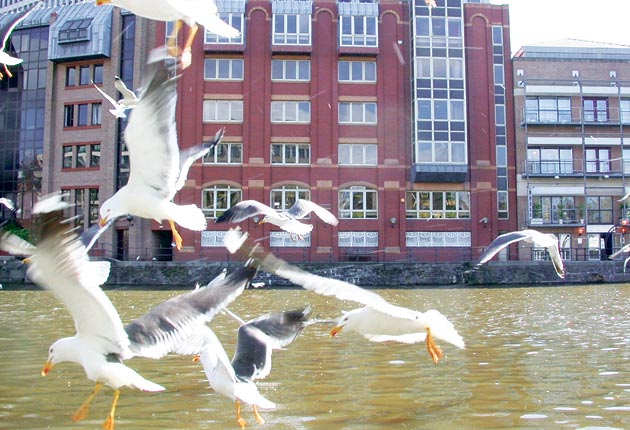
Britain's population of urban seagulls, the source of increasing complaints about dirt, health threats, noise and attacks on people, is now rising so fast that it may reach one million birds by 2020 if concerted action is not taken to manage the problem.
The national population is likely to be "substantially over 100,000 pairs" or 200,000 individuals, according to the leading expert on urban gulls, Peter Rock, an adviser to a string of councils in the South-west which are blighted by the urban gull invasion, among them Bristol, Bath and Gloucester.
The Government, however, has long claimed that there are only about 30,000 pairs – and has just turned down funding for the first serious research project on the ecology of urban gulls, which would seek to understand why their numbers seem to be exploding.
But pressure is mounting on the Government to recognise that what in the past has been seen as little more than a joke has become a serious environmental concern.
The phenomenon of the big urban gull colony is fairly recent: populations in towns and cities began to grow noticeably only in the early 1990s, mostly of herring gulls and their close relatives, lesser black-backed gulls.
But what is not understood is why urban gulls are flourishing, while herring gulls in the wild, in colonies in the countryside, and on the coastline, are in steep decline, and have been placed on the "Red List" of threatened species.
Don Foster, the Liberal Democrat MP for Bath, a city which now has nearly 1,000 pairs of the birds nesting on its rooftops after their population doubled in six years, said yesterday: "The fact that no research is going to be done on this is more than daft, it's barking mad. It still appears that unless you've actually experienced the problem, as have many towns and cities now, you sort of think it's a bit of a joke.
"But when you start to see the level of damage these gulls are causing to buildings and the environment generally, you realise that it's a really serious issue."
Mr Foster is one of two MPs who have formally raised the issue of urban gulls with the Government via adjournment debates in the House of Commons in the past 18 months, as concern has grown.
In April 2009, he told MPs that the birds caused "significant problems to many people, and cost individuals, businesses and local councils a great deal of money". And he went on to paint a picture of "faeces deposited on tables, chairs and other furniture outside catering premises, creating a health hazard; stone pavements and steps rendered slippery by freshly deposited faeces, creating safety hazards; aggression towards pedestrians in public spaces and gardens, which is extremely frightening; and the pecking-open of refuse sacks, which leaves debris and encourages other vermin, creating further health problems."
In February this year, Parmjit Dhanda, then the MP for Gloucester, a town whose urban gull population doubled in five years and which now has 2,800 pairs nesting on its rooftops, raised exactly the same concerns in another adjournment debate. But although government representatives made sympathetic noises in both cases, they declined the MPs' principal request, which was for scientific research into the gulls' rapidly rising numbers.
Mr Foster said: "In Bath we've currently got 980 breeding pairs, so with other non-breeding adults we've got about 2,500 gulls in the city. We're seeing more and more of them, but we don't know enough about urban gulls and what attracts them, and we need research to find out."
The research proposal which was turned down was for a three-year investigation into why urban gulls are flourishing. It has been rejected for funding by the Natural Environment Research Council. Due to take part in it was Peter Rock, who is now recognised by numerous local councils as the leading expert on urban gulls.
He said: "It's a bitter blow that this application failed, but our disappointment is overshadowed by the dashed hopes of those who live or work in urban gull colonies and of those who have been calling for solutions for years. We know virtually nothing about the ecology of urban gulls, but until we understand what we're dealing with, we're in no position to recommend various forms of management."
The official figure for urban gulls is 31,000 pairs, but this comes from the last national seabird count, Seabird 2000, which took place a decade ago. Mr Rock thinks that this was a substantial underestimate at the time, and has now greatly risen, and arrives at his figure of a million pairs by 2020 by extrapolating the rates of increase which he is seeing in the colonies he is studying.
The scientist who co-ordinated Seabird 2000, Dr Ian Mitchell, said there was no scientific basis for the extrapolation Mr Rock was making, but he accepted that the current size of the urban gull population was simply not known.
Graham Madge, a spokesman for the Royal Society for the Protection of Birds, said that while urban gull populations were growing, the coastline colonies were in decline: "It is beyond doubt that the numbers of roof-nesting gulls have increased, but we believe that this rise does not offset the dramatic losses we have seen from the overall UK population, which has halved since the 1970s."
Case Study: 'They make awful noise and clog up our gutters'
The problems urban gulls are causing some householders are well illustrated by the case of Geoffrey, a retired publisher in Edinburgh. Geoffrey has lived in the same street of Victorian houses for 30 years and never seen gulls as an issue – "I love all God's creatures" – but then they started nesting locally and problems began. "They make an awful noise," he said. "In summer, it's like living next to an African lake with sounds all around you, day and night. We have a flat roof, which gets covered in excrement from them. Our gutters are clogged with debris and we're having to get them cleaned out four times a year at great expense – £200 a time."
This year, the gulls began nesting on his own roof. Geoffrey says he consulted the RSPB, who referred him to the council. "The council said they could not remove the nest while the birds were nesting. They would do it when the young had left the nest, and the cost would begin at £70, depending on access. So I decided to do it myself.
"I attired myself in my thickest Harris tweed, a First World War trench helmet and thick gloves. And I needed all of that to get back down, as I was being attacked from above."
Geoffrey removed the nest from his roof, which the RSPB at first suggested yesterday was illegal, later clarifying that it was not. Geoffrey himself said: "This morning, I was up on the same part of the roof, removing a wasps' nest. If you can remove a wasps' nest, you should be able to remove a gulls' nest."
Join our commenting forum
Join thought-provoking conversations, follow other Independent readers and see their replies
Comments