Government asked to investigate new pesticide link to bee decline
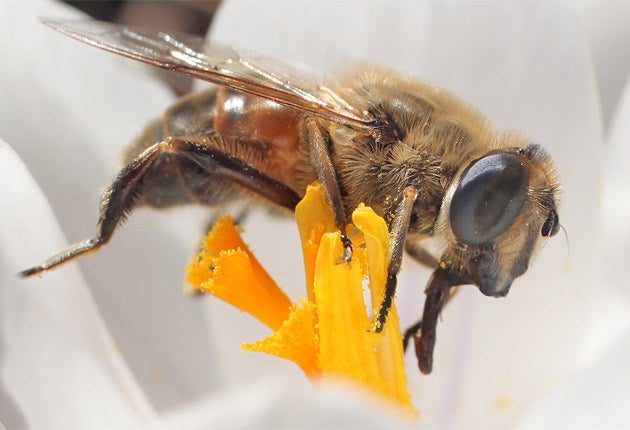
The Government is being asked to investigate a possible link between a new generation of pesticides and the decline of honey bees. It is suspected that the chemicals may be impairing the insects' ability to defend themselves against harmful parasites through grooming.
The Environment Secretary, Caroline Spelman, will have to answer a question in the Commons from the former Home Office minister David Hanson about whether the Government will investigate if the effect of neonicotinoids on the grooming behaviour of bees is similar to its effect on termites.
The pesticides, neonicotinoids, made by the German agribusiness giant Bayer and rapidly spreading in use, are known to be fatal to termites by damaging their ability to groom themselves and thus remove the spores of harmful fungi.
In a leaflet promoting an anti-termite insecticide, Premise 200SC, sold in Asia, the company says it is the direct effect on the insects' grooming abilities of the neonicotinoid active ingredient, imidacloprid, which eventually kills them. Now bee campaigners in Britain want to know if this mechanism could also be at work on European honey bees and other pollinating insects which are rapidly declining in numbers.
"Grooming protects insects from all kinds of pests and viruses, while helping to maintain general health and functioning," Ms Williams said yesterday. "A defence for honey bees against the varroa mite [a parasite causing colonies to decline] is to groom the mites away from the body. Do we know for sure that neonicotinoids do not hamper the ability of honey bees to deal with varroa?"
Matt Shardlow, chief executive of Buglife, the invertebrate conservation charity, said: "Scientific studies have shown that neonicotinoids significantly reduce the activity of honey bees, and it is highly likely that this would include a reduction in the amount of grooming that they do.
"Hence there is a clear potential mechanism for these pesticides to damage the first line of defence that insects have against disease. Again it seems clear that insecticides are linked to sickness in bees and impairment to pollination services."
The possibility fits in with what has already been discovered about the harmful effects of neonicotinoids – in that bees treated with imidacloprid, which is Bayer's biggest-selling insecticide worth £500m a year in sales to the company – are far more susceptible to disease, even at microscopic doses. This has been shown by two independent studies carried out in the past two years.
In its publicity material for Premise 200SC, Bayer says: "The termites are susceptible to disease caused by micro-organisms or fungi found in soil.
"A principal part of their defence system is their grooming habits, which allow the termites to get rid of the fungal spores before these spores germinate and cause disease or death. Premise 200SC interferes with this natural process by lowering defences to nature's own weaponry."
Dr Julian Little, Bayer's UK spokesman, said: "We do a lot of tests of the effects of insecticides on bees, and impairment of grooming has never shown up."
Specific tests to see whether or not bees' grooming ability was impaired by neonicotinoids had not been carried out, he added.
Join our commenting forum
Join thought-provoking conversations, follow other Independent readers and see their replies
Comments