Spread of alien moth puts Britain's conker trees at risk
Latest research finds horse chestnuts from Cornwall to Yorkshire are now under attack
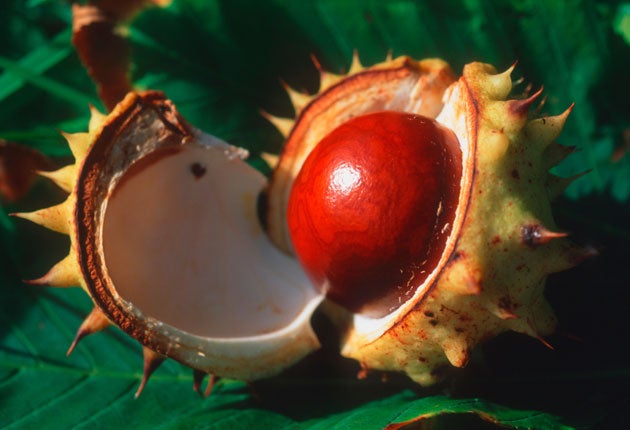
The future of Britain's conker crop is at risk from an "alien invader" that is attacking horse chestnut trees across the country. New research has found that the leaf miner moth, which weakens trees by making them shed their leaves early, is spreading faster than feared and has now hit as far west as Cornwall and as far north as the York moors.
Biologists fear the moth, first found in Greece, makes horse chestnuts more susceptible to the fatal bleeding canker disease, which causes trees to lose branches and bark and already affects more than half of all chestnut trees in some parts of the UK.
Nurseries have stopped planting horse chestnut saplings because there is no cure for infected trees – which means that as the trees die they are being replaced with different species. Great avenues of horse chestnuts, including one at Barrington Court, near Ilminster in Somerset, have already been cut down and replanted with a variety of oak.
Experts have compared the threat from the outbreak to Dutch elm disease, which all but wiped out Britain's elms in the 1970s. Guy Barter, the Royal Horticultural Society's chief adviser, said the leaf miner moth, which first emerged on a tree in a garden in Wimbledon, west London, in 2002, was "here to stay". He added: "In all likelihood there won't be an unaffected tree in Britain. It's unlikely there will be any way of remedying this infestation, which might render trees more susceptible to other problems like canker, which is potentially fatal." Michael Pocock, an ecologist at the University of Bristol who is studying the leaf miner outbreak, warned the moths "may cause trees to die prematurely".
Anne Frank's horse chestnut tree in Amsterdam, which she immortalised in the pages of her diary, was brought down by a storm in August. It suffered from an infestation of the moth and was also diagnosed with bleeding canker 10 years ago.
Mike Glover, the managing director of Barcham Trees, which plants more young trees than any other nursery in Europe, said he had stopped growing the most popular conker species, the white flowering tree found across Britain. "It's a complete disaster. They are so susceptible to disease that we just don't recommend them in any circumstance," he added. His nursery used to plant 5,000 conker saplings a year.
Mr Barter warned that conker games, including those due to be played at this Sunday's World Conker Championships near Ashton, Northamptonshire, might have to be played with "synthetic or virtual conkers" in the future. Organisers of this year's championships are already struggling to find enough conkers for the 450 competitors who travel from around the world to take part. A spokesman said they were short of at least 1,000 conkers and urged anyone within a 20-mile radius of Ashton to donate any decent ones that they could find.
The average conker has shrunk during the past few decades. Keith Flett, from the Campaign for Real Conkers, said conkers had halved in size during his lifetime. "Really large ones used to be about 2 inches [5cm] across; now on average we see a lot more that are about the size of a 10p piece, which is too small to be usable."
The leaf miner moth is spreading at a rate of around 40km (25 miles) a year. What most concerns scientists is that there is no natural predator. The RHS advises gardeners to collect and burn all the fallen leaves at the end of autumn to help to contain the outbreak because the moth pupae overwinter in the piles.
Join our commenting forum
Join thought-provoking conversations, follow other Independent readers and see their replies
Comments
Bookmark popover
Removed from bookmarks