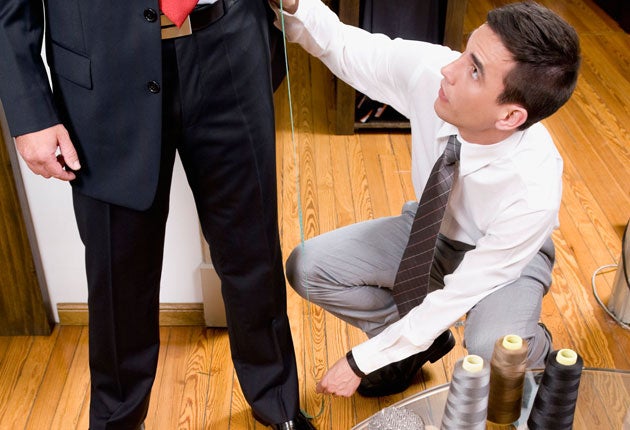
It is like the butterfly effect, only in reverse. Tropical storms batter Australia, and you end up paying substantially more for a new suit.
Suit prices are expected to rise 10 per cent this year, a consequence of the doubling in the cost of wool.
Australia is the world's biggest producer of wool. Last week prices rose to a record $14.85 (£9.05) per kilo. Large-scale flooding across Queensland and Victoria early this year caused an estimated $7.3bn (£4.8bn) of damage, leading to a dramatic slowdown in production. Globally, wool output is are at its lowest levels for 85 years. Growing demand for wool suits from increasingly wealthy Chinese businessmen has also contributed to the surge in prices.
Wool brokers in Australia cut their inventories of wool to almost zero. In the UK, several wool auctions have been cancelled as supplies have run so thin. Already suit makers have been forced to raise prices. Harvie & Hudson, a family-owned business on London's Jermyn Street, has added £50 to the price of its suits.
Traders expect prices to remain high for several years while farmers increase global sheep numbers. In the meantime, retailers are nervous about whether they will be able to avoid passing the higher prices on to customers. For them, this is not an ideal time to raise prices.
A spokesman for Marks & Spencer, whose wool suits start at £159, said: "We will do all we can to mitigate the commodity impact and maintain our opening price points where we can [while] maintaining M&S quality."
Bernd Hake, UK managing director of Hugo Boss, which has 450 stores across Europe, said: "If the wool price remains on this level we will readjust our prices."
Not all of its suits are made using wool – Marks and Spencer sell a polyester two-piece for £59 – but high quality ones are. The rising global demand for them is outstripping supply of the raw materials needed.
The price rises may see such cheaper suits grow in popularity, as producers contemplate man-made fibre blends to avoid passing on higher costs to customers, although polyester prices have also increased. Wool-mix fabrics have increased in popularity, with young professionals less concerned about their suits being 100 per cent wool.
The rising costs will also affect other wool-rich clothing, such as socks and jumpers, but these are items in which synthetic fabrics can be more easily used as a replacement without such a serious compromise on quality.
The recent price rises are a dramatic reversal for an industry that has been in steady decline since around the 1960s. In 1966 the price of wool dropped by 40 per cent in a single year. Although it remains popular in expensive tailoring, its use in other garments has declined since the growth of synthetic fibres.
The result has been sharply reduced production and movement of resources into production of other commodities – in the case of sheep growers, to production of meat.
But the story has, before now, been rather different. The earliest known article of woollen clothing was found in a cave in the modern day Republic of Georgia, dating back to 34,000 BC. Though cotton from China was becoming available, it was wool, as well as leather and linen, that clothed the vast majority of Europeans during the days of the Roman Empire.
In the Middle Ages when silk, imported along the Silk Road from China, was considered an extravagant luxury, the wool trade was the economic engine of much of Europe. Northern Germany, central Italy, France, Belgium and the Netherlands were all dependent on wool, producing cloths from English raw wool exports. So important was this to the English economy that an export tax on wool called the "Great Custom" was levied. That the Lord Chancellor, until very recently the presiding officer of the House of Lords, has since the 14th century sat on the "Woolsack", a chair stuffed with English wool, is no coincidence.
When the Woolsack was replaced after the Second World War, wool from all corners of the British Empire was used. By that point Australia had become the world's largest producer. Some 25 per cent of the world's wool is still produced there.
Join our commenting forum
Join thought-provoking conversations, follow other Independent readers and see their replies
Comments