All the tea in Cornwall: We drink tea by the gallon, and now at last we're growing it in Britain
Anthea Gerrie discovers why the home brew is prized from Chelsea to China
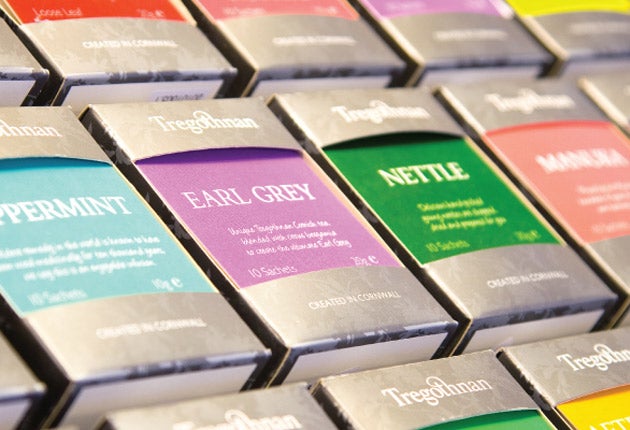
For all the tea in China, it seems we could have been growing our own for the past 200 years. Deep in Cornwall, a descendant of Earl Grey is proving you don't need Himalayan slopes or a sub-tropical climate to grow tea bushes producing leaves good enough for Britain's top tea tables, and in plentiful enough quantities to export.
That's export as in to China, Japan and other tea-growing countries. The Tregothnan estate, once mocked for its quirky little experiments with camellia sinensis – the tea bush – is now producing and harvesting more than 10 tons a year of tea that the experts consider fine, fragrant and worth a pretty penny.
"We consider it a miracle tea," says Nobu Kitayama, who distributes Tregothnan to high-class department stores and five-star hotels throughout Japan. Expat Joyce Cardew of Tokyo explains why she's happy to pay way over the odds for a tea that comes all the way from Britain.
"They are nurturing and preserving wonderful old plants originally raised in Japan, and I love that feeling of bringing the tea back to its original home," she explains. Sentimentality also plays a big part in boosting sales. "We've had Tregothnan on the menu for five years because we were really keen to showcase it as a British product," says Glenn Piper, the manager of Claridge's tea room. "Visitors love the idea that the afternoon tea they associate with England can include a homegrown brew."
As well as the commercial crop grown in Cornwall, there are a handful of tea bushes thriving in Aberdeenshire, and reported pockets in Dorset and Wales. So why have we spent centuries propping up the economies of China, India and Kenya rather than trying to cultivate our favourite drink?
"It was always considered it couldn't be done here – that's why the East India Company first got involved with smuggling tea from China to Darjeeling and Assam," explains horticulturist Philip McMillan Browse, who helped to create The Eden Project.
But this pessimism was misplaced. "The British also thought they couldn't grow any kind of camellias outdoors after they first brought them back from the East," he adds. "It took them 50 years to realise they could, after raising them for 50 years in glasshouses." It was the hundreds of camellias and magnolias growing happily in the wild at Tregothnan, whose owners are descended from Britain's most passionate collectors of exotic plants, which sparked their audacious investment in tea less than a decade ago.
"When I came here as head gardener in 1996, Lord and Lady Falmouth were wondering what they could do here which would tie in with the history, pay for the six full-time gardeners and last for at least 500 years," says Jonathon Jones, who is Tregothnan Tea in every aspect now, from the growing to the marketing of the lucrative crop.
"Although tea seemed unlikely because no one had done it in England before – and you'd think surely if they could, they would – it came to mind when I saw how many plants we had here like magnolia campbellii from Darjeeling, where the champagne of teas is grown," he adds. "The fact those plants were doing better here than in their native habitat was one of the deciding factors."
He confesses that an initial test planting was a disaster – "a gale of wind blew it all into the deer park" – but in 2001, he produced a tiny batch. "Only about 50 grams, but it proved the point," he says. "If there was any tea at all, we could scale it up."
The gardener became an international marketeer after unveiling his first large-scale crop at the International Tea Expo in Kenya in 2004. "Twinings offered to buy our entire production, but we realised there was more value in marketing it ourselves under the Tregothnan brand," he explains. "It's the world's only English tea, produced in the country that made afternoon tea famous."
However, without deep pockets, the Cornish tea crop might never have acquired more than curiosity value. Tregothnan is now turning over £1.1m worth of tea per year, but it has taken a £2.6m investment and a patient wait of five years from planting to harvesting the first crop.
Purchasers with deep pockets were also needed to help to build the brand, and even in a recession, they have fallen over themselves to become purveyors of true English tea. Fortnum & Mason, which has exclusive rights to Tregothnan's single-estate tea, sells it for a staggering £1,500 per kilogram.
"If you want to drink it as part of your afternoon tea in our tea room, it will cost you an extra £20 per person," says the store's tea buyer, Darren Williams. But he says there is no shortage of takers, especially from abroad. "The Japanese absolutely love it, both to drink in and take away, and we had a Russian customer who bought seven kilos and asked us to repack it into dozens of 100-gram gift packs," he says. "There are plenty of British tea connoisseurs too who just want to taste something different. It may be pricey, but it totally ties in with our ethos of sourcing the best British products."
But Tregothnan is not just for connoisseurs. Plain old garden centres sell its tea blends too, such as Afternoon blend, which is mixed with about 12 per cent of the imported Darjeeling these native leaves resemble, to guarantee consistency of taste. Also available are Earl Grey, flavoured with bergamot, and the Classic, mixed with Assam to make a more tannic breakfast blend.
It will cost you 18p a cup to drink homegrown – about 10 times the cost of a bog-standard tea bag – but Jones asks: "Why should we be expecting to pay less than 2p a cup for our national beverage?"
More and more tea lovers are agreeing with that sentiment as the cuppa drifts slowly upmarket. New research from Mintel shows the size of the premium sector is growing, even though builder's tea is on the decline, and specialist importers are enjoying dizzying business. "We expect to turn over £5m this year," says David Hepburn of Jing, which sells through mail order and to Britain's top hotels and Michelin-starred restaurants, and which has enjoyed a quantum leap in sales in the past five years. "We drink 165 million cups of tea a day in the UK, and huge numbers of people are experimenting with new teas – pu-erh, or flowering varieties, for example," he says. "It's like the coffee revolution, with people going to suppliers who roast and grind their own rare beans. The same thing is happening in tea, with a growing interest in provenance."
If the chic members' club Morton's is to be believed, tea is actually starting to replace coffee. "A few years ago, we would mostly serve coffee at breakfast, but now people realise they need more than just a quick fix of caffeine," says its restaurant manager, Nicolas Vallon. "People are becoming conscious of the fact that leading busy lifestyles can take its toll on your body so try and take small measures to protect their immune systems – like drinking good tea, which is known for its health properties."
The effect is filtering down to the supermarkets. Polly Astbury, tea buyer for Waitrose, reports: "Premium tea is showing growth, with traditional afternoon teas such as Darjeeling and Earl Grey up 12 per cent year on year." But Tregothnan will never be a supermarket brand, says Jones. He encourages visitors to come to the estate for a "bush to cup" experience at its tea room on the Fal. If Earl Grey could be there himself, looking up at the 20 acres of tea bushes stretching into the distance, he would surely be bursting with pride that his descendants had brought his favourite brew home to Britain.
The newest brews
Pu-erh, which Alice Waters, America's queen of foodies, says she's never without in her home, is the "coffee" of teas: strong, macho and addictive, with a high caffeine content. The smoky taste comes from fermentation. Buy Numi's in a chocolate-bar-style brick from which you break off one cube at a time.
Flowering teas were created to infuse the cuppa with some theatre. Flowers that grow beside the leaves in the wild are wrapped into the tea, opening up gorgeously in the pot to reveal a bloom. Get these from Jing (www.jingtea.com) with a glass teapot, which helps you to enjoy the show.
Matcha looks like an unlikely gourmet item: bright-green powder you whisk into hot water to make a brew as fast as a cup of instant coffee. Nevertheless, the Japanese consider it the queen of teas, and it has great health-giving properties. Loose from Teapigs (www.teapigs.co.uk).
Chocolate tea is just that: an amalgam of a strong, black tea with cocoa beans. Numi makes a chocolate pu-erh, while Teapigs' chocolate-flake tea is based on Assam.
What's in your teapot?
All tea is defined as an infusion of the dried leaves of the camellia sinensis plant in water, but how it is processed after picking dictates whether it is categorised as black, green or white.
White tea – considered by connoisseurs to be the most delicate – is merely steamed and dried.
Green tea is withered before it is steamed, fired or pan-fried. It is then rolled and dried.
Black tea is subjected to the final step of oxidising or fermenting before firing. This is the classic British brew and most likely to originate in India or Africa.
Oolong tea, popular in China and with tea connoisseurs, has a delicate taste that comes from a short fermentation following a shake or roll to bruise the edges of the tea leaves.
Many mass-market tea bags are filled with the tea dust and "fannings" left over after whole leaves have been removed to pack as loose leaf tea.
Join our commenting forum
Join thought-provoking conversations, follow other Independent readers and see their replies
Comments