How to cook the perfect chips
We all love to eat them, but few of us know how to make them. Yet as Christopher Hirst discovers, learning the skills to transform a fast-food staple to a truly transcendent treat is well worth the effort
Sign up to IndyEat's free newsletter for weekly recipes, foodie features and cookbook releases
Get our food and drink newsletter for free
Is any food more tempting than the fried potato chip? As anyone who orders a portion in a restaurant knows, people are ruthless about filching frites. Yet there are few culinary staples that vary so much in quality. The items that constitute 50 per cent of Britain's national dish are likely to be greasy, soggy, and limp or tough, gnarled and leathery. Generally, we chomp away regardless, but this ubiquitous body fuel can also be one of the finest foods known to man. If the right kind of potato is fried with sufficient care, the result is a transporting gastronomic experience.
There is no reason why we should not be better at chips. Though we did not invent this delicacy – the French, Belgians and Spanish all claim discovery – we certainly eat enough of them. One in every four UK potatoes is consumed in the form of chips. Even if you did not know that this is National Chip Week, there is a strong likelihood that you have unconsciously joined the celebrations. Every year, the British stow away 225 million meals from fish and chip shops and over twice as many meals incorporating homemade chips. As awareness campaigns go, you may think that National Chip Week is somewhat superfluous.
The British scarcely require encouragement to increase their intake. We do not need more chips but better chips. "One looks forward to a good chip in a restaurant. It's a treat," says food PR Carolyn Cavele, "but one is invariably disappointed." Instead of the pale, flaccid heap served by too many chippies or the under-cooked "fat chips" that emerge from the kitchens of even highly-rated restaurants, we should be able to expect excellent renditions of this national favourite. Due to laziness, meanness and ignorance, classy chips with a crunchy exterior and a fluffy, well-flavoured interior remain a rarity.
In an effort to achieve this gastronomic paragon, I selflessly thrust any attempt at "a well-balanced diet" to one side. I cooked (and ate) chips eight times over three days in an attempt to achieve the quintessence of chippiness. Somewhat less selflessly, I co-opted the services of my wife as tasting panel for my fried offerings. Twice-fried, to be precise. Culinary scientist Harold McGee explains the necessity for an initial gentle fry: "so the starch in the surface has time to dissolve ... and glue together the outer cell walls into a thicker, more robust layer." When the chip is fried again at high temperature, it is this robust layer that gives the crunch.
For my first effort, I followed in the footsteps of American food writer Jeffrey Steingarten, who illicitly imported six pounds of horse fat from Vienna to New York in order to recreate the legendary frites that Alain Passard serves in his Michelin three-star Paris restaurant L'Arpège. "They have a not disagreeable horsy flavour," says Passard, "a lightness and true crispness that you cannot obtain with other fats and oils." Unfortunately for Steingarten, his equine rendering "began prematurely to go rancid and dark", though initial results were "exceptional".
So, did I commit the unspeakable sin of cooking with horse fat? Not exactly. But how about beef fat? In my native Yorkshire, fish and chip shops have used dripping for donkey's years. It is so commonplace that nonconformist establishments announce, "We fry in vegetable oil." Locals say that dripping explains the excellence of Yorkshire fish and chips, though occasionally the results have a distinct tinge of Bovril. In the event, I used a 50:50 mix of dripping and groundnut oil, as recommended by Steingarten. The potatoes for chips have to be a floury variety. For my first endeavour, I used King Edwards.
The initial fry took 10 minutes at 125C. Scientists at Leeds University have discovered that chips release a cocktail of aromas including cocoa, butterscotch, cheese, potatoes, onions and flowers, but a bouquet of beef fat pervaded our kitchen. It was not too unpleasant for anyone accustomed to the fragrant atmosphere of a Yorkshire fish and chip shop. My wife, who comes from Surrey, lit two scented candles. After the second frying (three minutes at 190C), I nibbled my first chips. My wife and I agreed that the taste was good (not at all beefy). Though pleasingly non-greasy, there was not much in the way of crunch. They certainly did not match the "extraordinarily crisp and tasty" results described by Steingarten.
For my next attempt, I used Maris Piper potatoes and groundnut oil. I first washed the chips in cold water, the soaked them in salty water, which has the effect of drawing some of the water from the potato so producing a crispier chip. Finally I patted each chip with a paper towel to ensure complete dryness. No Hollywood starlet ever received more TLC.
I plunged my spud starlets into groundnut oil at 150C for five to six minutes. According to Lindsey Bareham's In Praise of the Potato, the result of the first fry should be chips that are "flabby-looking, soft but not browned". When the heat of the oil had been cranked up to 185C, the chips returned for two to three minutes before being presented to my in-house adjudicator. She gave a mixed review. "Quite interesting but not uniformly crisp." Red Duke of York potatoes fried in light olive oil were notable for flavour but greasy. Kestrel potatoes in corn oil were moderately successful, but still some distance from perfection. An experiment with rapeseed oil ("the perfect oil for all your cooking") was aborted when my wife complained about the smell and opened all the windows, "Poo! It's disgusting."
Some refinement of technique was required. I returned to Maris Piper and groundnut oil, but adopted an elaboration from Heston Blumenthal. In his book In Search of Perfection, he suggests simmering the washed chips in salted water before frying. No time is given. Blumenthal merely says, you gently simmer "until the chips have almost broken up". I found that 10 minutes was about right. After that, you're making mash not chips. As a result, the surface of the chips becomes wrinkled and slightly crumbly, so providing more surface to crisp up. The chips are allowed to cool, then chilled in the fridge before the initial frying at 130C. Blumenthal says they should cook "until they take on a dry appearance and are slightly coloured". It's a bit hard to tell if chips have taken on "a dry appearance" in a foaming vat of oil, but they were slightly coloured after nine minutes. After another phase of cooling and chilling, the world's most pampered chips returned to the oil at 190C. Blumenthal says eight to 10 minutes, but I found two minutes sufficient for "golden brown".
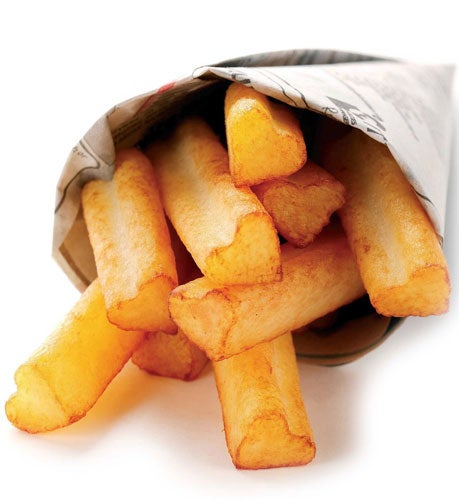
Yes, it is all a bit of a fiddle (you can prepare the chips up to the final fry several hours in advance), but the results were sensational. Within a stupendously crunchy, slightly flaky skin, there was a richly tasting, creamy interior. It was a combination of the very best roast potato and heavenly mash in the form of a chip. "I've suddenly discovered why people like chips," said my wife. "Very, very nice indeed." No salt, still less ketchup was required for us to polish off a bowlful. I then made another batch with Arran Victory, a heritage potato sold by Waitrose. Possibly the results were even better, with a slightly nutty flavour. If not the perfect chip, it was an undeniably fine fry.
From spud to sensation: Do try these at home
500g Maris Piper or Arran Victory potatoes (approximately two large or six small) will make sufficient chips for 2-3 people. It is best to fry in small batches.
1) Peel and chip 400-500g potatoes, then wash thoroughly.
2) Boil large pan of salted water. Add chips and return to boil, then reduce to gentle simmer (no bubbles) for 10 minutes.
3) Remove chips from water and leave to cool on a cake rack. When cool, chill in fridge.
4) In a heavy-bottomed saucepan, heat 1.5 litres of groundnut oil to 130C. Using mesh basket, fry chips for nine minutes.
5) Remove basket and shake to remove oil. Cool chips on cake rack, then chill in fridge.
6) Just before you are ready to eat, heat oil to 190C. Use mesh basket to fry chips for 2-3 minutes until golden. Cooking times can vary with different hob sizes and potato varieties so keep a close eye on colour of chips. Drain chips, then spread on double layer of kitchen paper. Serve immediately.
Frying tonight: Where to eat the best
The chips served at the Crab and Lobster restaurant, Asenby, North Yorkshire, are "crispy, crunchy, hand cooked and delicious," according to devotees.
The Chip Shop, Stoke, Plymouth, is famous locally for its chips. "In all my travels, I have yet to find a finer chip, fluffy on the inside and crisp on the outside," says a fan.
French fries de luxe (cooked in duck fat) won top place for Comptoir Gascon, Charterhouse St, London EC1, in Time Out's search for London's top 50 chips.
At Toff's, 38 Muswell Hill Broadway, London N10, a Blumenthal-style technique – chips are rinsed, boiled and cooled before frying – results in sensational fries.
Chips and Things at Moorends in Doncaster is another local hero, with chips that are "hunky – crisp and golden on the outside and white and fluffy on the inside," according to one fan.
Subscribe to Independent Premium to bookmark this article
Want to bookmark your favourite articles and stories to read or reference later? Start your Independent Premium subscription today.
Join our commenting forum
Join thought-provoking conversations, follow other Independent readers and see their replies