Jelly: it's not just for children
Once, it was just for children's tea parties. Now the trembling treat is being reclaimed as a delectable grown-up summer dessert. Gerard Gilbert reports
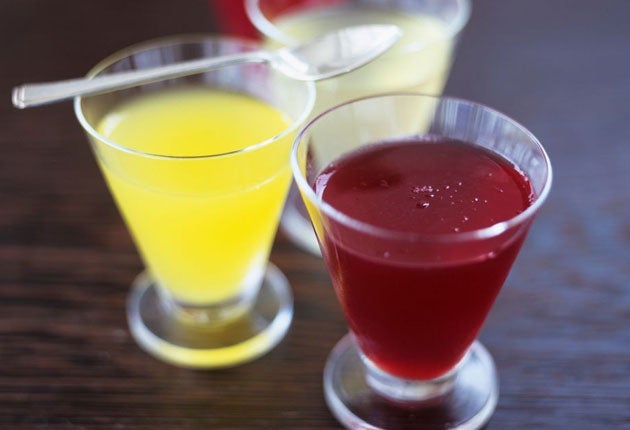
Jelly on a plate, jelly on a plate ... wibble, wobble, wibble, wobble ... jelly on a plate – thus goes one of the first bits of doggerel that my daughter learned. Indeed jelly is firmly associated with the nursery and children's tea parties – and those lurid cubes of additive-packed, "fruit"-flavoured, concentrated gelatine that I remember, as a boy, eating raw out of a packet. You can still buy the ready-made stuff (just add water) of course – minus the additives – but these days jelly is also a much more delicious, grown-up affair.
In the past few years the wobbly stuff has been rediscovered by chefs and food writers like Heston Blumenthal and Nigella Lawson, using outré ingredients from beetroot and quail to gin and tonic, as well as by a new breed of enthusiasts spearheaded by Sam Bompas and Harry Parr – a pair of enterprising Old Etonians, self-styled "jellymongers" who come as a Gilbert and George style package known by their surnames. The duo have applied Parr's architecture training to the quivering food in order to construct jelly facsimiles of St Paul's Cathedral and Norman Foster's famously wobbly Millennium Bridge across the Thames.
"There are a number of interesting trends that jelly ties into," says Bompas. "One is molecular gastronomy – to the sorts of chefs who are looking to do new things with food, jelly means that they can transform anything into an unusual, wobbly and slightly comic texture, which can be set off against other textures. So you actually find jellies on a lot of menus now."
You certainly do, and jelly's revived status as a fashionable foodstuff was sealed when Bompas and Parr were commissioned to produce one (laced with absinthe) as a centrepiece at music producer Mark Ronson's £30,000 birthday party. In his choice of pud, Ronson was, unconsciously or not, mimicking the Victorians, whose smartest dinner tables would have a monumental and suggestive wobbling jelly as a crowning glory.
Mrs Beeton included more than 50 jelly recipes in her seminal 1861 tome Household Management, from cactus fruit to guava, rhubarb to Irish moss. Sam Bompass says he is more a fan of Beeton's near contemporary, Agnes Marshall.
"She was like Beeton but far cooler," he says. "Every single jelly recipe she has – and she has a lot – finishes with a glass of brandy or some other spirit." Indeed I'm struck by how many modern jelly recipes include the strong stuff – an echo of the lethal jelly shots that Yuppies used to knock back in the Eighties.
But I've decided to make a couple of jellies with my four-year-old daughter, and we select a pair of straightforward-looking, alcohol-free fruit recipes from the internet – one involving infused strawberries, the other made out of orange juice straight out of the carton. Next I need the gelatine.
When Bompas & Parr began their wobbly constructs a few years ago, they swooped like a two-man plague of locusts on London's supermarkets, emptying them of all available – and it wasn't widely available – leaf gelatine (powdered gelatine produces less smooth and clean-tasting jellies). Thanks to the revival that they are partly responsible for, it's a lot easier to find these days. And that includes the apparently de rigueur Supercook Select Fine Leaf Gelatine Platinum Grade, which, after a fruitless hunt among the massed ranks of instant fruit jellies, I found lurking at the back of a shelf in the home-baking section in Tesco. Four leaves will, it promises on the back of the packet, set approximately one pint of liquid.
Gelatine is extracted from the bones, connective tissues and organs of cattle and horses, which might help explain why the jelly revival had to await the passing of the worst of the BSE crisis. Vegetarians have the alternative of using a seaweed extract, agar-agar flakes, although in his book, The Vegetarian Option, Simon Hopkinson writes that: "Agar flakes will not produce a crystal-clear jelly in the way conventional gelatine leaves do ... however an agar jelly has the advantage that it does not form a skin and it will eventually set at room temperature."
So that's the setting agent sorted. The search for a suitable jelly mould, especially since I am in a hurry and can't wait for an internet delivery, was at first a tad trickier. Sam Bompas to the rescue again.
"Plastic is good", he says. "When we started we used Tupperware – literally anything can be used as a jelly mould, even a child's sandcastle bucket, as long as the rim is wider than the base so the jelly can just slide out. On the other hand, there are a lot of ceramic moulds around which are very difficult to use. Stay away from them. The best ones are copper moulds."
Food historian Ivan Day runs period cookery courses from his Cumbrian farmhouse, including some that focus on jelly, and reckons to have taught former students Bompas and Parr everything they know about the wobbly stuff (details of future courses can be found on historicfood.com). Day owns an unrivalled collection of moulds, including the very earliest wooden ones, as well as some very valuable Wedgwood creations.
He has others in the shape of Renaissance obelisks, swans and even Sir Edward Landseer's lions from the base of Nelson's column in Trafalgar Square, with one lion apparently having been traditionally placed at each corner of the dining table. "Jellies weren't just food to eat, but a major way of ornamenting your table," says Day. "To see jelly at its best, a Victorian setting by candlelight can't be surpassed."
The golden age of jellies was triggered by the advent of manufactured gelatine in the mid-19th century, he says.
"Before that you had to go to a lot of trouble to make it ... you had to boil up calves' feet or pig skin, or even ivory and stag's horns. The manufacture of gelatine really came as a side product of the photographic industry, which required a much finer substance."
Day's jelly courses can include an attempt at the fabled Alexander Cross jelly, which was originally made to celebrate the wedding of Edward Prince of Wales and Princess Alexandra in 1863. When sliced it reveals the Brunswick star, made of blancmange and running through the centre like a stick of rock. Bompas & Parr's creations are a good deal less reverential.
"We made an entire Christmas dinner as a jelly," remembers Bompas, "a layer for everything that would be on your plate. We also once made a zebra meat jelly in black and white stripes – it tasted pretty disgusting actually."
Their most ambitious project yet was unveiled at last weekend's Courvoisier History of Food exhibition in London. "We worked with neuroscientists at the Wellcome Foundation to create a jelly that responds to your brainwaves."
On a more prosaic level, the record for the biggest jelly goes to a team of engineers from the British Army, "but they kind of cheated because they didn't unmould their jelly," say Bompas. Ah, yes, the unmoulding. Our strawberry and orange jellies, after an eternity in the fridge (I think I under-did the gelatine) finally set, but my attempts at turning them out on to a plate were undignified to say the least.
"When you are ready to unmould," writes Nigella Lawson at the end of her gin-and-tonic jelly recipe (see left), "half-fill a sink with warm water and stand the jelly mould in it for 30 seconds or so. Clamp a big flat plate over the jelly and invert to unmould, shaking it as you do so. If it doesn't work, stand it in the warm water for another half-minute or so and try again."
Oh, well, at least ours taste good, fresh, clean and altogether 10 times better than the manufactured packet jelly. And you can see that "jellymongering" is pregnant with possibilities for the creative cook. And Ivan Day reckons the jelly revival is a good sign.
"Jellies are popular in times of stability and peace, when there's a lot of money around, and people want a variety of foods and tastes," he says. Oh dear. Does the new austerity signal the end of the new jelly boom? If so, let's hope it's just a wobble.
Gin and Tonic Jelly By Nigella Lawson
Ingredients to serve 8
300ml plus 50ml water
300g caster sugar
Zest and juice of 2 lemons
400ml tonic water (not slimline!)
250ml gin
25g/15 sheets of leaf gelatine
A 1/4-litre jelly mould, lightly greased with almond or vegetable oil
Put the water and sugar into a wide, thick-bottomed saucepan and bring to the boil. Let it boil for 5 minutes, take off the heat, add the lemon zest and steep for 15 minutes. Strain into a measuring jug, then add the lemon juice, tonic and gin; you should have reached the 1200ml mark; if not, add more tonic water, gin or lemon juice to taste.
Soak the gelatine in cold water for 5 minutes to soften. Meanwhile, bring 50ml of water to the boil in a saucepan. Remove from the heat, squeeze out the gelatine leaves and whisk them in. Pour some of the gin and lemon syrup mixture into the saucepan and then pour everything into the jug. Pour into the mould and when cold, put in the fridge to set. This should take about 6 hours.
From www.nigella.com
Easy Lemon Jelly: Bompas & Parr
Ingredients for 500ml, serves four
125ml lemon juice
100ml orange juice
125ml sugar syrup (equal parts caster sugar and water)
150ml water
5 leaves of gelatine
Squeeze the juices into a measuring jug and then add the sugar syrup and water. Cut the gelatine leaves into a few pieces and place in a heatproof bowl. Add a few tablespoons of the jelly mixture so that the gelatine is just covered. Let the gelatine soften for 10 minutes while you bring a small pan of water to a simmer.
Place the bowl of softened gelatine over the simmering water and stir from time to time until totally melted. This takes about ten minutes. Then pour the remainder of the jelly mixture over the melted gelatine and stir to combine. Pour through a sieve into a jug and then carefully fill your mould. Refrigerate until set.
From Jelly with Bompas & Parr (£14.99, Pavilion)
Join our commenting forum
Join thought-provoking conversations, follow other Independent readers and see their replies
Comments
Bookmark popover
Removed from bookmarks