The war of the rosés
A scheme to industrialise the production of rosé, and beat the New World at its own game, has provoked a furious response from traditional producers in France. John Lichfield reports from Faye d'Anjou
Sign up to IndyEat's free newsletter for weekly recipes, foodie features and cookbook releases
Get our food and drink newsletter for free
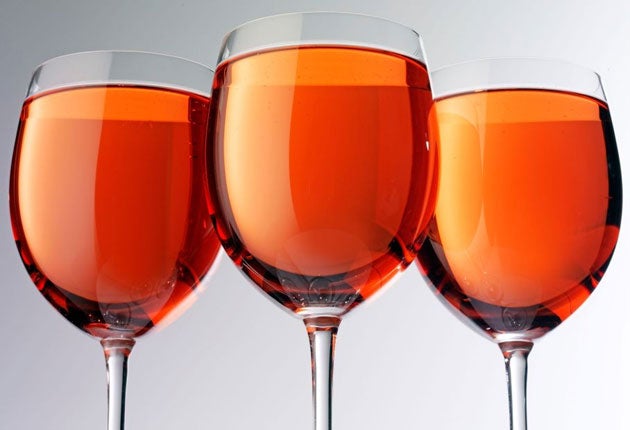
Olivier Lecomte poured out a generous glass of Cabernet d'Anjou, which blushed deep pink with a hint of gold. "What you have there," he said "is a true rosé wine. A wine made with the heart." According to the European Commission, a rosé by any other name would taste as sweet or, rather, as "demi-sec". But would it be a true rosé, made with the heart?
A commercial, and moral, debate is raging between Brussels and some French wine producers on how to make authentic rosé wine and how to label it. The debate threatens to re-ignite a much wider, and more explosive, argument on the nature of wine itself. Is wine a mysterious product of soil, soul, weather, grapes, sweat and tradition? Or is it an industrial product for mass-consumption like any other?
Brussels (with surprising complicity from the French government) has decided that there is no great mystery about "pink" wine. You simply shove a bit of red wine into a great deal of white wine and, hey presto, you have rosé. The wine growers of Provence and Anjou in the Loire valley – the world's largest producers of rosé wines – beg to differ. Olivier Lecomte is the president of the association of Anjou rose wine growers. He has 100 acres of vines at Faye d'Anjou, near Angers, 80 per cent of which produce the two celebrated, semi-sweet local, pink wines, Rosé d'Anjou and Cabernet d'Anjou.
"There is a great deal of anger here in Anjou and a great deal of shock," he said. "We have worked very hard to improve the quality of our wines and to prove that a genuine rosé is not just a mongrel or hybrid, like some people once claimed, but a different and excellent wine in its own right. We have succeeded. In recent years, our sales have been rising rapidly. It is not surprising that others want to jump on the bandwagon. Now, abruptly, we are told that rosé wine can be concocted any old way, to an industrial formula, a money-driven formula."
Under the existing European Union rules, the practice of mixing red and white wine, known as "coupage", is banned. The only exceptions allowed are for Spanish "mezcla" (mixed) wine for domestic consumption and for pink Champagne. Rosé wine has to be made by one of two traditional methods. Red grapes are crushed and the skins are separated from the fermenting juice after two or three days, before it colours deeply. Alternately, immature pink wine juice is "bled" from vats of fermenting red wine.
French rosé is often blended from wine produced by both methods. It is then cared for like a white wine, rather than a red. "True" rosé is therefore a white wine made from red wine grapes. If made well, it is a wine which is subtly different from either red or white.
In other countries, notably in South Africa, Argentina, Chile and Australia, cheap rosé can be produced, quite legally, by blending red and white wine to achieve an acceptable and easily marketable taste. The European Commission has now decided – initially with support from France – that EU wine producers should have the right to do the same.
Rosé sales have been booming worldwide, defying the problems of other types of wine. Young people, especially, have taken to rosé as a fun drink, which is refreshing, uncomplicated and relatively cheap. (Anjou rosé sells in the UK at between £5 and £8 a bottle. Other French rosés sell for as little as £3 a bottle.)
At the same time, surpluses of red and white wine are piling up once again. Why not mix the unwanted red and white, Brussels suggests, and call it rosé, taking on the "New World" wine producers at their own game? The declared intention is to allow EU exports of rosé wine to compete with "blended" South African, Chilean and other rosés in rapidly developing markets, such as China.
The French government, supported by French wine traders from non-specialist, rosé-producing regions, gave its outline approval to the idea in January. A final decision is expected next month.
When news of the decision began to circulate, pink grapes of wrath fermented in Provence and Anjou. The French government rapidly shifted its position. As a result, Brussels proposed a compromise this week. "Real" rosé wines, the Commission suggests, could be marketed under a new label: "traditional rosé". Blended or "fake", rose wines would have to be labelled "rosé coupé" or "rosé de coupage." The problem is therefore solved? Not at all. Patrice Laurendeau is president of Interloire, the association that represents all the wine interests of the lower Loire valley. He has 150 acres of vineyards at Notre Dame d'Alençon, two-thirds of them producing rosé.
"It should not be for us to have to rename our wine," he told the Independent. "If the others want to label their bottles 'rosé made from jumbling up red and white', that's fine.
"We represent the only real rosé. We have made a great and successful effort to market our wine as a youthful drink, a modern type of wine. If we are forced to put the word 'traditional' on our bottles, people will think, especially young people, that it is a fuddy-duddy wine, an old-fashioned kind of drink. That will ruin everything we have achieved."
There is another reason why the Anjou rosé producers object to the word "traditional". Much of the rosé wine produced in Anjou and Provence was "traditionally" very bad. Thirty years ago, as M. Laurendeau freely concedes, Anjou rosé was "full of sulphur, filthy stuff, undrinkable". Sustained efforts have been made during the past 20 or 30 years to raise the quality, M. Laurendeau said. "We don't want to be associated with the way that Anjou rosé was traditionally made. We want to sell our wine as the only true way of making rosé, but much, much improved on what it used to be."
As always in the politics of wine, nothing is simple. The real, but largely unspoken, fear of the French rosé producers is not foreign competition but a flash flood of "blended" rosés from other surplus-ridden, wine regions in France. Would superior quality and taste alone not protect the Anjou and Provence rosé vineyards from "Frankenstein" imitators? Not necessarily. Modern wine-makers and wineries are sophisticated alchemists of taste.
"Some of this mixed red and white stuff could, unfortunately, be rather good," M. Laurendeau said. "At least it would seem rather good to those who did not know any better. Of course it would not have the fruitiness or depth of a true rosé, but it would be convincing enough and, above all, cheap."
France has been engaged in a long, international struggle to protect its own philosophy of wine, based on "terroir" or the importance of authentic, local taste and tradition, rooted in soil and micro-climate. It has, nonetheless, had to admit that the "New World" approach, based on supplying wine "factories" with the best available grapes and producing consistent, simply labelled, consumer-friendly wines, has swept the middle-market shelves in the UK and elsewhere.
Officially, France still argues for tradition and "terroir". At the same time, France is increasingly moving towards simple-labelled "Australian-type" mid-market wines of its own.
The original decision of the French government to support the EU move towards "fake" rosé is, according to the Anjou producers, a turning point. With wine surpluses swelling around the world, Paris and the more hard-headed parts of the French wine industry are increasingly ready to abandon tradition for pragmatism.
Subscribe to Independent Premium to bookmark this article
Want to bookmark your favourite articles and stories to read or reference later? Start your Independent Premium subscription today.
Join our commenting forum
Join thought-provoking conversations, follow other Independent readers and see their replies