The Independent's journalism is supported by our readers. When you purchase through links on our site, we may earn commission.
Meet your doctor (please don't unplug it)
If you live in a remote area and need a specialist doctor, chances are there won't be one close by. But can a network of hi-tech terminals and online medics make the connection? Matilda Battersby reports.

Sign up to our free Living Well email for advice on living a happier, healthier and longer life
Live your life healthier and happier with our free weekly Living Well newsletter
A good bedside manner is as important in a doctor as their impressive medical qualifications. A gentle voice, pleasing manner and soothing presence are all elements that help patients feel reassured.
But can a doctor have a good bedside manner if they are not actually at your bedside? That's what a pioneering new stroke service in Cumbria and Lancashire aims to find out. It allows expert stroke consultations to take place when doctors are not in the hospital.
Stroke consultants might be having dinner, watching television, gardening on a Sunday or asleep in bed. That is, until they receive a call from hospital notifying them that a patient needs attention. Then, they spring into action at a speed The Flying Doctors team could only marvel at, and examine their patient an average of 15 minutes later.
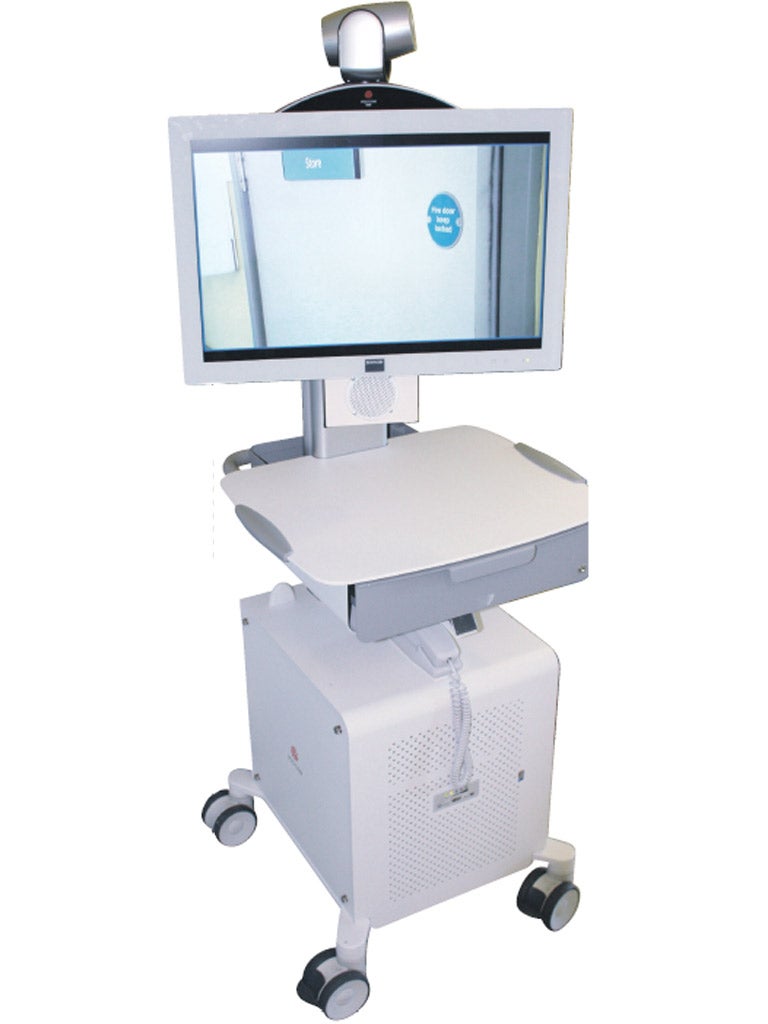
The service gives patients access to top stroke specialists 24 hours a day, seven days a week. How? It's simple. Doctors are now doing what many of us do at work or via Skype: they are appearing via webcam at the patient's bedside.
Using telecommunications systems in this way seems (like plenty of bright ideas) rather obvious – but it's the result of years of work. After a highly critical report into national stroke services in England published by the National Audit Office in 2005, the Cumbria and Lancashire NHS Trust organised a clinical advisory group to devise the best care for stroke patients in line with the Government's 2007 National Stroke Strategy.
A stroke occurs when the blood supply to the brain is cut off. This can happen for two reasons: a clot or a haemorrhage. Clots cause 80 per cent of all strokes so doctors need to quickly establish if a patient is eligible for thrombolysis, known in non-medical terms as "clot-busting" medication.
Timing is crucial in this situation as there is a four-and-a-half hour window in which a patient will respond to clot treatments. Beyond this there can be irreparable damage to a patient's brain and victims can end up needing round-the-clock medical care for the rest of their lives. Strokes are the third-largest cause of death in England and the single largest cause of adult disability.
Other NHS Trusts with limited stroke services elect dedicated hospitals to which patients with suspected strokes are sent. But geography made this impossible in Cumbria and Lancashire. Journey times from remote areas would be too long and patients would have deteriorated by the time they were examined. They were forced to think more creatively.
"We came up with a system based around wherever the consultant happened to be because there are not enough specialists in our area to give thrombolysis treatment at local hospitals," says Kathy Blacker, director of the Cumbria and Lancashire Cardiac and Stroke Network. "A couple of the hospitals had 9am to 5pm stroke service units but others had no capability at all. We needed to provide a 24/7 service and knew we couldn't centralise because of the geography."
After three years of discussions, Cumbria and Lancashire launched Telestroke in July 2011. It brings 16 stroke physicians across eight hospitals to patients on screen via a specialist Virgin Media Business telecommunications network.
Similar systems exist in other parts of the country – the Scottish Centre of Telehealth (SCT) has been running since 2006. Other countries, too, are keen on the technology, which doctors in Barcelona use for HIV consultations. There are similar schemes being set up in Africa, too.
So far in Lancashire 24 patients' lives have been saved, 40 more this year have recovered with no symptoms or disabilities and 30 fewer patients require full-time care, according to the latest estimates.
Strokes cost the NHS and economy in Britain £7bn a year. But the Cumbria and Lancashire model has saved the NHS Trust more than £8m so far, according to estimates. The bulk of the expenditure saved would have gone on long-term care for those left without means to look after themselves.
Clinical staff worried initially that patients wouldn't like Telestroke. But they've conducted satisfaction surveys and of the 250 to receive Telestroke consultations only one has responded negatively.
"Everything has changed so quickly in terms of smartphones and interactive engagement," Blacker says. "Patients are unfazed by it."
CASE NOTES
The patient's view
Howard Thomas, 70, a retired insurance broker, was the very first patient to use the Telestroke service after he had a stroke on 31 July 2011:
"I had been staying at a campsite in Cumbria with my wife. I felt fine when I went to bed but woke up the next morning around 11am to go to the loo and I didn't make it. I was all over the place. My wife phoned 999 and the ambulance took me to Kendal Hospital.
"It was a Sunday so no stroke specialists were there but I was seen by a consultant via Telestroke. Less than 24 hours later I recognised and spoke to my son and my wife. I've never heard of anyone getting over a stroke as quickly as I have.
"The lady I'd seen on the Telestroke came in to see me on the Monday and I recognised her. I couldn't recollect seeing her on screen but I knew she was a familiar face straight away."
The doctor's view
Dr Mark O'Donnell, Stroke Consultant at Blackpool Teaching Hospital NHS Foundation Trust and clinical lead for the Lancashire & Cumbria Cardiac and Stroke network:
"We are at home and get a call. After a brief discussion with the referring doctor we decide whether or not to proceed with the Telestroke consultation. Some discussions resolve the difficulty and in some cases it's apparent that nothing can be done.
"We dial into the teleconferencing technology from our home PCs. It takes a matter of minutes.
"I think all of us on the scheme had a little bit of anxiety to start off with about the impersonal nature of the technology.
"The system has gone down on a couple of occasions. Both times it was a problem with the internet connection. There is a 24-hour helpline but under such circumstances you just have to wait. Thankfully it is rare."
How it works
1. Patients visit A&E with stroke symptoms and are wheeled into cubicles which contain Telestroke screens
2. Doctors at the hospital telephone the stroke specialist on call
3. The stroke specialist dials into the Telestroke technology and communicates directly with the patient via webcam
4. The specialist can look at brain scans using the Telestroke technology
5. A patient and their family can ask questions of the consultant
6. The stroke specialist might prescribe thrombolysis treatment which will be administered by hospital staff
Subscribe to Independent Premium to bookmark this article
Want to bookmark your favourite articles and stories to read or reference later? Start your Independent Premium subscription today.
Join our commenting forum
Join thought-provoking conversations, follow other Independent readers and see their replies