Breast vs bottle: the new battleground
Just as the Department of Health is trying to promote breastfeeding, food giant Nestlé, makers of powdered baby milk, is forging links with the Government.
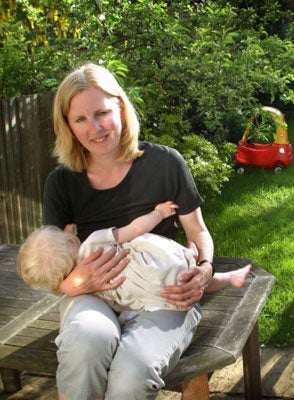
Efforts to encourage more women to breastfeed are being threatened by "aggressive" lobbying directed at the Government by the baby milk manufacturing industry, campaigners warned yesterday.
The powdered milk manufacturer Nestlé has forged formal links with the Department of Health and took a ministerial aide on an all-expenses-paid trip to South Africa, The Independent on Sunday has discovered.
To coincide with the start of National Breastfeeding Awareness Week today, the Secretary of State for Health, Alan Johnson, is under pressure to encourage mothers to give their babies breast milk beyond six months. Evidence suggests it helps curb obesity in the poorest families and prevents illness.
Children's charities also want the Government to impose an outright ban on the promotion of powdered formula milk because they claim it encourages women to stop breastfeeding too early.
A ban on advertising infant formula for babies up to six months was introduced in the UK in January. Ministers are considering whether to extend the ban to follow-on formula milk products.
An investigation by the IoS has uncovered strong ties between Nestlé, the world's largest baby milk manufacturer, and the Department of Health. Rosie Cooper, a parliamentary private secretary to the Health minister Ben Bradshaw, is undergoing a year-long Industry and Parliament Trust fellowship with Nestlé, and in February went for a week to South Africa as a guest of the group to oversee its corporate social responsibility activities.
Critics said it was "very worrying" that a member of the Government was working so closely with Nestlé, which is trying to break into the mainstream baby milk market in the UK.
Last night the Department of Health insisted it was taking steps to increase breastfeeding rates, especially among younger women in disadvantaged areas.
To mark National Breastfeeding Awareness Week, mothers will be sent text messages to persuade them not to give up.
But the NCT (National Childbirth Trust), Unicef, Save the Children and campaigning group Baby Milk Action, which has organised a boycott of Nestlé, are demanding the Government go further by introducing tough new laws cracking down on the multimillion-pound powdered milk market.
The Department of Health declined to say whether the Health Secretary or other ministers knew of Ms Cooper's links to Nestlé. She has not recorded the South Africa trip on the Register of MPs' Interests but has said she did not consider this necessary because her fellowship with Nestlé is registered with the Electoral Commission.
While she has not breached parliamentary rules, MPs said the decision raised questions about her judgement.
Ms Cooper's trip to South Africa shows the extent to which Nestlé has forged links at the heart of government. She and three fellow Labour MPs had their flights, accommodation and other expenses paid for on the week-long visit, which took place from 7 to 14 February.
A week later, Ms Cooper, MP for West Lancashire, asked Gordon Brown during Prime Minister's Questions about coffee and Fairtrade Fortnight, with which Nestlé is involved.
Campaigners claim Nestlé is still breaking the World Health Organisation code for marketing breastmilk substitutes by promoting its formula milk in the developing world.
The World Health Organisation banned the marketing of breast milk substitutes nearly 30 years ago. But it was only in January this year that the UK banned the promotion of formula milk to mothers of babies under six months.
There are rules restricting promotion of follow-on milk for older babies, including a ban on references to pregnancy and showing babies under six months in advertisements. Yet there is no outright ban on follow-on formula, and critics say that a failure to close the loophole would mean mothers were still being encouraged to give up breastfeeding.
Belinda Phipps, chief executive of the NCT, said: "Research shows that over-promotion of any sort of formula depresses the breastfeeding rate.
"Nestlé are trying to launch a brand in the UK but they have had difficulties because of their reputation across the world. Nestlé does do some good work in order to improve its public profile but it is viewed really badly around the world.
"Any parliamentarian should be extremely wary of accepting hospitality from such an unpopular company."
The Liberal Democrat health spokesman, Norman Lamb, said: "It is a massive error of judgement to have this link with Nestlé, given her [Ms Cooper's] position.
Mike Brady, campaigns and networking coordinator at Baby Milk Action, said: "Time and again we see Nestlé trying to ingratiate itself with health workers and policymakers through gifts, free trips, sponsorship and so-called partnerships.
"Surely the Government should not look to companies to fund and organise trips such as this. If there is a legitimate public interest in fact-finding in South Africa, it should be publicly funded."
Senay Camgoz, Unicef UK spokesman, called on the Government to stop the infant formula industry exploiting loopholes in the legislation concerning the advertising of its products.
Ms Cooper defended her work with Nestlé last night. She said: "I was advised by the registrar of member's interests that I did not have to declare the trip on the register, as visits undertaken as part of an IPT fellowship are directly excluded.
"I subsequently contacted and declared the trip with the Electoral Commission as she advised. I began my fellowship long before becoming a PPS at the Department of Health.
"I have never raised any issue concerning Nestlé, either in my capacity as a PPS or as a backbench MP."
The Breastfeeding Manifesto Coalition, an umbrella organisation of 40 charities and royal colleges, including Save the Children, Unicef and the Royal College of Midwives, also calls for other steps by the Government to support breastfeeding.
They want the Government to bring England and Wales into line with Scotland, where women have a legal right to breastfeed in public. Women in England and Wales are allowed to do this, but if, for example, a restaurant manager objects, they have no rights enshrined in law.
Research by the NCT shows that nine out of 10 women stop breastfeeding before they want to.
The Department of Health is to launch a "Breast Buddy" scheme, fronted by Atomic Kitten singer Jenny Frost, under which women nominate a close friend or relative to provide emotional support while they are breastfeeding. Mothers from low-income backgrounds, and those aged 16 to 25, who are less likely to breastfeed, will be targeted by the initiative.
The Government wants breastfeeding rates to increase by two percentage points per year. In 2000, 71 per cent of mothers initially breastfed – but by 2005 the figure had risen to 77 per cent.
Official figures show a clear link between breastfeeding and poverty – except in London, where rates are high regardless of income. In Knowsley, Merseyside, one of the most disadvantaged areas in the country, just 28 per cent of mothers breastfeed. Hartlepool, Stoke-on-Trent, Sunderland, Middlesbrough and Hull are all in the bottom 10 primary care trust areas.
The top 10 areas are all in London. Lambeth – which does have pockets of extreme poverty – is top overall, with 93 per cent of mothers breastfeeding.
The Department of Health said the awareness campaign had nothing to do with the activities of Nestlé. A spokesman said: "We want to show that this is not just for middle-class white people – we want to give everyone encouragement for breastfeeding. It is healthy and beneficial for children and mothers. We want to dispel any myths or public negativity towards it and tackle inequalities."
Advertisers spend £10 promoting formula for every £1 the NHS spends encouraging breastfeeding.
Nestlé could not be contacted for comment last night, but its website says: "Nestlé firmly believe that breastfeeding is the best way to feed a baby, and we are strongly committed to the promotion of breastfeeding throughout the world.
"However, some mothers, for a variety of reasons, do not breastfeed, and in these cases, infant formula is the only product recognised by the World Health Organisation (WHO) as a suitable alternative."
To have your say on this or any other issue visit www.independent.co.uk/IoSblogs
Join our commenting forum
Join thought-provoking conversations, follow other Independent readers and see their replies
Comments