Mobile phone radiation wrecks your sleep
Phone makers own scientists discover that bedtime use can lead to headaches, confusion and depression

Sign up to our free Living Well email for advice on living a happier, healthier and longer life
Live your life healthier and happier with our free weekly Living Well newsletter
Radiation from mobile phones delays and reduces sleep, and causes headaches and confusion, according to a new study.
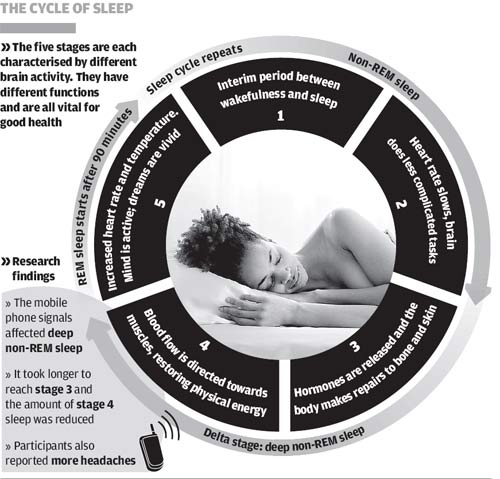
The research, sponsored by the mobile phone companies themselves, shows that using the handsets before bed causes people to take longer to reach the deeper stages of sleep and to spend less time in them, interfering with the body's ability to repair damage suffered during the day.
The findings are especially alarming for children and teenagers, most of whom – surveys suggest – use their phones late at night and who especially need sleep. Their failure to get enough can lead to mood and personality changes, ADHD-like symptoms, depression, lack of concentration and poor academic performance.
The study – carried out by scientists from the blue-chip Karolinska Institute and Uppsala University in Sweden and from Wayne State University in Michigan, USA – is thought to be the most comprehensive of its kind.
Published by the Massachusetts Institute of Technology's Progress in Electromagnetics Research Symposium and funded by the Mobile Manufacturers Forum, representing the main handset companies, it has caused serious concern among top sleep experts, one of whom said that there was now "more than sufficient evidence" to show that the radiation "affects deep sleep".
The scientists studied 35 men and 36 women aged between 18 and 45. Some were exposed to radiation that exactly mimicked what is received when using mobile phones; others were placed in precisely the same conditions, but given only "sham" exposure, receiving no radiation at all.
The people who had received the radiation took longer to enter the first of the deeper stages of sleep, and spent less time in the deepest one. The scientists concluded: "The study indicates that during laboratory exposure to 884 MHz wireless signals components of sleep believed to be important for recovery from daily wear and tear are adversely affected."
The embarrassed Mobile Manufacturers Forum played down the results, insisting – at apparent variance with this published conclusion – that its "results were inconclusive" and that "the researchers did not claim that exposure caused sleep disturbance".
But Professor Bengt Arnetz, who led the study, says: "We did find an effect from mobile phones from exposure scenarios that were realistic. This suggests that they have measurable effects on the brain."
He believes that the radiation may activate the brain's stress system, "making people more alert and more focused, and decreasing their ability to wind down and fall asleep".
About half of the people studied believed themselves to be "electrosensitive", reporting symptoms such as headaches and impaired cognitive function from mobile phone use. But they proved to be unable to tell if they had been exposed to the radiation in the test.
This strengthens the conclusion of the study, as it disposes of any suggestion that knowledge of exposure influenced sleeping patterns. Even more significantly, it throws into doubt the relevance of studies the industry relies on to maintain that the radiation has no measurable effects.
A series of them – most notably a recent highly publicised study at Essex University – have similarly found that people claiming to be electrosensitive could not distinguish when the radiation was turned on in laboratory conditions, suggesting that they were not affected.
Critics have attacked the studies' methodology, but the new findings deal them a serious blow. For they show that the radiation did have an effect, even though people could not tell when they were exposed.
It also complements other recent research. A massive study, following 1,656 Belgian teenagers for a year, found most of them used their phones after going to bed. It concluded that those who did this once a week were more than three times – and those who used them more often more than five times – as likely to be "very tired".
Dr Chris Idzikowski, the director of the Edinburgh Sleep Centre, says: "There is now more than sufficient evidence, from a large number of reputable investigators who are finding that mobile phone exposure an hour before sleep adversely affects deep sleep."
Dr William Kohler of the Florida Sleep Institute added: "Anything that disrupts the integrity of your sleep will potentially have adverse consequences in functioning during the day, such as grouchiness, difficulty concentrating, and in children hyperactivity and behaviour problems."
David Schick, the chief executive of Exradia, which manufactures protective devices against the radiation, called on ministers to conduct "a formal public inquiry" into the effects of mobile phones.
To have your say on this or any other issue visit www.independent.co.uk/IoSblogs
Subscribe to Independent Premium to bookmark this article
Want to bookmark your favourite articles and stories to read or reference later? Start your Independent Premium subscription today.
Join our commenting forum
Join thought-provoking conversations, follow other Independent readers and see their replies