Fostering: How making new children feel at home can be a family affair
Being a foster carer can have a positive impact on one's own children as well.
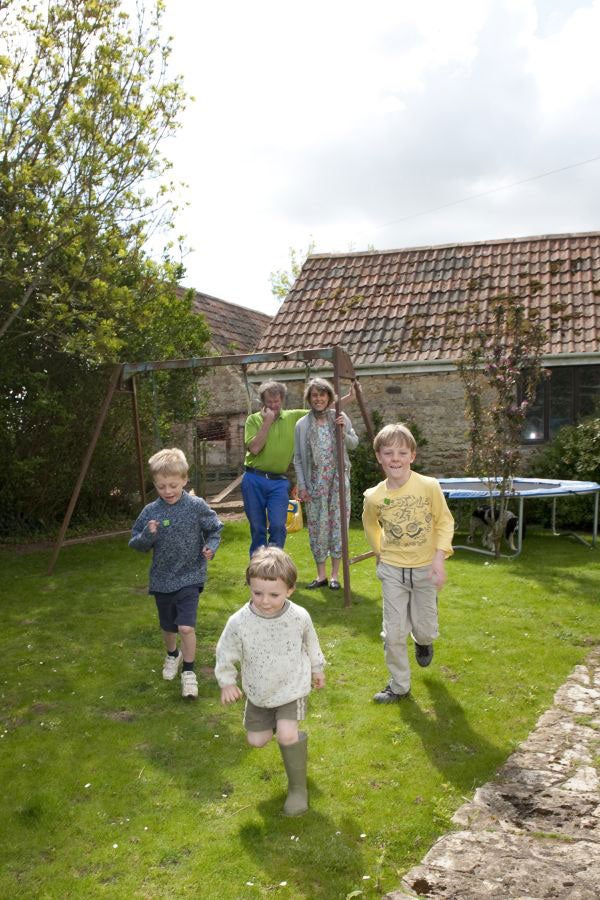
Becoming a foster carer inevitably involves significant changes to the lives of the chief carers involved. But what of the impact of fostering on the carer's own family, particularly the children who are expected to share their homes – and their toys – with strangers?
For Rachel and Philip Goodfellow, who have been fostering for the past four years at their farmhouse on the Dorset/Somerset border, fostering is very much a family affair.
Specialising in emergency and short-term care, the entire family is used to children arriving at very short notice, sometimes at night and perhaps in dramatic circumstances.
For many youngsters, the arrival of a distraught child in the middle of the night – usually with a social worker, but sometimes accompanied by a police officer – would be a daunting experience.
But for the three youngest Goodfellow boys – George, 10, William, six, and three-year-old Peter – the temporary nature of the arrangements fits in perfectly with the rhythm of family life.
"Being little boys, my three love the excitement of an emergency placement, particularly if it's accompanied by a police car," says Rachel.
"Although the emergency may actually involve a child staying with us for anything from a weekend to a year, temporary respite works better than long-term fostering [in our case] because the boys know it won't last forever."
Although the family has played host to a wide age range, Rachel believes that fostering children significantly older or younger than her own boys greatly reduces any potential rivalry.
At present, the family is caring for a baby girl – who came at six weeks as an emergency and is still with them, more than a year later – as well as a teenager.
"Our current baby is the most successful placement we've ever had, and the boys will be very sad when we have to hand her back. Although she takes up a lot of my time, she isn't too challenging, she doesn't play with the boys' toys, she gurgles and smiles a lot and she goes to bed early.
"As far as the boys are concerned, that makes her just about perfect, and certainly less of a threat than a boy of their own age who might want to rifle through their things."
With the Goodfellow's oldest son, Alex, away at university, George assumes lead-boy status when a new foster child arrives, and he helps to introduce them to the assortment of piglets, chickens, ducks, dogs and cats that share the family's rural existence and take up much of their free time.
While George is very proud of the role that he plays in making new children feel at home, Rachel stresses that she doesn't take her own children's acceptance of fostering for granted.
"Although I am chief carer on paper, I see us very much as a foster caring family. If ever my boys asked us not to do it any more, we'd certainly take account of their wishes."
Inevitably, there have been "a couple of bad experiences with bullying and aggression towards the boys", and, on each occasion, she and her husband have been forced to rapidly end the foster placement. But on balance, she believes the experience has been a very positive one for the whole family.
"All three of the boys get very involved when new children come, and George in particular is a terrific ice-breaker when the birth parents of our foster children come to visit. Although George knows he mustn't tell his school friends too much about each new child's circumstances, being part of a fostering family has made him and his brothers very open and friendly and able to interact with people from all walks of life. Sharing their lives with strangers has made them very accepting."
Rachel and Philip are careful to arrange family-only holidays on a regular basis, though, and Rachel in particular is convinced that adequate time away from fostering is important to prevent what she calls "the problem of carer burnout".
At present, George says he doesn't particularly want to be a foster carer when he grows up, but Rachel believes he may well change his mind later on.
If George does decide to follow in his parents' footsteps, he will be treading a path already well worn by the Watt family; in their case, an entire dynasty of foster carers has been giving children and young people a much-needed refuge for more than 40 years.
For Peter Watt, whose mother, Sandra, became a foster carer in the Seventies when he and his five siblings were still small, fostering is a natural part of family life. But for Peter's wife, Vilma, the first experience was not positive.
"When I saw the sheer chaos and noise in Sandra's home, I thought fostering would be too much of a challenge for me to take on; but, some seven years since Peter and I started fostering, I can't imagine ever giving it up."
Vilma and Peter, who have one small child of their own, as well as older children from previous relationships, have now fostered around 50 children at their home in south London, many of them with special needs. Peter's brothers, Damian and Gerry, and his sister, Bernadette, have also been inspired to go into fostering.
Initially, Vilma, who gave up a job as a legal aid solicitor to become a foster carer, said she didn't want to take children with special needs. "I had no experience of children with special physical or mental needs, and felt it would be hard to cope. But in the past seven years, we've looked after children with all manner of emotional, physical and mental health issues, including autism, and a range of emotional or abuse problems.
"As a respite carer, I have become accustomed to children arriving at all hours of the night and day. Some have had more severe problems than others, but we have learned how to handle things as we have gone along, and nothing really fazes me now."
Vilma's own older daughter, now 16, found all the to-ing and fro-ing of foster placements "a shock at first", but she too has learned to deal with being part of a foster family.
"There have been issues with jealousy, of course, as there are in all families; and, to compensate, we always tried – and sometimes failed – to reserve time for just me and her. Now that she's more mature, she tells me that there are good and bad things about fostering. The hardest thing has been the separation from children she has grown very attached to, particularly the very young babies.
"But we make a special effort to stay in touch with many of the children who have shared our lives, and my daughter loves that continuity."
Not surprisingly, Vilma occasionally longs for some peace and quiet, and she agrees that, on the rare occasions when she and Peter have a weekend away together, they return with their batteries recharged.
"As a family, we have encountered children from all sorts of different backgrounds, and that's naturally given all of us a wider perspective on life," she says. "Our view nowadays is the more the merrier."
Christmas can be a tight squeeze for the Watt clan – particularly when as many as 30 of the family and their foster children attempt to squeeze into Sandra Watt's house for lunch. But Vilma no longer puts her hands over her ears when the noise reaches fever pitch. "The chaos I saw at Sandra's house that day is simply normal to me now, and I really wouldn't have it any other way."
'My foster carer has been like a mother to me'
Uganda-born Erina Naluwaga, 23, works on the Fostering Network's young people's project, putting on creative events for teenagers and young people in care.
After suffering abuse inside her own family, she went into care at the age of five. After five years with a long-term foster family, followed by a period of multiple placements, her social worker arranged a private school boarding place in Chelmsford, where she stayed until she was 18, before going on to do a degree in creative advertising at the University of the Arts London.
"I was a very quiet child, and I didn't make my feelings known, but being sent from placement to placement was bewildering, and, for a long time, I didn't know who to trust.
"I know many people are very sensitive about having been in care, but for me there have been distinct benefits. The other girls at my school were pretty surprised by the fact that I was black and from London, as well as being in care, but I see now that it gave me an opportunity to grow in confidence and develop academically; something that very few children in care ever get.
"My main foster carer has been like a mother to me, and she and her family live only five minutes away from me. While I consider them to be my real family in many respects, I'm also OK with my own birth family too, and remain in contact with my own siblings as well as some of the children I lived with in my various foster homes.
"My ambition is to run a business offering educational advice and support to children in care, so they can be given a chance to succeed academically, just as I was."
'I want to be like Joan and become a carer'
Dylan, 12, has lived with his foster mother, Joan, since he was seven, and has regular contact with his birth mother and two half-siblings. He says he was "passed around three times" before his current foster placement, and has no intention of letting that happen again.
"I see Joan as my 'life mum', and I'm very close to her and her grown-up daughter. Although I'm glad that my birth mum is also around, I'm the only child living in Joan's house, and that makes it special for me.
When I think about being fostered and things like that, it's usually when I'm in bed and unable to sleep. When I get sad, all I need to do is knock on Joan's door and she'll tell me that everything is going to be alright. She either stays with me until I fall asleep or we'll go downstairs for some tea and biscuits and a chat until I feel better.
I haven't told most of my friends at school about being adopted; I will tell them if I decide it's right, but, until then, I don't think it's really anything to do with them. I think my teachers might know, but they've never mentioned it to me.
I want to be a policeman when I grow up, because I think they do an important job, but I also want to be like Joan and become a carer. Being a dad will also be very important to me."
Join our commenting forum
Join thought-provoking conversations, follow other Independent readers and see their replies
Comments