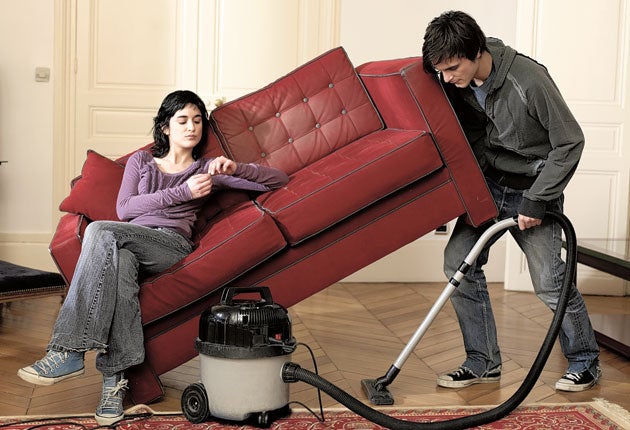
Domestically speaking, I'm a dirty pig," admits Barney Webber, a 40-year-old film editor who lives with his partner, Katherine, in Yorkshire. "In my old flat, I once didn't Hoover for four years and I'd only change the sheets every few months. These things just don't matter to me," he says.
"But they do to Katherine, so I've tried to make an effort. I used to try to do the washing-up, but she pushes me out of the way. And if I've been what she considers to be untidy she won't say anything but follows me around picking up anything I put down, and sighing. It's her way of letting me know I've made a mess without actually saying so. Ironically, that just makes me more stubborn than if she'd been direct." The status quo, he says, makes him feel sad. "If I died tomorrow, there would be nothing in the house that showed I lived there."
On the other side of the fence, Sarah Bingham, 36, says her husband Jonathan is lazy. The couple, a policewoman and solicitor respectively, have been together six years and live in Hertfordshire. Despite Sarah's requests for more help, quite a bit of shouting and even, lately, something she'd never imagined – separate beds – Jonathan simply doesn't help enough around the house. "He does try sometimes, but doesn't bother to do it properly," she says. "Sometimes I'll let dirty dishes pile up in the hope he'll take responsibility. He doesn't."
Since Sarah's hours increased last year "it's gone from being irritating to really hurting," she says. "I come home shattered – to a pigsty. He has no respect for me." Earlier this year, she filed for divorce. Jonathan's lack of support at home, she says, was a significant contributing factor. Both scenarios are likely to ring a bell with many couples: the division of domestic labour can be a highly emotive issue, and the potential fallout – feeling undervalued, powerless, nagged, invisible – is a hotbed for some sticky relationship issues.
Although husbands across the board have reportedly almost doubled their domestic efforts since 1961, British women in couples, on average, still spend two-thirds more hours doing chores than men do. And it's taking its toll: a report published last week by the London School of Economics indicates that divorce rates are lower in families where husbands help out with the housework.
In response to similar evidence in the US, the quest for domestic equality has become something of a movement, with a spate of books, talk-show appearances and websites on the topic.
And the approach is far from man-bashing. There's Marc and Amy Vachon's Equally Shared Parenting, or ESP ("Most women naturally set the standards – the way laundry is done, which brand of ketchup to buy, and how to correctly vacuum all surfaces. This doesn't work with equal sharing: a woman's mantra must become 'I will let go.'") Or psychologist, Joshua Coleman's book The Lazy Husband: How to Get Men to Do More Parenting and Housework ("Men aren't going to be in any rush to change, because the current system works so well for them. To get your husband to do his fair share, you're going to have to lead the charge.") And, most recently, Getting to 50/50: How Working Couples Can Have It All by Sharing It All, by Sharon Meers and Joanna Strober.
All agree that male/female stereotyping is a large part of the problem – and provide strategies for getting past it. For example, ESP suggests both parties make sacrifices, whether it's stepping down the career ladder or relinquishing exclusive control over home-decor choices. Meanwhile, 50/50 advocates adaptability: "If you stop making gender-based assumptions about who will, say, do the washing," says Meers, a former Goldman Sachs executive and an evangelically happy wife and mother, "then you have to plan." She and her husband sit down once a week with the calendar to negotiate chore division. "It's about truly believing that my obligation to him and his to me is that we owe each other full lives."
It sounds assertively American, but the idea is gaining traction over here. Duncan Fisher is the British author of Baby's Here! Who Does What? (published next month). "Busy couples try to make things efficient," he says. But often that means we, as Fisher puts it, "sleepwalk" into default roles, usually determined by tradition.
"It's when things aren't discussed – where responsibility is just dumped – that resentment builds," he says. "Then the one with the most dumped on them will often try to dish out tasks." (A cartoon in his book shows a woman waiting with a long list of jobs for her husband). "If you feel like a helper, you won't take responsibility. To get things done, a person needs to own the tasks." Feeling nagged, he says, creates distance: "You would stay late at work, go on that business trip – and the dynamic builds."
A lot of us, Fisher believes, are unaware of these dynamics: "The key is to sit down and talk through who does what. Even if it's not feasible to change at that time, talking builds understanding, which makes people nicer to each other."
It worked for Heidi Scrimgeour, 33, a freelance writer from County Antrim, Northern Ireland, who's married to Matt.
"As the one working from home, I'd naturally do more chores," she says. "I'd call Matt 'half-arsed' – he'd empty the bin, but not put in a new bin-liner; mop a floor – if I asked him. And I'd hit default 'fishwife mode'. Having children, she says, was the catalyst for change as her workload multiplied. "We sat down and really talked. The big realisation? He wasn't lazy or deliberately messy: that stuff just wasn't as important to him.
Accepting that meant stepping back and seeing his perspective. Matt went into problem-solving, list-making mode; letting him take ownership worked. Now we tidy the kitchen – together – before bed, or he'll be on dinner duty if I have a deadline. It's not perfect, but we work as a team: he knows what needs doing, I try to care less about the dusting. You can choose to make life a misery by focusing on unimportant things but, really, it's only washing-up."
Some names have been changed.
Getting even
* Don't assume that your partner automatically understands what's wrong. Talking openly about what's stressing you out is the first important step.
* Accept that you may have different standards for domestic life. Both partners may need to change their expectations.
* Tackle the issue together: negotiating a new approach jointly, rather than trying to impose a set of rules, will get better results.
* Try not to take it personally: your partner isn't being messy in order to hurt you.
* Being accusatory won't not solve the problem. Calmness, kindness and trying to see each other's perspective work better.
Join our commenting forum
Join thought-provoking conversations, follow other Independent readers and see their replies
Comments