Coming here, the man who lends cash to people banks won't touch
Nobel prize-winning financier to open branch in Glasgow
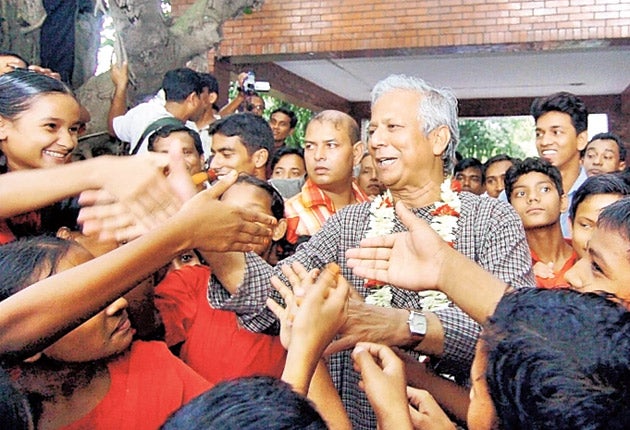
For more than 30 years Muhammad Yunus has lent money to the kind of people that ordinary banks would not normally touch. While western financial institutions zealously chased their wealthy clients, shunning anyone with a poor credit rating, Professor Yunus became the banker to the world's poor.
His pioneering microfinance programme – lending small sums of cash to some of the world's poorest citizens – won him the Nobel Peace Prize in 2006 and cemented his reputation as Asia's foremost social entrepreneur. Now, after helping millions of impoverished Bangladeshis work their way out of poverty, he is turning his attention to Britain.
Within the next 12 months Professor Yunus hopes to open a branch of his Grameen Bank in Glasgow that will give credit to up to 4,000 people who would otherwise be unable to get it.
His customers will probably be perennially unemployed and the kind of people whose credit ratings are so bad that they would be unable to sign up for a mobile phone contract. But Professor Yunus is convinced the money will eventually be repaid.
"I lend to the kind of people that financial institutions ignore," he explains in a phone interview with The Independent from the Bangladeshi capital, Dhaka. "Anywhere there are loan sharks, pawn sharks, people paying money back at exorbitant rates, that's where we'll be. These people may not be considered credit-worthy by the banks, but over the last 34 years [we have found] that our borrowers are just as credit worthy, just as eager to pay back what they have been lent."
His lending philosophy is simple and counter-intuituve to the western banking model. Over the past three decades Grameen has lent small sums of money to some of the poorest citizens of Bangladesh, India and China, people who would otherwise have no choice but to borrow from loan sharks at rates that keep them continually trapped in poverty.
Grameen's loans are usually given to women, who are deemed to be more financially responsible, and in groups, so that they all encourage each other to meet repayment obligations. There is no collateral to claim back if the borrowers default, and interest rates are largely comparable to those of high street banks.
Grameen has four branches in the US, and others in Mexico, Colombia, Guatemala and Costa Rica.
"In New York we opened up our first branch at a time when there was no financial crisis," Professor Yunus, 69, explains. "Yet even as the banking system collapsed, we continued to flourish. There was no impact on our borrowers, who still have a repayment rate close to 100 per cent."
Grameen claims that 95 per cent of its US borrowers pay back their loans, which on average run to approximately $1,500 (£1,000). The finer details of how much will be on offer to borrowers in Glasgow has yet to be decided but Professor Yunus says the amounts will be "similar to the US".
The UK's first Grameen bank will be opened in conjunction with Glasgow Caledonian University, which will begin a feasibility study to decide how micro-credit will work best within a Scottish context. According to Professor Yunus, a successful branch of Grameen needs about $6m of guaranteed income over four years to make an impact and provide credit for around 4,000 borrowers.
There are times when Professor Yunus' aims for Glasgow sound like something out of the Conservative's "Big Society" pitch. His latest book, Building Social Business, is 300 pages of Big Society pleading for people to go out there and create businesses which generate cash and contribute to the greater good at the same time.
"There are thousands of families in Glasgow who are third-generation unemployed and it's such a shame," he says. "The only solution we've come up with is to throw money at them each month so they can eat. That has stifled their energy and creativity."
So is Muhammad Yunus, the so-called "Banker to the Poor", against the concept of welfare?
"Not at all," he replies. "I don't want to be misquoted on that. Welfare is a wonderful thing: when people are in trouble we should help them out. But that is just part one of welfare. Part two is helping that person get out of their trouble. The problem is that governments spend so much time doing part one that they completely forget about part two."
He adds: "But this is not just the responsibility of the government, it is the responsibility of all of us to come up with ideas that might take five, 10 or 100 people out of unemployment."
Although Professor Yunus has faith in grassroots social entrepreneurialism, he has little time for the global banking system, which he says will keep repeating the same mistakes unless it is reformed root and branch.
"We allow the existence of a financial system that pursues fantasy economies, building castles out of air," he says. "We chase after artificial assets and bundles of paper that turn out to be completely meaningless. And when this system goes wrong, the bankers come begging. Why do we allow such a banking system to control the fate of billions of people?"
The Scottish experiment
* The exact details of how Grameen will work in Scotland have yet to be fully worked out but it will almost certainly follow the highly successful model Professor Yunus has adopted in the United States.
* The bank will target women living below the poverty line and will offer them loans of up to $1,500. Sighthill, one of Glasgow's poorest estates, is being lined up as a potential laboratory to test out the first loans.
* The idea is to lend people enough money to begin small start-up businesses, such as selling items from their homes, at market stalls or in collectives. Ideally this will, in turn, provide them with enough income to invest further and lift themselves out of poverty.
* Deals still need to be struck on whether the participants will be allowed to hang on to their benefits if they take out loans.
Join our commenting forum
Join thought-provoking conversations, follow other Independent readers and see their replies
Comments