Stephen Glover: Murdoch's cheerleading for Labour is being forgotten
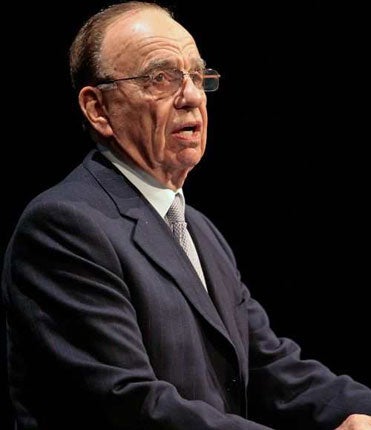
During Rupert Murdoch's long affair with New Labour, there were a few people on the left who went on expressing their loathing for the old rogue. The Guardian's Polly Toynbee springs to mind. But, for more than a decade, the man who had once been a hate figure became really not a bad chap after all.
And he certainly delivered for New Labour. Mr Murdoch's major contribution was as a cheerleader for Tony Blair's various wars. The Sun and The Times were enthusiastic supporters of the invasion of Iraq, and neither paper worried very much about Mr Blair's sometimes contingent relationship with the truth. Indeed, one wonders whether the British Government could have taken us to war in Iraq if, for some freakish reason, the passionately pro-American Rupert Murdoch had been against it.
Particularly when William Hague was Conservative leader, the Murdoch papers had it in for his party. The Times conducted a vicious campaign against his friend and Tory benefactor Michael Ashcroft, assisted by its allies in New Labour, before overstepping the mark by ludicrously suggesting that the billionaire was some kind of Central American drug runner. Despite Mr Hague's extreme Euroscepticism, the Eurosceptic Sun generally portrayed him as a nincompoop, and once famously represented him as a dead parrot on its front page.
That was the time, of course, now so difficult to imagine, when almost the entire media establishment, from the BBC to The Daily Express, was sympathetic to New Labour and the Tories were considered by all right-thinking people as a hopeless, nasty little sect. In those pre-Iraq War days, only The Daily Mail and The Daily Telegraph declined to join the party, though they sometimes despaired of the Tories.
Peter Mandelson's bitter remarks about The Sun last week should be interpreted in this historical context. No one in New Labour, apart from Mr Blair himself, was friendlier towards Rupert Murdoch, or more appreciative. Lord Mandelson did not fret when for several years we virtually lived in a media one-party state. Now, as The Sun switches its allegiance to the Tories, he puts on that splendidly bogus high-minded look and, in that pained way of his, waxes moralistic.
His argument against The Sun is wholly threadbare. He suggested that the paper influences Rupert Murdoch's Sky News which, in turn, influences the BBC in favour of the Tories. Surely he cannot believe this hokum. For one thing, Sky News has not been discernibly pro-Tory, and I challenge Lord Mandelson to produce an example of anti-Labour bias on the channel. For another, it is absurd to imagine the much larger BBC taking its cue from Sky News. What he said would not have passed muster in a first-term undergraduate media studies essay.
This is not to say, however, that The Sun covered itself in glory in the way it attacked Gordon Brown last week. Its own newly appointed political editor, Tom Newton Dunn, is said to have been discomfited by the severity of the assault. He knew the Prime Minister's eyesight is so poor that he cannot write legibly. Most people, including many readers on The Sun's website, thought Mr Brown was at least trying to do the right thing in penning a hand-written note, though obviously he should not have misspelt names.
The Sun's first major strike against the Prime Minister went awry and hardly redounded to the paper's credit. Lord Mandelson's remarks about the paper were not just wrong-headed but also unnecessary, given that public opinion had already rallied to the Prime Minister. Dominic Mohan, its new editor, should choose his next casus belli more carefully.
Whatever he does, though, we will hear a lot more from Lord Mandelson and others in the Government about the supposed iniquity of The Sun and the Murdoch press in supporting the Tories. A few like-minded commentators will crank into action. Evidently, Rupert Murdoch is acceptable to them when he supports a left-of-centre party, but he turns back into a dangerous monster who imperils the democratic process when he endorses a right-of-centre one.
An editor can't have it both ways with the watchdog
The Guardian drew itself up to a great height after last week's report by the Press Complaints Commission (PCC) which concluded, rightly I believe, that there is no evidence of current illegal phone hacking on national titles, as the paper had alleged. It published an irate and lofty leader, and Nick Davies, the reporter who had suggested that phone hacking still goes on, and was more widespread several years ago at the News of the World than has been admitted, sprang into print. The Guardian even issued a statement dismissing the report as "complacent" and declared that the PCC does not have the "the ability, the budget or the procedure to conduct its own investigations".
I cannot recall a newspaper reacting in so high-handed a way to a report it did not like. The nearest memorable case happened to involve The Guardian. In 2003 its editor, Alan Rusbridger, talked about withdrawing from the PCC after it had ruled that the paper had been wrong to pay a prisoner for a diary which described his time in jail with the novelist Jeffrey Archer.
On the other hand, The Guardian has sometimes been on the receiving end of favourable judgements by the PCC, in which case it is perfectly content. For example, in 2006 it found in favour of the paper after a complaint was made about an article that drew parallels between Israel and apartheid South Africa. In that instance The Guardian did not question the resources or methodology of the commission.
As a member of any organisation, one should learn to take the rough with the smooth. If Mr Rusbridger believed the PCC has been under resourced, he could have campaigned to do something about it, rather than attacking the organisation over rulings he dislikes, having embraced favourable ones. The Guardian assumes it occupies a moral sphere all of its own, and, if it says something is true, that belief overrides the opinion of all other earthly authorities, and doubtless divine ones too.
I hope Mr Rusbridger does not ever end up in court on a charge. Should judgment go against him, he will lecture the judge about his intellectual limitations, rebuke the jury, and declare he does not propose to serve any sentence that might be imposed on him. If he believes the PCC is utterly defective, he can withdraw his newspaper. Or accept its conclusions like a man.
Join our commenting forum
Join thought-provoking conversations, follow other Independent readers and see their replies
Comments
Bookmark popover
Removed from bookmarks