Stephen Glover: Too close for comfort: How the 'Telegraph' mishandled McBride
The story about Damian McBride's smears of leading Tories has been interpreted largely in political terms. It also casts a fascinating light on the general workings of the press, and in particular on the relationship between The Daily Telegraph, a Tory newspaper, and No 10.
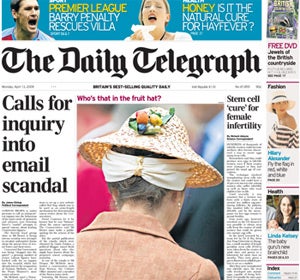
It was the Telegraph which broke the story on Saturday 11 April. Incautious observers might conclude that this was an example of a Conservative newspaper doing what Conservative newspapers are supposed to do – discomfiting a Labour Government. In fact, its motives were probably exactly the opposite.
The front page splash in early editions did not finger McBride as the man who had sent the emails containing the smears. This was a bit like writing about Kim Philby's defection to the Soviet Union without identifying him. McBride was the story. By later editions his name was included, possibly because the paper realised that it was pointless trying to keep him out of it. Nevertheless, the Telegraph's write up of his disgraceful activities was hardly apoplectic.
Why did the paper at first not identify McBride? Conspiracy theorists suggest with some plausibility that it was trying to protect him. They see the publication of the piece as a spoiler written on behalf of No 10. Andrew Porter, the paper's political editor, is a very close drinking companion of McBride's (as I noted when he was appointed in September 2007) and a recipient of stories from him. Will Lewis, the editor of The Daily Telegraph, is also a mate.
The byline above the splash was that of Christopher Hope, the Whitehall editor. Nonetheless, it is suggested that Porter's and Lewis's relations with McBride led to the paper trying to protect the No 10 insider, and to its soft presentation of the facts in a manner calculated to do as little damage as possible to Gordon Brown.
The Telegraph had been given McBride's emails by Paul Staines, who writes the Guido Fawkes blog, and had agreed not to publish them without his agreement. This it broke, in the knowledge that The Sunday Times and the News of the World were intending to publish the emails the next day.
If editors at the Telegraph really believed they could somehow neutralise the story and protect McBride by omitting his name, they were being fantastically naïve. However the facts were presented, they were bound to be incendiary. Moreover, what was the point of underplaying the story if two rival newspapers were intending to go big on it? The conspiracy theorists may be slightly overstating their case. The Telegraph was trying to have its cake and eat it – to beat other newspapers to the punch while trying, probably in the knowledge that it would ultimately make no difference, to protect its friend McBride.
Even this interpretation is hardly in the Telegraph's favour. Its breaking of its agreement with Paul Staines leaves an unpleasant taste. (Incidentally, it also carried a hatchet job of him about a week ago which was unworthily nasty.) More seriously, it was closer to McBride than any newspaper should have been, let alone a Tory one. After Tony Blair's election as Labour leader in 1994, Alastair Campbell developed a strategy of charming Tory journalists who were becoming disenchanted with John Major. But Campbell never exercised the influence on the political staff of a Conservative newspaper to the degree that McBride did in the case of The Daily Telegraph.
It is true that once he had resigned, it was scathing in its criticisms of him. But how could it be otherwise? McBride's best friend would have been forced to admit that he had behaved abominably. When it mattered, the paper offered him a degree of protection it should not have done.
This has upset some of its Tory columnists, who naturally do not like to see their paper being too close to No 10 at a time when left-of-centre titles are trying to put as much distance as possible between themselves and a Prime Minister disappearing beneath the waves.
Last week, Ben Brogan joined The Daily Telegraph as its chief political commentator, having been political editor of the Daily Mail. Perhaps he will help restore some balance to the paper's political coverage. On the one hand, its political staff has been closer than was prudent to No 10. On the other, Simon Heffer has been tossing rotten cabbages from the right in the direction of the Cameroons.
Disorder has flourished under the editorship of a man, Will Lewis, who is neither a natural Tory nor especially knowledgeable about politics. Brogan's role will be partly to mend fences with David Cameron, but there is also a good deal of general reconstructive work to be done to the paper's political reputation. How could The Daily Telegraph ever get so close to a man like Damian McBride?
Grade not the man to save ITV
Michael Grade must be ruing the day he left the BBC in the lurch, resigning as chairman and jumping ship to ITV. When he took over as chairman and chief executive in early 2007, he can have had no idea of the awfulness of the advertising recession that lay ahead, or that ITV's shares would crash. Now he is leaving – or was he pushed? – as chief executive.
Last Friday ITV shares stood at 31p, valuing the company at less than one sixth of BSkyB. In fact, ITV's shares fell as low as 16.5p on 10 March, and have risen only because of speculation that it might be the subject of a bid.
Tempting though it is to blame Mr Grade for ITV's tribulations, that would probably be unfair. All that can be said is that he was not the man to rescue the company in such appalling circumstances. The real rogues of this story, though, are those such as Charles Allen, who argued that if the various ITV companies could only be combined in one giant broadcaster it would be able to compete with the best in the world.
What a laughable proposition that now seems. The outstanding programmes produced by ITV could be counted on the fingers of one hand. Yet the best of the independent companies that once made up ITV – Granada, Yorkshire and, at an earlier stage, London Weekend Television – between them produced far more original programming.
It hardly seems to matter now whether ITV continues to bump along as it is, or whether it is snapped up by the company controlled by Silvio Berlusconi, the Italian Prime Minister. That said, it would have been better if Mr Grade had stood down altogether since his continuing presence as chairman may deter the strongest candidates from applying for the post of chief executive.
Join our commenting forum
Join thought-provoking conversations, follow other Independent readers and see their replies
Comments