A victory for investigative journalism as PCC rejects complaint by Bell Pottinger against The Independent
Complaint followed exposé which revealed company’s willingness to represent countries with appalling records on human rights.
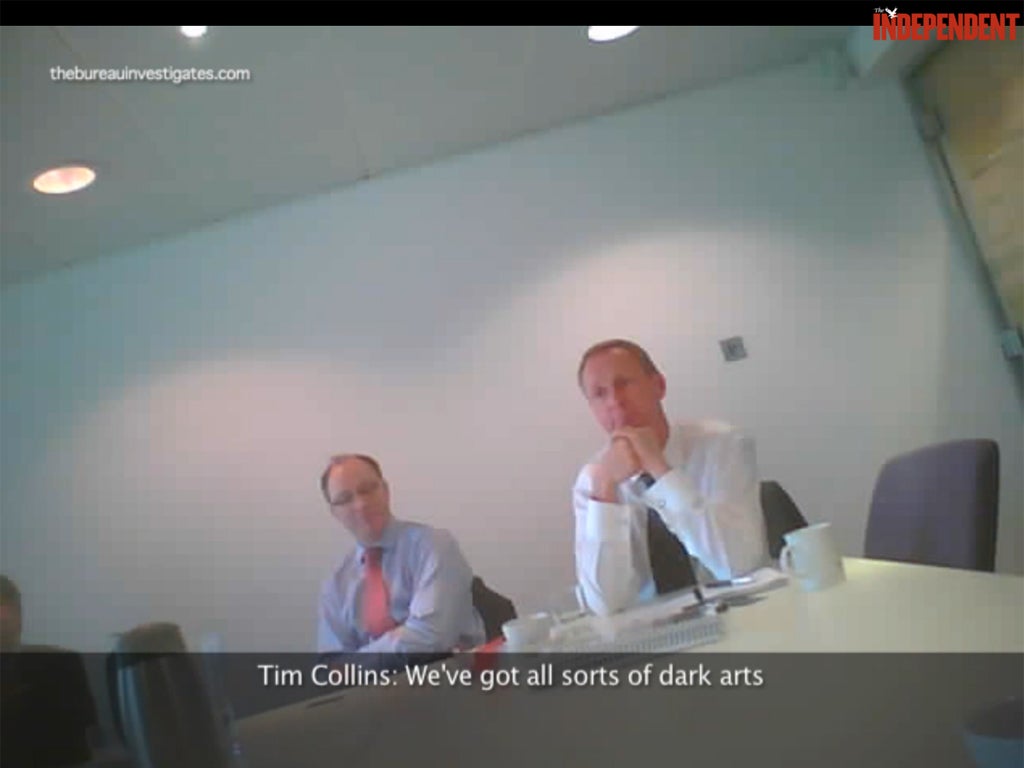
The right of investigative journalists to deploy subterfuge when attempting to shed light on the murky relations between politicians and lobbyists has been protected with a benchmark ruling by the Press Complaints Commission.
The regulator rejected a complaint brought against The Independent by the powerful lobbying and communications firm Bell Pottinger, following an exposé which revealed the company’s willingness to represent countries with appalling records on human rights.
It dismissed claims by the company, founded by Margaret Thatcher’s favourite PR executive Lord Bell, that an undercover operation by the Bureau of Investigative Journalism was unjustified because Bell Pottinger would have responded openly to the inquiries of journalists. The investigation “raised issues of significant public interest”, the PCC ruled.
The Independent revealed last year how Bell Pottinger had told journalists posing as representatives of the Uzbek cotton industry, who offered limited reform, of how it could use the “dark arts” to help its clients. Bell Pottinger boasted of its relationship with senior Government figures including David Cameron and the Foreign Secretary William Hague and talked of how it could manipulate Google and Wikipedia to minimise negative issues surrounding clients
The PCC rejected Bell Pottinger’s claim that the investigation was merely “embarrassing”, saying: “The material published…was more than just embarrassing: it provided significant insight into the means employed by lobbyists to assist such clients, including the network of political contacts that would assist this process.”
The Bureau had begun its investigation in the wake of comments by Mr Cameron, when leader of the Opposition, that the lobbying industry was “the next big scandal waiting to happen”. When the Coalition Government failed to introduce reforms of the sector in its first year, the Bureau carried out a series of interviews with confidential sources from within the industry to determine how to proceed. Based on what it was told, it concluded that there was a public interest justification for engaging in subterfuge to investigate the activities of 10 lobbying companies that had represented countries with dubious human rights records. The Commission supported this approach.
“The means employed by the journalists had been appropriately tailored to explore the allegations made by confidential sources about the firm’s activities, which raised issues of significant public interest. This was not a ‘fishing expedition’,” the PCC said.
“The public interest was served by subjecting them to wider scrutiny and comment, particularly at a time when the possibility of imposing greater regulation on the [lobbying] industry was being debated.”
The PCC highlighted the fact that during meetings between the undercover journalists and Bell Pottinger staff, the lobbying company had admitted that some of its work was too “embarrassing” to put in writing.
“The Commission could not accept that the complainants would have provided detailed information about such techniques to the BIJ and the public interest in the story lay largely in the precise information it included about the techniques used by [Bell Pottinger] and their relationships with political figures.”
Iain Overton, the Editor of the Bureau of Investigative Journalism, said the ruling was “a great result” which “exonerates” the work of the reporters and the decision to go undercover: “It impresses that the work of the Bureau, and investigative journalism, still has an important public role to perform and that stories such as this one can’t be smothered by the velveteen hands of PR spin.”
He said that he had expected Bell Pottinger to complain to the regulator. “During our undercover filming Bell Pottinger executives explained to us that one of the PR tools they used to attack news stories was to make an official complaint to the PCC. True to their word, Bell Pottinger went on the offensive following our exposé, claiming foul. Their bluster had no substance.
“The PCC’s final ruling exonerates our journalism and reinforces that undercover filming, when done in the public interest, has an important role to play in exposing wrongdoings. It also shows Bell Pottinger for what they are: masters of ‘dark arts’. When you consider this in light of the human rights abuses of the governments they have represented - Sri Lanka and Belarus to name just two - it reinforces the real need for a legal and public register of clients, as is practised in the US.”
Chris Blackhurst, the Editor of The Independent, said: “This is a landmark victory for those who believe in the importance of investigative journalism and its power to shine a light into the darker areas at the top of our society. The Independent always believed that it was acting entirely within the public interest and it’s reassuring to see that view upheld by the PCC.
“Bell Pottinger’s argument that there was no justification for subterfuge because all we had to do was ask them whether they would act for Uzbekistan never held water. There’s a world of difference, as Bell Pottinger well knows, between saying something for public consumption and saying it in private to win business.
“While the days of the PCC appear to be numbered it is worth recording that it could be a force for good and was not always concerned with stories involving celebrity tittle-tattle and tabloid intrusion.”
Paul Lashmar, a leading investigative journalist and an academic at Brunel University, praised the adjudication. “This is a very important area because a lot of organisations with dubious backgrounds use lobbyists and PR companies to cover up their activities,” he said.
“It’s quite clear that The Independent and the Bureau acted properly in this and that it was not a fishing expedition - they uncovered embarrassing information that was not in the public domain. It’s a bit ironic that the PCC has made one of its most important and nuanced judgments when it’s on its last knockings.”
Lord Bell told The Independent after the ruling: “The good thing is that as a result of the complaint I was given access to the entire tape of the meetings. I have been able to satisfy myself that nobody who works for me did anything wrong whatsoever, or behaved in any way improperly, unethically or illegally.
“The second good thing is that we have been cleared by our professional body the PRCA [the Public Relations Consultants Association].
“I think the fact that universally the PCC is regarded as not fit for purpose has been completely confirmed by the adjudication. I think the members of the Commission should be ashamed of themselves and I can’t wait for it to be replaced by a different body with different rules and most importantly with people who are independent.”
Join our commenting forum
Join thought-provoking conversations, follow other Independent readers and see their replies
Comments