Angela Morley: Composer and arranger who worked with Scott Walker and scored 'Dynasty' and 'Dallas'

For free real time breaking news alerts sent straight to your inbox sign up to our breaking news emails
Sign up to our free breaking news emails
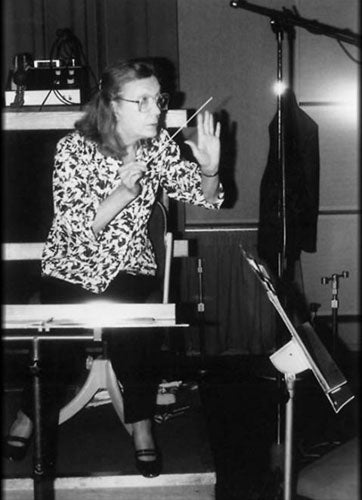
The full extent of Angela Morley's credits may not be fully appreciated as she spent the first 48 years of her life as Wally Stott. Combining her identities and her talents for composition, conducting and arrangement, Morley was responsible for several film scores including Peeping Tom (1959) and The Slipper And The Rose (1975), episodes of the TV series Dallas and Dynasty, hit records by the likes of Frankie Vaughan, Shirley Bassey and Scott Walker, and TV and radio themes, including for the renowned Hancock's Half Hour.
Wally Stott was born in Leeds on 10 March 1924, where he lived with his parents above their jewellery shop. As a young boy, he was intrigued by their collection of dance records andhe recognised them by their labels before he could read. He had pianolessons, but they stopped when his father died in 1933. His mother returned to her home town of Rotherham and there he taught himself to play the alto saxophone, playing in a dance band when he was 15.
When the war started, many dance band musicians joined the forces. This enabled the young Stott to find professional work, mostly in the north of England. In 1941, he joined the widely known Oscar Rabin Band, making his recording debut on "Waiting for Sally" and "Love in Bloom".
In 1944, Stott joined Geraldo, possibly the best-known bandleader of the time and certainly the busiest. They were featured on numerous BBC programmes and they could play swing or symphonies. Bob Adams, who played saxophone alongside Stott, remarked, "Wally played the alto beautifully. It is the sexiest of instruments and there was a beautiful effeminacy about the way Wally played." Stott studied Geraldo's orchestrations, particularly those written by Robert Farnon, and he took lessons in harmony and composition with Matyas Seiber and in conducting with Walter Goehr.
In 1953, Stott became the musical director for a new British label, Philips. The label had a relatively small staff and Stott's job was to assist Johnny Franz in selecting material for the artists and then to arrange and conduct the recording session, which Franz produced. Although many of the British artists were covering American hit songs, Stott determined to make the records as distinctive as possible. Frankie Vaughan's personality was showcased in "Green Door" (1956) and Stott strove to make "The Garden of Eden" (1957) more forceful than Vaughan's competitors. Stott wrote the explosive arrangement for "Tower of Strength" (1960), an early Burt Bacharach and Hal David song, which topped the UK charts.
The same principle held for Shirley Bassey and her hits included "The Banana Boat Song" (1957), "As I Love You" (1958) and "Kiss Me Honey Honey Kiss Me" (1958). Robert Earl, who scored a hit with "I May Never Pass This Way Again" in 1958, said, "The combination of Wally Stott and Johnny Franz was very good for me. They didn't believe in fade-out endings so all those ballads end on big notes."
Philips would release American product from Columbia and when their artists visited the UK, Stott would arrange and conduct their recordings. He worked on "I Am a Camera" with Marlene Dietrich in 1954, Christmas songs with Rosemary Clooney in 1957, and the highly rated album Mel Tormé Meets The British (1957). Stott released instrumental records and both "Limelight" (1953) and "The Cat From Coos Bay" (1954) were popular. He made several albums including Tribute To Jerome Kern (1956), Christmas by the Fireside (1959) and London Pride (1960). Peter Sellers, bored with playing variety bills, once said to his audience, "I'm going to play a record for you" and watched while they listened to Stott's "Christmas Sleigh Bells".
In addition, Stott scored several films including Hindle Wakes (1952), Charley Moon (1956), The Heart of a Man (1959), The Lady Is a Square (1959) and Michael Powell's highly regarded Peeping Tom (1959). His jaunty accompaniment to riders in Hyde Park, "Rotten Row", is very familiar, and he dedicated "A Canadian In Mayfair" to Robert Farnon. He wrote and conducted for Chappell Recorded Music Library, which often supplied music for films, and Broadway arrangements for Reader's Digest mail order releases. "Wally Stott was at the top of the range," said his fellow arranger, Tony Osborne. "We all looked up to Wally because we knew that he was second only to Robert Farnon, and it was a pretty close run thing at that!"
Despite this huge workload, Stott also worked for the BBC and when another composer, Stanley Black, became ill in 1954, he was assigned to write the music for a new comedy series Hancock's Half Hour. He wrote a cantankerous signature tune, played on a tuba by Jim Powell. Although Stott had never met him, it conveyed Hancock's personality perfectly. When they did meet, Hancock congratulated him on his work. He also wrote a parody of The Archers signature tune for Hancock by playing its theme, "Barwick Green", backwards.
Stott also conducted the orchestras for "Ring-a-Ding Girl" and "Say Wonderful Things", Ronnie Carroll's entries in the Eurovision Song Contest in 1962 and 1963.
Stott was involved in rock'n'roll, too, arranging Marty Wilde's album, Wilde About Marty (1959), as well as several of his hits. He arranged Dusty Springfield's "All I See Is You" (1966) and several of Scott Walker's interpretations of Jacques Brel's deeply troubled chansons, including "Jacky" (1967). Stott arranged Walker's 1969 album, Scott 3. Walker commented that "Working with Wally Stott on Scott 3 was like having Delius writing for you."
He scored the films, The Looking Glass War (1969) and Where Eight Bells Toll (1971), both of which starred Anthony Hopkins.
If Brel had known about Stott's private life, he might have been tempted to write about it. Stott's first marriage, to the choral arranger Beryl Stott, had ended in divorce, and he had recently remarried. However, when Stott returned from a holiday in Scandinavia in 1972, Johnny Franz was astonished to find him dressed as a woman. He had undergone a sex change operation, causing one of Philips' artists, Harry Secombe, to remark that, "I've heard of leaving your heart in San Francisco, but this is ridiculous." Musicians can be coarse and blunt, and rather than be a figure of ridicule, Morley told Franz that she would no longer be conducting. Franz persuaded her to continue and, largely because of her superb musicianship, she was accepted. Morley's transformation was also acknowledged by Christine Parker, Stott's second wife, who decided to remain with Morley.
Morley received Oscar nominations for the scores of Frederick Loewe and Alan Jay Lerner's music for The Little Prince (1974) and for Robert and Richard Sherman's musical version of Cinderella, The Slipper and the Rose (1978). In 1977, Morley took over from an ailing Malcolm Williamson on Watership Down, and although the best-known music sequence, "Bright Eyes", was written by Mike Batt, Morley's "Keehar's Theme" for alto sax and orchestra is often included in concert repertoires.
Moving to Los Angeles, she worked on several TV series including Dallas, Dynasty, Cagney and Lacey, and Wonder Woman, and won three Emmys for her work. She assisted John Williams in arranging his gargantuan scores for Star Wars (1977), Superman (1978) and The Empire Strikes Back (1980) as well as many other film scores that she either arranged or conducted. She arranged Mel Tormé's Christmas Songs in 1992 and turned her attentions to the recording of her own music.
In 1994, after being close to an earthquake, Morley moved to Scottsdale, Arizona. She was involved in the recording of two CDs of her music by the John Wilson Orchestra and she often lectured on film scoring at the University of Southern California.
Spencer Leigh
Walter Stott (Angela Morley), composer and orchestrator: born Leeds, 10 March 1924; married twice (one daughter, one son); died Scottsdale, Arizona 14 January 2009.
Subscribe to Independent Premium to bookmark this article
Want to bookmark your favourite articles and stories to read or reference later? Start your Independent Premium subscription today.
Join our commenting forum
Join thought-provoking conversations, follow other Independent readers and see their replies