Arthur Wilson: Trombonist hailed as the most important of his generation

For free real time breaking news alerts sent straight to your inbox sign up to our breaking news emails
Sign up to our free breaking news emails
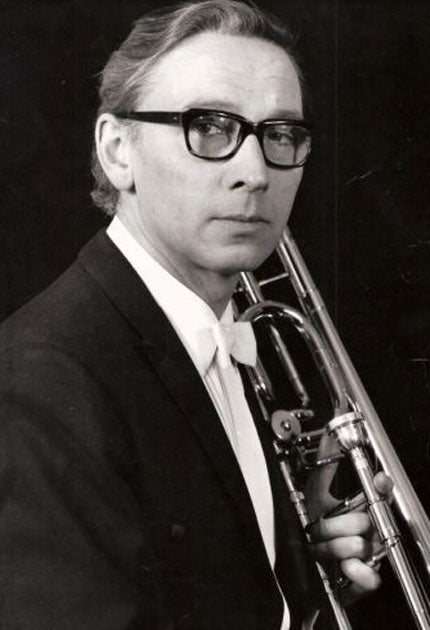
Arthur Wilson was a master of the trombone and a mainstay of British orchestral brass in the second half of the 20th century, both through his playing and his teaching. Seldom in the orchestral spotlight, he none the less made audiences aware of the trombone in the quality of his playing in the Philharmonia, which he joined as second trombone in 1951, becoming principal in 1962 until leaving the orchestra in 1979. During this time he played regularly under Karajan, Klemperer, Giulini, Muti, Maazel and Frubeck de Burgos, all of whom appreciated his musicianship and the skill with which he brought the orchestra's trombone section to such a high standard. He was Professor of Trombone at the Royal College of Music from 1967 until 1999, seven years beyond professorial retirement age, and many trombonists in British orchestras today owe the development and honing of their skills to his inspiration and care.
Arthur Wilson was born in London with a father and grandfather who were both professional trombonists of the dance-band and theatre-pit world. When he was 16 his father lent him his spare trombone and let him get on with it, and Arthur modelled his playing on the records of Tommy Dorsey. He remained largely self-taught until National Service, when he joined the band of the Coldstream Guards, and from there went to the Royal College of Music on one of the exhibitions offered at that time to military bandsmen. This set him on the path of orchestral trombone playing, contact with other young players – many of whom would later become colleagues – and training at the hands of Morris Smith.
A variety of post-war work kept him busy until 1950, when the position of second trombone in the London Symphony Orchestra fell vacant. After one year there he was successful in gaining the same position in the newly formed and high-powered Philharmonia Orchestra, later becoming principal. It was during this period that he decided that the first trombone parts written by Beethoven, Berlioz, Schumann and others in the 19th century for the alto trombone should be again played on that instrument and not the tenor trombone in general use. At first this caused comment but the tonal difference was increasingly appreciated by conductors, to the extent that other principal trombones also took up the alto instrument.
After leaving the Philharmonia, Wilson joined the orchestra of the Royal Opera House, Covent Garden as co-principal trombone until 1981. In 1967 Morris Smith died and Arthur was the obvious choice to succeed him as professor of the instrument at the Royal College of Music, being elected a Fellow in 1995. He was active in other areas, being a founder member of the Philip Jones Brass Ensemble and principal trombone of the English Chamber Orchestra whenever it expanded to play large-scale works, particularly for Britten and Barenboim.
His diary was ever full. His wisdom was also imparted to younger players when he was appointed trombone coach to the National Youth Orchestra and he went on giving advice to players who called upon him in his busy years of retirement.
For trombonists today, the name Arthur Wilson brings immediate, pleasurable reminiscences coupled with a deep sense of gratitude for all that he did for them individually and for their instrument generally. They remember a gentle man, always correctly dressed, ready with a humorous tale or generous with words of trombone wisdom, acts of kindness and warm hospitality.
I had the good fortune to know Arthur from his Philharmonia days and from 1986 as a near-neighbour in north London. His later years were beset by the onset of Parkinson's Disease and as this progressed he was sustained by his wife, Fiona, who ensured that he was able to get to the Wigmore Hall or Glyndebourne, while carers enabled him also to go to Lords – he was a great cricket lover – and Wimbledon. He retained his gentle manner, welcoming mien and enquiring mind, and the house was ever-full of friends and professional musicians.
Arthur John Wilson, trombonist: born London 21 June 1927; married 1949 Edna Violet Snelling (marriage dissolved 1977), 1991 Fiona Margaret Grant; died London 10 July 2010.
Subscribe to Independent Premium to bookmark this article
Want to bookmark your favourite articles and stories to read or reference later? Start your Independent Premium subscription today.
Join our commenting forum
Join thought-provoking conversations, follow other Independent readers and see their replies