Baroness Park: Diplomat and Intelligence Service officer who served in Moscow, Hanoi, Africa and Mongolia
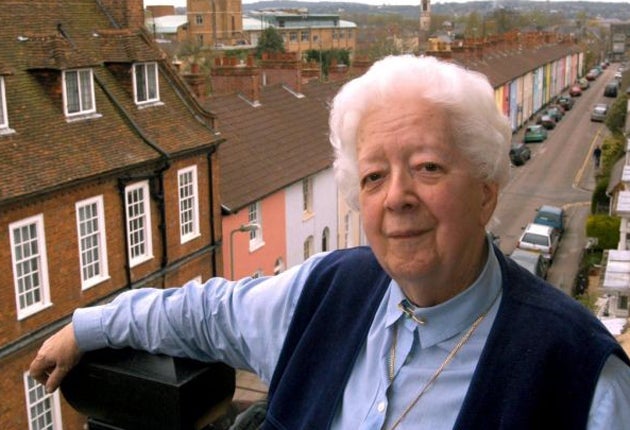
The shade of Daphne Park would not be the least disconcerted or offended – she was a Lady of powerful opinions pungently expressed – by being dubbed "Baroness Spooks".
Indeed, the cross-Party Alliance she most valued in her autumn days was with another distinguished former member of the Security Services, the Labour peer, Lady Meta Ramsay of Cartvale. It encapsulated Park that she should put in Dod's Parliamentary Companion that her recreations were good talk, politics and difficult places. She was, indeed, a difficult and fascinating Lady.
About Daphne Park little or nothing was ordinary. Although she was actually born in Britain, within weeks she was on her way to Africa, where her father, John Alexander, who never actually married her mother, was a gold prospector. Until she was three she was trekked around remote places in the gold field areas. John Alexander and her mother Doreen Gwynneth Park, a stoutly Welsh lady from Monmouth (which Daphne took as her territorial title when her friend Margaret Thatcher, a fellow Somervillian, raised her to the House of Lords), came back to England fleetingly for her brother to be born.
On return to Africa, John Alexander was sent by his superiors to unhealthy country where there was an ever-present threat of a hungry lioness who might take a fancy to the only white children in the area, and where mosquitoes and tsetse fly were an even greater threat. So Doreen Park leased a coffee plantation in the Kenyan hills. As she knew that she herself was going blind, gradually she taught Daphne to read at a very early age. In 1928, when she was seven, her mother organised a correspondence course which used to arrive by runner. Later she reflected that it was a wonderful way of learning history, geography and literature but she could not recommend it as a way for learning maths.
In 1932 her parents decided that they could not teach her any more and so her mother skimped and scraped for the fare for her to come home to England, where her Monmouth grandmother and London great-aunts became her guardians. She was not to see her parents again until 1947, when she was 26 years old, as war-time communications made it impossible.
A great aunt sent her to what Daphne was throughout her life to regard as a superb London experimental secondary school, the Rosa Bassett School, where her teachers took a kindly interest in the scrawny child separated from her parents marooned by Hitler and Mussolini in Africa. They put her in for a state scholarship to Somerville and she won a County Major Award. About a month before she was due to go up to Somerville her grandmother and aunts moved out of London so that technically she no longer qualified for the County Major Scholarship.
Park recalled – she was always able to laugh at herself, which was a redeeming feature in such a tigress of a lady – that she went, like a real St Trinian's girl with wrinkled stockings, glasses and pigtails, to the Surrey County Council education committee for a loan; they said yes, they would give a loan provided Park agreed to teach in Surrey for five years after she left Somerville. She took them aback by telling them that she did not want to teach since she wanted to be a diplomat. The Surrey officials replied to her that there were no women diplomats.
Ten days later they sent for Park again to tell her that they had decided not to make a loan. Park told me that she leapt to her feet and demanded why they couldn't have told her that before. The Surrey Education officer then told Park that she wouldn't make a very good diplomat if she didn't have the patience to keep her mouth shut until the end of his sentence.
He then beamed and said as she knew very clearly what she wanted to do, and since it was a public service, and since he was impressed by the fact that she wasn't prepared to fudge, the Surrey County Council had created a special scholarship for her. Park told me that she had often regurgitated that story when people said to her that bureaucrats were frightful. That Surrey County Council official was to have a lifelong influence on one who took a pride in defending the public service, even in conversation with Margaret Thatcher in her heyday.
Park went in to the Special Operations Executive in 1943, working as a codes instructor, and after a spell helping track down war criminals, she became a member of the Intelligence Service in 1948. Following a spell in a junior position as a member of the UK delegation to Nato – the start of a lifelong love affair with that organisation – she was posted in 1954 to Moscow, nominally as Second Secretary to the British Embassy but in fact as station head for the Intelligence Service. She caught the professional eye of that most discerning of diplomats, Tommy Brimeloy, to be Permanent Secretary at the Foreign Office).
Brimeloy's hard-nosed view of policy in relation to Communist states rubbed off on Park. On promotion Park's next posting, in 1959-61, was as Consul and First Secretary in Leopoldville, where she had to deal with Patrice Lumumba and his pro-Russian associates, the murderous friends of the future president Mobutu, and the dissidents in the fabulously rich state of Katanga. No one who shunned hard work and hard physical conditions would have survived in that maelstrom. But Park was physically tough and as hard as nails and escaped with her life more than once.
Serving at the epicentre of intelligence in London from 1961-63, she was appointed by a Conservative government to the Zambian capital Lusaka in 1964, where she never hesitated to give candid advice to Arthur Bottomley and other Labour ministers when the political complexion changed in 1964. She was very much at the centre of events when Ian Smith, Joshua Nkomo and Robert Mugabe were in the world's headlines.
When I went to Lusaka at Speaker Betty Boothroyd's request to represent her as a speaker at a conference of the southern cone of Africa, Zambian politicians recollected the unforgettable woman who had been the British representative all those years before. Unforgettable, unforgotten: that was Daphne Park, wherever she was posted.
Park never would tell me what she got up to between 1967 and 1969, when she was appointed Consul General in Hanoi. What I do know is that she has won the high regard of the man responsible for this hot cake of an appointment, Sir Maurice Oldfield, sometime British Intelligence chief in South-East Asia and the advisor who did more than any other man to stop Harold Wilson acceding to Lyndon Johnson's request to send a battalion of bagpipers as a symbol of British support for the Americans in the Vietnam War.
Courage, Park always claimed, was at the top of her list of qualities. She did not only mean physical courage. When I asked her who she most admired she paused and said quietly: "You know, it was an English governess in Poland who stayed behind when the Germans came. Because she seemed timid and quiet she was ignored while she ran an escape line for crashed pilots and others out of Poland for the whole of the war."
In the same way Park came to admire some of the new rulers of Indo-China, though not their political philosophy. As if Hanoi was not a problem enough in 1972, she was sent briefly to the British Embassy in Ulan Bator when an embassy opened in Mongolia. Recalled to London, she worked inside the Foreign Office 1973 to 1979 and was on the brink of a very senior position indeed when she decided to retire early after she had been approached to be a candidate for the principalship of her old Oxford college, Somerville.
As a member of the British Library Board from 1983-1989 she was regarded as a huge asset by the chairman, Professor Fred Dainton, formerly Vice Chancellor of Nottingham and Professor of Chemistry in Oxford. His successor, Commander Michael Saunders-Watson, said she was tremendously impressive, both on the Library Board and as chairman of the Royal Commission on the Historical Monuments of England 1989-94. As the owner of the great stately home of Rockingham Castle and the founder of the Heritage Educational Trust, Saunders-Watson was in a position to judge. All who came in contact with Park, not least her fellow members of the House of Lords, were deeply impressed – and justifiably so.
Daphne Margaret Sybil Desiree Park, dilpomat, a mistress of Somerville College Oxford 1980-1989: born London 1 September 1921; educated: Rosa Bassett School, Streatham, Somerville College, Oxford (BA Modern Languages 1943),Newnham College, Cambridge; served: First Aid Nursing Yeomanry 1943-1948; Allied Commission Austria 1946-1948; UK Delegation to Nato 1948-1952; Second Secretary British Embassy Moscow 1954-56; Foreign Office 1956-1959; Consul and First Secretary, Leopoldville 1959-61; Foreign Office 1961-63; High Commission, Lusaka 1964-67; Foreign Office 1967-69; Consul General, Hanoi 1969-1970; Charge D'Affaires Ulan Bator 1972; Foreign Office 1973-79; Principal, Somerville College, Oxford 1980-89; Governor, BBC 1982-87; Member, British Library Board 1983-89; Member, Lord Chancellor's Committee on Legal Aid 1984-1990; Pro-Vice Chancellor, University of Oxford 1985-89; Chairman, Royal Commission on the Historical Monuments of England 1989-94; Member, House of Lords 1990; died 24 March 2010.
Join our commenting forum
Join thought-provoking conversations, follow other Independent readers and see their replies
Comments