
For free real time breaking news alerts sent straight to your inbox sign up to our breaking news emails
Sign up to our free breaking news emails
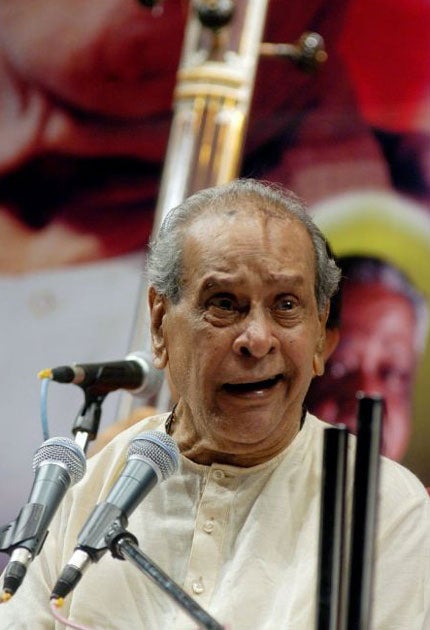
It is not often that one can describe somebody as the greatest in their field. In the case of the Indian classical vocalist Bhimsen Joshi that accolade really did apply. Renowned for his music's unsurpassed expressiveness and virtuosity – especially his tayyari or fast-passage extemporisations – he was one of those musicians of whom it can be said that to see them perform is a blessing. He became one of the foremost representatives of the gharana – school or style of music-making – known as Kirana. Yet there was always the possibility of something stylistically unexpected or joyously wayward emerging during a recital.
He was one of seven children born to a literary-minded, Kannada-speaking family; his mother Godavaribai named him after his grandfather Bhimacharya, believing him to be his reincarnation. His father, Gururaj Joshi ,was a schoolteacher, lexicographer and linguist, the author of, among other works, a major Kannada-English dictionary and Bhimsen Joshi's first biography, the Kannada-language Nadaputra (Child of Sound, 1967). There would be other biographies of his son, notably two by the eminent Indian critic, Mohan Nadkarni, Bhimsen Joshi – The Man and His Music (1983) and Bhimsen Joshi: A Biography (1994).
Bhimsen began picking up bhajans [Hindu hymns] from his mother from early on and as little more than a tot could replicate them pretty faithfully. His parents recognised his musical gifts and arranged for paid lessons, first with Channnappa Kurtakoti and then Pandit Shyamachaya. Besotted with music, he played truant in order to loiter near a shop and listen to records being played for customers.
At the age of 11, he ran away from home looking for a guru to teach him music. Hopping on a train from Gadag to Bilapur, he evaded the ticket inspector and sang classical and hit songs in exchange for food. After many adventures he reached Gwalior, where he received his first professional fee, when the Maharajah gave him 10 rupees (enough for two meals a day for three months) and a coconut. Two years later, the runaway fare-dodged his way home.
One of his favourite musicians was Abdul Karim Khan, a singer with a maverick streak whose sublime powers of spontaneous creation in a raga were matched by his fondness for breaking the rules. Joshi's long-suffering father managed to wangle a meeting with Khan's shishya [pupil] Sawai Gandharva in 1935 and he accepted the boy as his shishya. He slaved, doing menial work for his guru for 18 months before his first lesson, a test of his commitment and what would become of his voice after it broke. Many singers' voices change register or timbre when singing, suggesting a measure of artifice. Joshi's singing voice only differed from his speaking voice in its heightened artistry. There was nothing "put on" about his voice, or him.
During the war he was accepted as an All India Radio staff artist, a career fillip, at AIR's Lucknow station. With the decline of courtly patronage, AIR was taking over the role of India's principal patron of the musical arts. The duties were light – three 10-minute broadcasts a week – and he roomed with Bismillah Khan, a virtuoso of the shehnai, an oboe-like instrument. With the threat of Japanese invasion, he returned to Bombay in late 1942. Yet though he passed the Bombay station's audition, the hoped-for regular slots never materialised.
After a big concert break in January 1946, his star rose, especially thanks to his command of the khyal song style. As Sheila Dhar wrote in Raga 'n' Josh (2005), audiences "simply worshipped" him. However, Joshi was not exclusively a classical performer. He sang for films. One, Ankahee (1985), had particular resonance; its plot hinged on the source of his surname – jyotishi, a practitioner of jyotish, or astrology.
His marital life was complicatedbut not unique. In 1944 he married his cousin Sunanda, with whom he had two sons and two daughters. Both pre- and post-Partition, India was a land witha plethora of civic, religious and regional practices concerning marriage. By the simple expedient of relocatingto Nagpur in the Central Provinces, there could be no charges of bigamy when he married again in 1951. That marriage produced two sons and a daughter, and for many years Joshisupported both families under the same roof until he set up Sunanda in another property.
In 2008 he was the last person to be awarded India's Bharat Ratna, its highest civilian award. Its penultimate recipient had been Bismillah Khan in 2001.
Bhimsen Gururaj Joshi, Hindustani classical singer: born Gadag, Dharwad District, Bombay Presidency (now Karnataka), India 4 February 1922; married firstly Sunanda Hungund (deceased 1992; two sons, two daughters), secondly Vatsala Dhondopant Mudholkar (two sons, one daughter); died Pune, Maharashtra 24 January 2011.
Subscribe to Independent Premium to bookmark this article
Want to bookmark your favourite articles and stories to read or reference later? Start your Independent Premium subscription today.
Join our commenting forum
Join thought-provoking conversations, follow other Independent readers and see their replies