Bill Frindall: Long-serving scorer on 'Test Match Special'
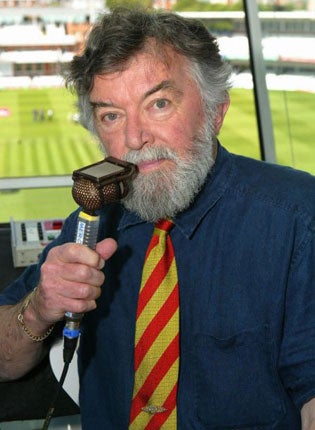
Only in cricket, with its obsession for statistics and records, could the rather anoraky image of a scorer, the person who chronicles each and every ball of a game, be transformed into that of a celebrity. But that is exactly what Bill Frindall, who died at the age of 69 on Friday after contracting Legionnaires' disease, became during 42 years of faultless scoring for BBC's Test Match Special.
Frindall was the doyen of cricket scorers. His profile gave this largely unappreciated but absolutely necessary breed of cricket followers a voice and respect at the sport's top table. Watching him work was a sight to behold. He was territorial, arriving early every morning to fill a large proportion of the front desk with books, scoring pads, stop watches and a computer. That the space he took up resulted in the commentator and summariser squeezing into a tiny area did not bother him. He knew how important he was to the smooth running of the programme, and he let those around him know it; heaven forbid if anyone spilt anything on his work.
Those who have spent time scoring will realise how confusing the whole experience can be, and Frindall was the first to use a new method, which marked each ball against the batsman rather than the bowler. The linear scoresheets made it easier to collate information. Yet despite often having his head in three things at once – scorebook, computer and reference book – when attempting to confirm a statistic or record, he was meticulous.
The concentration needed to maintain such consistently high-quality work was immense, and Frindall believed it was his time in the RAF that prepared him for the task. Writing honed by his training to be an architect meant that each page was beautifully laid out and easy to read. Every scorecard, like the wagon-wheels he produced to show where a batsman scored his runs after playing a significant innings, was a work of art.
He was a perfectionist. As a commentator you had no excuses forgetting anything wrong. Indeed, ifhe said that the scoreboard inthe ground was wrong the commentator would trust his view. Such a stance continued with records, too. There were several instances of television flashing a record up on screen onlyfor Test Match Special to refuse to confirm it until Frindall had given it the thumbs-up.
In India before Christmas there was an example of this when Graeme Swann took two wickets in his first over of Test cricket. Television said that it was the first time the feathad taken place. Within minutes Frindall pointed out that England's Richard Johnson had performed the same feat against Zimbabwe at Chester-le-Street in 2003.
Frindall, educated at Reigate Grammar School and the Kingston School of Art, took great delight in informing people that he was born on 3 March 1939, the day the famous timeless Test between South Africa and England in Durban began. The pay-off was that he was 11 days old when the imminent departure of the boat home caused the Test to be abandoned as a draw.
His love of cricket was genuine and he played for many teams as a tearaway fast bowler. Indeed, it is believed he contracted the illness that caused his death while touring Dubai withthe Lord's Taverners. One of the teams he played for was Elvinos , a nomadic touring side set up by the late,legendary figure of sports journalism, Reg Hayter. Frindall used to turn up atElvinos' winter nets at Lord's – an excuse for mates to meet up, roll back the years and have a chat – then,with his beard and hair flowing and his shirt undone to just above the navel,he would sprint in believing hewas Fred Trueman Nobody had the heart to tell him that he ran in quicker than he bowled.
Frindall's association with the BBC began on 2 June 1966 when he scored the first Test between England and the West Indies. He did not miss any of the 246 home Tests that followed. In all he worked on 377 Tests, the last being England's pre-Christmas match against India in Mohali. As he placed his books in his bag at the end of the match I can still remember him saying, "See you in the summer, Gussie."
Frindall initially became famous for being Brian Johnston's stooge. Indeed it was Johnston who christened him the "Bearded Wonder". He also had a good relationship with John Arlott, who quickly found out that he enjoyed driving. On hearing the news Arlott reportedly said: "I like drinking; we're going to get on well." Jonathan Agnew continued the tradition of poking fun at Frindall when he became the BBC's cricket correspondent.
Armed with his own personal microphone, Frindall rarely missed an opportunity to air his views , some of which were not that politically correct. His interruptions were not always appreciated, particularly by Henry Blofeld, whom he would pull up every time he got the name of a fielder wrong. It was the perfectionist in him coming through again.
Frindall was stubborn too, particularly over records and what should be judged as a Test or one-day performance. Right to the end he refused to recognise the Super Series encounter between Australia and the Rest of the World in Sydney. In the Playfair Cricket Annual, the statistical book he edited for 23 years, the performances of Andrew Flintoff , Stephen Harmison and others are ignored. He also became upset when the game's ruling body the ICC decided to award one-day international caps once the toss had taken place, not after the first ball of the game had been bowled. His at times curmudgeonly approach to life will be hugely missed by those who worked with him and listened to him.
Frindall's celebrity status earned him plenty of work on the after-dinner speaking circuit, where he puton an extremely good show. Hisact contained lots of tales about Arlott and Johnston, who he imitated extremely well.
In 2004 Frindall was awarded the MBE, of which he was immensely proud. He won the Beard of the Year award, too. He is survived by his dedicated wife and their daughter Alice, along with two sons and a daughter from his first marriage.
Angus Fraser
William Howard Frindall, cricket statistician, broadcaster, writer and editor: born Epsom, Surrey 3 March 1939;married 1960, Maureen Doris Wesson (marriage dissolved 1970, two sons,one daughter), 1970 Jacqueline RoseSeager (marriage dissolved 1980),1992 Deborah Margaret Brown (one daughter); 2004 MBE; died Swindon 29 January 2009.
Join our commenting forum
Join thought-provoking conversations, follow other Independent readers and see their replies
Comments
Bookmark popover
Removed from bookmarks