Bill Speirs: Trade union leader who espoused Scottish nationalism and led the Make Poverty History campaign
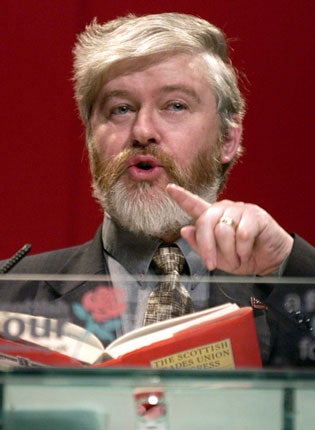
Bill Speirs was a huge figure in the public life of Scotland for a quarter of a century, from 1980 until 2005. He was passionately and genuinely in favour of a Scottish parliament and when he was chairman of the Labour Party in Scotland even his friends admitted that Speirs was indistinguishable from a nationalist. Though he might well have kept me at a distance, as an arch antidevolutionist and leader of the Labour Vote No campaign, we actually became close friends. The reason was simple: we shared a deep opposition to the Falklands War and subsequently to the military action in Iraq and latterly Afghanistan.
For all his Scotland-centric views, Speirs was an international figure who had the respect of those involved in the international trade union movement, espousing anti-apartheid action in South Africa and such causes as the rights of Columbian banana workers, who were being exploited. He also had fierce sympathy with the Palestinians as a result of many visits to the West Bank. The director of the executive office of programmes for Unison, Bill Gilbey, recalled as a fellow member of the international trade union team of observers at the 2005 Palestinian elections, that the name of Bill Speirs meant a great deal: “The Palestinians we met and my fellow delegates from other countries were almost in awe of Bill’s experience, knowledge and understanding of the problems.”
William MacLeod Speirs loved to tell us that he was “a son of the rock” – that means a proud man from Dumbarton.
In conversation with wealthy businessmen and grandees – he was always pleasant and good company with those with whom he had profound disagreements – he would say with a chuckle that he betted they weren’t born in such a superb baronial mansion as his birthplace. He referred to Overton House, which in the 1950s was a maternity hospital with marvellous views of the Clyde and Dumbarton rock.
A clever son of a family going back generations in the engineering side of the shipyards, he won a bursary to the John Neilston Institute, a famous Paisley secondary school. This prepared him not only for university entrance to Strathclyde but for a first class honours degree in politics. Following that, and before joining the staff of the Scottish Trades Union Congress, he was a successful lecturer at The University of Strathclyde, Glasgow Caledonian University and the Paisley College of Technology.
I first heard his name from the Principal of Strathclyde University, Sir Samuel Curran, who predicted that this brilliant student would soon become one of my colleagues in the Scottish group of the parliamentary Labour Party. This was not to be.
Whereas Speirs could most certainly have won selection in many west of Scotland constituencies, he chose to join the STUC and help the then general secretary, Jimmy Jack, in campaigns for improving workers’ conditions.
No man in Scotland did more to promote the importance of health and safety at work.
Speirs did a great deal of the work in leading the opposition to Mrs Thatcher, both at the time of the miners’ strike and during the protests against the poll tax. He was a tremendous hands-on beaver at organising meetings.
Because he worked so hard himself, he inspired other people to go to the proverbial ends of the earth, and supported them when they defied the law in relation to the poll tax.
To my dismay, Speirs was extremely effective in spreading the notion that a Scottish parliament would protect Scotland against the ravages of Mrs Thatcher. I know that he was angry that devolution had been, as he saw it, denied to Scotland after the referendum in March 1979, and he was determined to rectify the position in the 1980s and early ’90s. He was all the more effective by being charming to those with whom he disagreed.
One of Speirs’ triumphs, with his boss and friend Campbell Christie, whom he succeeded in August 1998 as general secretary of the STUC, was leading the Make Poverty History campaign. This culminated in huge demonstrations in Edinburgh in the week of the G8 summit in Gleneagles in July 2005. His theme of international trade union rights was the issue at the heart of any effective programme for tackling world poverty: he demanded for all workers the right to freedom from forced labour, freedom from child labour,
the right of non-discrimination in the workplace and above all the right to form and join a trade union and to conduct bargains on a collective basis.
“I never met anyone whose core values and personal beliefs were so organically connected to his public and political positions,” Dave Moxham, the STUC’s deputy general secretary told me. “Bill was a builder of broad coalitions but a man who never compromised the interests of the workers he represented. A powerful political innovator who remained uniquely approachable to those who had less knowledge than he had.”
As general secretary of the STUC he was often called upon to give evidence to the parliament in Westminster and to the parliament at Holyrood.
He made himself a considerable authority on the Scots whisky industry, saying, “the STUC and the Scotch Whisky Association have worked closely together for years in seeking to insure that the industry continues not only to survive, but develop as a significant contribution to employment in the Scottish community.”
Speirs told me that he did not want to be general secretary for more than five years, and in 2006 he chose to step down, giving stress as his reason. In fact his friends knew that it was the onset of an illness which was to cause his death at the early age of 57.
Tam Dalyell
William MacLeod Speirs, trade unionist: born Dumbarton 8 March 1952; General Secretary, Scottish Trades Union Congress, 1998–2006; married firstly Lynda (divorced; one son, one daughter), secondly Pat Stewart; died Glasgow 23 September 2009.
Join our commenting forum
Join thought-provoking conversations, follow other Independent readers and see their replies
Comments