Bob Keane: Record producer who kick-started the careers of Sam Cooke, Frank Zappa and Barry White

For free real time breaking news alerts sent straight to your inbox sign up to our breaking news emails
Sign up to our free breaking news emails
The Los Angeles record producer Bob Keane, who would go out of his way to spot new talent, had one motto in life: "The door is always open". During his key decade (1957-67), from the start of rock'n'roll to the beginning of psychedelia, he played a significant role in bringing Sam Cooke, Ritchie Valens, Frank Zappa and Barry White to public attention.
Robert Kuhn was born the son of a building engineer in Manhattan Beach, California on 5 January 1922. He took up the clarinet when he was seven and by the time he was 17 he had his own jazz band. They played when another band cancelled a radio broadcast at the last minute, and as a result he was signed to MCA Records as "the world's youngest bandleader".
After war service helping to train recruits, Kuhn worked with Artie Shaw's band and even took his solos when the belligerent Shaw wanted time off. In 1950 he was the conductor for NBC's The Hank McCune Show, the first TV show to use canned laughter. He decided to change his name after announcers kept calling him "Bob Coon". He realised that this would be an embarrassment and he became Bob Keene and later Bob Keane.
In 1957, a businessman, John Siamas, offered to partner Keane in a new record venture, Keen Records. Siamas wanted to record pop versions of Greek standards, but Keane knew that this spelt failure. Over at Specialty Records, the producer Robert "Bumps" Blackwell had persuaded the gospel singer Sam Cooke to sing pop and had recorded the delightfully romantic "You Send Me". Art Rupe, the owner of Specialty Records, thought that his label might be boycotted if they encouraged Cooke to give up gospel, so Blackwell played the tapes to Keane. Keane could hardly believe his luck, and within a few months of their inauguration, Keen Records had a US No 1.
At first, Siamas and Keane were good friends and Siamas was best man at Keane's wedding. However, they fell out when Keane realised that Siamas was creaming off the profits. He left the company but was able to keep the recording equipment. He set up a new label, Del-Fi: he chose the name as a constant reminder not to trust Greeks.
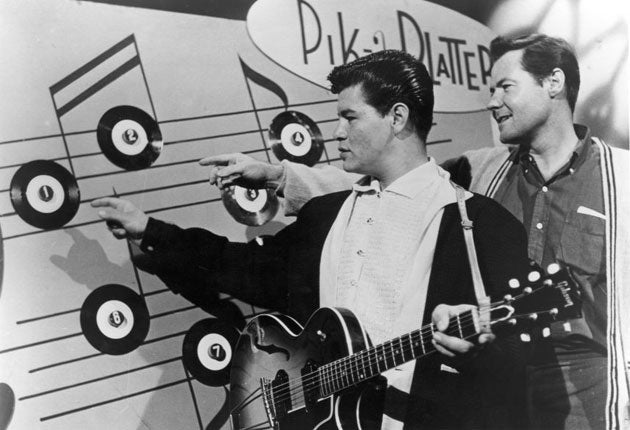
Del-Fi had a moderate success with Henri Rose's "Caravan" and when Keane was having some stationery printed, he was told of a 15-year-old Mexican who was "the Little Richard of the San Fernando Valley". When he saw Ritchie Valens in Pacoima, he was impressed by his stage demeanour, but thought his compositions lacked structure.
"Ritchie usually had a title and a little phrase, but the rest of the song would go nowhere," Keane told me in 1996. "He hadn't worked out how to write middle eights and the compositions would meander around and come to a close. I had to rewrite the songs and put them together. We cut 'Donna' on my little portable recording system, and then we added other instruments at the Gold Star Studio and I sang some harmonies."
Such ad hoc recording led to one of the era's biggest hits, "Donna", in 1958. However, the single is now remembered for its B-side, "La Bamba". "I liked 'La Bamba' as soon as I heard it played by Ritchie in the back of my car," Keane continued. "He was playing it on his guitar as an instrumental. He had to get the Spanish lyrics from his aunt. The Americans didn't relate to Latin music, which was ethnic music to them, so I figured it would have to be a throwaway."
In February 1959, Valens died in the plane crash which also killed Buddy Holly and the Big Bopper. Over the years, Keane did much to preserve Valens' legacy and was an advisor on the film La Bamba (1987), which starred Lou Diamond Phillips as Valens and Joe Pantoliano as Keane. Keane welcomed the exposure but felt that Valens' story had been turned into a soap opera.
Keane was devastated at losing his protégé, but did record another young Mexican, Chan Romero, who wrote "Hippy Hippy Shake". Other successes included Ron Holden's "Love You So", Little Caesar and the Romans' "Those Oldies But Goodies" and Johnny Crawford's "Cindy's Birthday".
He signed a young Frank Zappa, whose idiosyncratic singles were later collected on the album Cucamonga (1997). "He was living on the outskirts of LA and they were the first things he recorded," Keane said. "He had a good feel but the subject matter was crazy, like 'How's your ma, how's your pa, how's your bird?' It was pretty funny, but a lot simpler than the stuff he did later on. It is typical Zappa, though, and I really like it."
Although Del-Fi had a varied catalogue, Keane found a niche with surf music. His many surfing singles included the Centurions' "Bullwinkle (Part 2)" and the Lively Ones' "Surf Rider". He was also the first to record the king of the surf guitar, Dick Dale, but he let him go after an argument with Dale's father.
In 1965, he started an R&B subsidiary, Bronco, and hired Barry White as producer and A&R man. This led to the hits by Felice Taylor, "I Feel Love Comin' On" and "It May Be Winter Outside (But in My Heart It's Spring)".
In 1963, Keane signed the El Paso band the Bobby Fuller Four, who were fanatical about Buddy Holly and the Crickets. They had a US Top 10 hit with a revival of the Crickets' "I Fought the Law" (1966) on another Del-Fi subsidiary, Mustang. Fuller was set to become a major star but was foolish enough to date the girlfriend of a mobster. This might, or might not, have led to Fuller's bizarre murder in 1966 – the crime was unsolved - but once again, tragedy ruined Keane's business plans.
This time, Keane had had enough and he left the record industry, selling burglar alarms to Hollywood celebrities for a living. Then, in 1977, he managed his sons, John and Tom, who performed as the Keane Brothers on national television. In the 1980s Keane revived Del-Fi and released some superbly packaged collections, including box sets from Ritchie Valens and the Bobby Fuller Four. In 1994, Quentin Tarantino showed his interest in Del-Fi's catalogue by including some of its records on the soundtrack of Pulp Fiction. In 2003, Keane sold the Del-Fi catalogue (some 2,000 titles) to Warner Music, and he wrote his autobiography, The Oracle of Del-Fi, in 2006.
Spencer Leigh
Robert Verrill Kuhn (Bob Keane), record producer: born Manhattan Beach, California 5 January 1922; married twice (three sons, one daughter); died Hollywood, California 28 November 2009.
Subscribe to Independent Premium to bookmark this article
Want to bookmark your favourite articles and stories to read or reference later? Start your Independent Premium subscription today.
Join our commenting forum
Join thought-provoking conversations, follow other Independent readers and see their replies