Christopher Nolan: Irish author who overcame cerebral palsy to win the Whitbread Prize at the age of 21
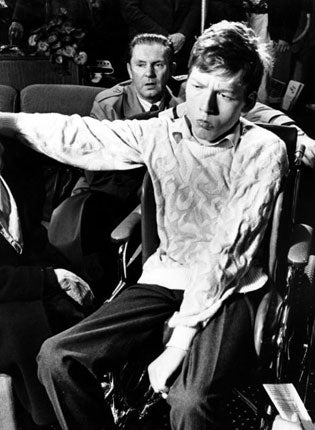
With the three acclaimed books he produced, Christopher Nolan proved himself a significant Irish literary figure. With his lifelong struggle against cerebral palsy he proved himself a man of almost superhuman fortitude and tenacity.
He could not speak or move, his condition being so severe that moving his eyes was virtually his only means of communicating unaided. Typing a single word took minutes: his mother had to cup his head in her hands while he tapped at a typewriter with a stick attached to his forehead.
The effort involved was herculean, heroic, for both Nolan and his mother Bernadette. It was a cruel paradox that a person in his condition – she once described him as being “gagged and in a straitjacket for life” – should have an indomitable craving to communicate.
It was therefore one of the highlights of his life when he received a Whitbread Prize at the age of 21. He wrote exultantly: “I want to shout with joy. My heart is full of gratitude. You all must realise that history is now in the making. Crippled man has taken his place on the world’s literary stage.”
He wrote for himself but also for those with similar conditions who had inner feelings but no way of conveying them. He felt he had a duty “to find a voice for the voiceless”.
A commentator wrote that he had: “A keen sense of the generations of mute and helpless who have been ‘dashed, branded and treated as dross’ for want of a voice to tell us what it feels like.”
The breakthrough that partially ended Nolan’s almost complete isolation from the outside world came at the age of 11, when he was treated with a drug which helped minimise the involuntary spasms of what he called “my bedamned body”.
It brought him enough control to be fitted with the rubber-tipped “unicorn” stick to use on an electric typewriter.
But the facility did not come easily: it took a year to master and required Bernadette to continuously cup his chin in her hands.
He described what he produced as “the outcome of an almighty battle” yet he was driven to persist, explaining: “My mind is like a spin-dryer at full speed; my thoughts fly around my skull while millions of beautiful words cascade down into my lap.”
More than once while writing his head shot back on his shoulders, “crashing like a mallet into his mother’s face”. Progress was achingly slow but writing was at last possible, and material that had been trapped in his head could finally find expression.
Four years of laborious effort produced Dam Burst of Dreams, a volume of short stories and poems which was published to much acclaim in 1981 when he was just 15. One critic described him as “astonishingly accomplished” while another described his style as “shrewd, irreverent, moving, joyous, bold”.
Bono of the Irish rock group U2, who went to the same school with Nolan, wrote a song commemorating his success. Named “Miracle Drug”, the lyrics imagined Bernadette talking to Christopher: I want to trip inside your head, Spend the day there, To hear the things you haven’t said, And see what you might see, The songs are in your eyes, I see them when you smile Nolan’s cerebral palsy arose from the fact that he was starved of oxygen at birth and almost died. He was left mute and quadriplegic. From early on, however, Bernadette and her husband, Joe, a psychiatric nurse, realised that he was a highly intelligent child.
The family moved from rural Ireland to Dublin, where he attended a variety of schools and even Trinity College for a year. Nolan told the story of his early years in the autobiographical Whitbread-winning Under the Eye of the Clock, published when he was 22.
He unsparingly recounted the effects of his condition, the cruelty of schoolmates and his experience of being “molested by scathing mockery, silenced by paralysed vocal muscles yet ironically blessed with a sense of physical well-being”.
The widespread praise for his work included some extravagant comparisons with Joyce and other Irish literary giants, especially since like Joyce he created new words and developed a prose style that shaded into poetry. He described dreaming, for example, as “mesmerised woldwaddling in inkblue heaven’s busy mobility of secrets”.
One or two voices suggested that the award of the Whitbread was in part a reflection of charity towards his condition, but this was dismissed by the chairman of the judging panel, Professor Ben Pimlott.
“All one can say is that this is a very extraordinary book,” he responded.
“It’s very powerfully written, very truthful. Sympathy did not play a part in it – he won because of the merits of his book, period.”
Many other accolades came Nolan’s way, including the Medal of Excellence from the United Nation’s Society of Writers, and in 1988 he was named Person of the Year in Ireland.
Thousands of letters of congratulation arrived at the Nolan family home. “He has shown them that life is worth living,” Bernadette said proudly. “It doesn’t matter whether you’re in a wheelchair or a bed – it’s what’s going on in your mind and your soul that is important.”
Another triumph followed with the 1999 publication of The Banyan Tree, a rural saga centring on the life of a lonely and ageing woman in Westmeath.
The Joycean influence was again evident in the novel’s lyrical flights, while Nolan was praised for his ability to attune himself to the woman’s thought processes.
Announcing his death last week his family said: “Following the ingestion of some food into his airways yesterday, oxygen deprivation returned to take the life it had damaged more than 40 years ago.”
Ireland’s Arts minister, Martin Cullen, said: “With grace and courage, and with the support of his family, he never gave up and he never gave in.
His bold creativity has ensured a written legacy.”
Many of the tributes that followed his death praised his family’s devotion.
Nolan will be remembered as a figure who overcame daunting odds to reveal a literary talent that in most cases would have remained stifled and silent.
As Bono said, this became possible “all because of a mother’s love and a medical breakthrough”.
It meant that a figure with no physical voice was able to express himself with remarkable lucidity in print; that a man with no physical command over his body was able to triumphantly display what he called his only gift, his exceptional command of language.
David McKittrick Christopher Nolan, author. Died in a Dublin hospital, aged 43, survived by his parents Bernadette and Joseph and sister Yvonne.
Join our commenting forum
Join thought-provoking conversations, follow other Independent readers and see their replies
Comments